

Attempted transfemicide of a sex worker in El Callao
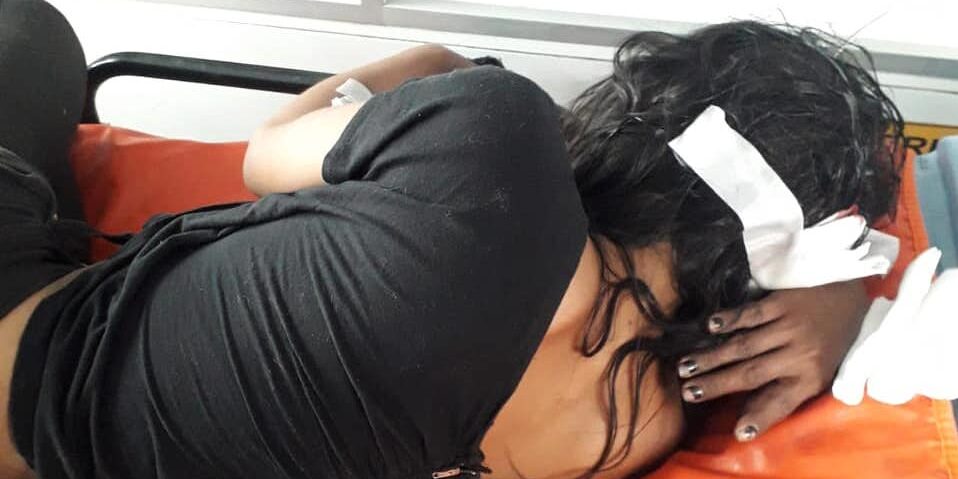
On Tuesday the 17th in the early morning, Jazmín Valladares Verástegui, a trans woman sex worker from Callao, Lima region, was attacked by a man who pretended to be a client.

Share

By Vero Ferrari
Early Tuesday morning, Jazmín Valladares, a transgender sex worker from Callao, Lima, was attacked by a man posing as a client. He dragged her to an open field in the Márquez area and tried to strangle her. Jazmín lost consciousness and awoke in excruciating pain. Her attacker had inflicted three deep cuts with a knife and repeatedly struck her. Her face was disfigured from her left eye to her forehead. Bleeding profusely, she managed to get up and go home, where her colleagues took her to the Márquez Health Center.
[READ ALSO: The State is the main agent of violence against LGBT+ people in Peru]
According to witnesses, the assailant had attacked another sex worker known as Cinthia a few hours earlier. He had beaten her in her own room, but she was rescued by her colleague Dulce, who heard her screams. Together they were able to force the assailant out of the room. After that, the man went looking for another victim.
Due to the severity of her injuries, she was taken to Ventanilla Hospital, where X-rays were taken and the three wounds on her head were sutured. The young woman is currently recovering physically and emotionally from the incident.
Presentes spoke with Taki Robles, executive director of the trans organization “Amigas por siempre del Callao” (Friends Forever of Callao), who accompanied Jazmín to the hospital. She points out that the situation of trans women sex workers in Callao, and in Peru in general, is one of continuous violence and precariousness.
"We are rarely able to report these attacks"
“Our lives are constantly at risk. We can rarely report these attacks because when we approach the police station we are revictimized for being trans, for being poor, for being sex workers, for not having an ID that recognizes our gender identity; they look at us with contempt,” Robles said.
The activist also pointed out that the vulnerability of trans women – who have a life expectancy of between 35 and 40 years in Latin America – is such that they cannot even access justice.
"We were like invisible"
“In our country, women are the most victimized by violence. The femicide rate, if we're talking about cisgender women, is very high, but what happens when a violent man encounters a trans woman? Well, the level of violence multiplies. This patriarchal pattern leaves us unprotected, even more so because there are no laws guaranteeing our safety, and the few laws that exist are rarely enforced. The legal frameworks are unknown to our community,” the activist added.
Robles recounted that on the day of the attack, while they were looking for help, they passed by two patrol cars, and the officer didn't even look at them or stop to ask what had happened. "We were like invisible; for other people, they would surely stop. Jazmín came from Piura looking for a better life; she had to turn to sex work and now she's traumatized," she concluded.
We are present
We are committed to journalism that delves into the territories and conducts thorough investigations, combined with new technologies and narrative formats. We want the protagonists, their stories, and their struggles to be present.
SUPPORT US

FOLLOW US
Related notes

We are present
This and other stories are not usually on the media agenda. Together we can bring them to light.