

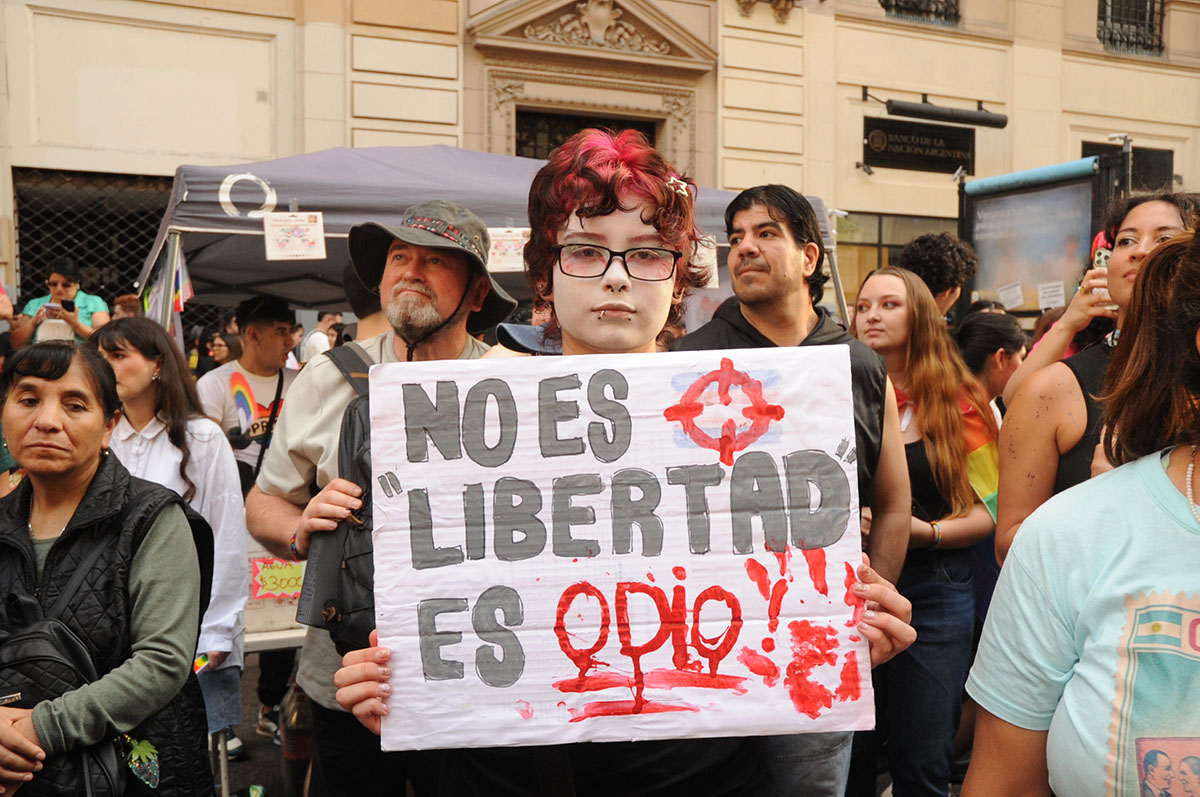
New homophobic attack in the streets of Buenos Aires: "I was paralyzed"
Mauro Grosso (37 years old) was the victim of a homophobic attack in the early hours of Saturday, September 14, in the Congreso area, Federal Capital.


Share

By Lucas Gutiérrez
Mauro Grosso (37 years old) was the victim of a homophobic attack in the early hours of Saturday, September 14, in the Congreso neighborhood of Buenos Aires. Shortly after 4:00 a.m., he left the venue at 1910 Avenida Rivadavia, where an LGBT+ party was taking place, when he was attacked as he turned the corner onto Sarandí Street. “I didn't see how many there were; two grabbed me from behind, and a possible third was hitting me the most. I started screaming, and the one holding me from behind taunted me, saying, 'Oh, look at the little faggot screaming.' That paralyzed me,” Mauro told Presentes.
“At that moment, I felt like I was regressing to elementary school, like when you're bullied and a single word can trigger so many things. I froze. Another kid was hitting me and saying, 'Shut up, faggot.' Those are the words I remember most,” Mauro explained. “I felt like a child, ashamed,” he told this publication, adding that after sitting and crying on the sidewalk for a while, he went back to his house, which is nearby.
[READ ALSO: Buenos Aires: Trans activist reports second attack by the same police officer]
That Friday, Mauro had gone out to celebrate that, after midnight, already Saturday, it was his birthday: “I got home, looked in the mirror, and felt heartbroken; I wanted to tell someone. Since I didn't have a cell phone, the first thing I thought of was to message them on Facebook.”
Mauro left the house again, this time to file a report. On his way to the police station, he said he passed a patrol car and thought the officers might be able to help him, but they didn't seem to take him seriously. He then filed the report at Precinct 3.
Lucas Longo, a friend of Mauro and an activist with 100% Diversity and Rights, accompanied him to file the complaints. “If Mauro hadn't been accompanied, it would have been very difficult for him to continue with the various steps required to file this type of complaint,” he explained to Presentes.
What to do in the face of this type of aggression
Longo said that the first thing to do after an attack of this type is to have the injuries documented by qualified medical personnel. “The person can go directly to the police station or prosecutor's office, and they should facilitate the documentation through a forensic doctor, but the truth is that it doesn't happen that easily. Therefore, what we recommend is that, whether through a public or private hospital, depending on the person's circumstances, they go to the emergency room to request attention so that any injuries they may have can be documented, and then file a report with the police or prosecutor's office,” Lucas explained.
The complaint was filed at the 3rd Precinct. “The police objective was to document the robbery. Of course, the material loss is important, but we want to document an assault with an aggravating factor related to violence and hate crimes based on sexual orientation,” Longo explained, emphasizing that “what the police do is focus on the theft or an act that targets private property and tell you that's as far as they go, but what you really have to do is insist because if there's an aggravating factor, that has to be documented.”
Report to the prosecutor's office
Maribé Sgariglia, an activist with the Argentine LGBT Federation (FALGBT) and part of the LGBT Ombudsman's Office , told Presentes: “In many cases, when victims go to the police station, they say that either their report wasn't taken, or half of the things they wanted to report weren't recorded. Most don't go to police stations because any LGBT+ person knows that it's not a friendly or respectful environment for our identities.”
In this regard, Sgariglia shared the option of filing a complaint with the prosecutor's office. "At the LGBT+ Ombudsman's Office, we help people complete complaints online because it's an authorized way to report abuse so they don't have to go to the prosecutor's office in person. It can also be done by phone or email."
When completing the reports, it is very important not to omit details such as physical assaults or threats. "These are things that constitute crimes, and what they do is provide context and make it clear that discriminatory acts occurred."
[READ ALSO: Gay couple chased and attacked in Almagro: “They beat us out of hate”]
Sgariglia further specified: “Sometimes, because there was an attack, only that is reported, but it is very important to provide specific context so that the prosecution takes it for what it is: a crime based on your sexual orientation or gender identity.”
In Argentina, the National Law against Discrimination does not cover attacks based on sexual orientation or gender identity, but "the anti-discrimination law of the Autonomous City of Buenos Aires includes sexual diversity and provides a regulatory framework to report an attack for being LGBT+ within the city of Buenos Aires," said Sgariglia.
The activist, who has been presenting national bills for years through FALGBT to address this lack of legislation but they haven't progressed, said: “At the national level, we don't have a law that protects us. That is, we can get married, we can change our birth certificates, but we can still be discriminated against. That's the irony.”
We are present
We are committed to journalism that delves into the territories and conducts thorough investigations, combined with new technologies and narrative formats. We want the protagonists, their stories, and their struggles to be present.
SUPPORT US

FOLLOW US
Related notes
We are present
This and other stories are not usually on the media agenda. Together we can bring them to light.