

One year without a Ministry of Health: HIV+ people denounce abandonment by the State
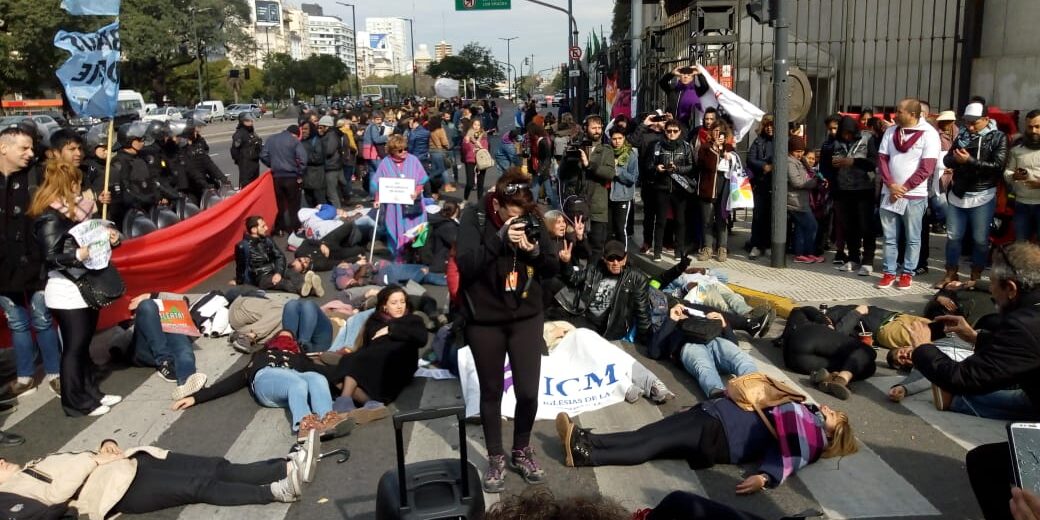
Employees of the former Ministry of Health are calling for a gathering on September 3rd at 12 noon around the building that now houses the Secretariat.

Share

By Lucas Gutiérrez
A year ago, President Mauricio Macri formalized the decision made a few days earlier: he eliminated nine ministries (Environment and Sustainable Development; Energy; Tourism; Labor; Modernization—created by Macri in 2015—Agroindustry; Health; Culture; and Science and Technology), downgrading them to secretariats. In response, employees of the former Ministry of Health are calling for a symbolic embrace of the building that now houses the Secretariat on Tuesday, September 3rd at noon. The National Front for the Health of People with HIV/AIDS will be present and will hold a press conference at 1 p.m.
The downgrading to a Secretariat implies budget reductions, less influence in decision-making, and a loss of autonomy, among other consequences. “It’s been a year since the downgrading, and that day cannot go unnoticed. Without a Ministry, a country cannot function,” Pedro Lynn, a former employee of the Ministry of Health and general delegate of the ATE (State Workers' Association) internal board of delegates, told Presentes.

Even before the downgrade, the situation was complex. Pedro Lynn explained: “Since Jorge Lemus took over (who resigned in 2017), the first measures he took were aimed at downgrading the Ministry: we lost budget, we lost functions, we had to resist layoffs. September 3, 2018, was the practical realization of their idea of public health: that the Ministry of Health should not fulfill a preferential or important function, that the provinces should take charge of their health systems, and that health is an expense.”
Fabio Núñez, a member of the Green and White Health Group of the State Workers' Association (ATE) and Human Rights Coordinator for the AIDS Directorate of the former Ministry, told this publication: “Last year, at the symposium held by the Huésped Foundation, we denounced what this degradation meant: more cuts, shortages of medication and general supplies, delays in purchases, and a lack of general supplies. Today, unfortunately, reality has proven us right. We know there have been problems with vaccines, shortages, and shortages of reagents, milk purchases, and other supplies.”
[HIV: In addition to medication shortages, there was police and media violence.
On August 1, while civil society and activists were denouncing shortages of antiretroviral drugs, the AIDS Directorate issued a statement referring to “alleged shortages.” On Friday the 16th, the Positive Cycle Association reported that at the Fernández Hospital in Buenos Aires, people living with HIV were being given a one-week supply of Darunavir 800 mg instead of a month's supply. “The shortage is due to the rationing of doses,” Sergio Ramírez of the Argentine Network of Young People Living with HIV (Rajap) told Presentes, while also denouncing similar rationing of medication in the province of Mendoza.
“The authorities insist that everything is fine, that there were administrative problems, they have effectively implemented a budget cut without officially stating that there was a cut and these are the consequences,” said Fabio Núñez.
José María Di Bello, president of the Fundación Grupo Efecto Positivo and a member of the Frente, told Presente: “This Tuesday we will be supporting our fellow workers from the former Ministry of Health. We will demand the return of the public policies we should have, not these imposed by the current regime that defines health not as a right, but as a purely commercialized commodity.”
[I'm on HIV+ treatment, I took a headache pill and almost didn't make it.
Last year, the Fundación Grupo Efecto Positivo (Positive Effect Group Foundation) denounced that without a Ministry and with budget cuts to the AIDS Directorate, the health of people living with HIV would be threatened. In July of this year, faced with new shortages, they denounced the situation through their procurement monitoring system. While the AIDS Directorate issued a statement saying that the medication arrived at warehouses on August 27 and would then be distributed, Di Bello points to subsequent purchases: “There is a process underway that involves analyzing the purchase offers. Given the dollar exchange rate, we will have to see if prices can be maintained, and if the laboratories don't end up withdrawing—it wouldn't be the first time that has happened. All of this means time, and it means people not receiving their medications.”
In an interview with this agency, the activist also questioned what will happen to those who had to change their medication regimens during the shortages: “They can’t assure us whether they’ll continue with the same regimen they were switched to or revert to the previous one. It’s not that simple; resistance to the previous regimens may have developed. The best course of action would be to conduct resistance tests, but we already know there are no reagents available, and purchases plummeted last week due to the devaluation.”
Regarding the 2020 budget for the Directorate of AIDS, Hepatitis, STIs, and Tuberculosis, Fabio Núñez said: “We know nothing. By this time of year, we should already be setting goals and programs, but that's not happening. This downsizing is abdicating the State's non-delegable responsibility to guarantee public health for the people. When this happens, those who can afford it pay, and those who can't, die.”
“We need to reclaim the Ministry and make it more than just a facade; we need to reclaim the policies. We believe that since our first meeting last year, this issue has been on the public agenda, and that workers will have an important role in discussing the health policies that we believe must be implemented in these times,” said Pedro Lynn.
We are present
We are committed to journalism that delves into the territories and conducts thorough investigations, combined with new technologies and narrative formats. We want the protagonists, their stories, and their struggles to be present.
SUPPORT US

FOLLOW US
Related notes
We are present
This and other stories are not usually on the media agenda. Together we can bring them to light.