

Thousands demanded an end to violence against transvestites and trans people in Argentina
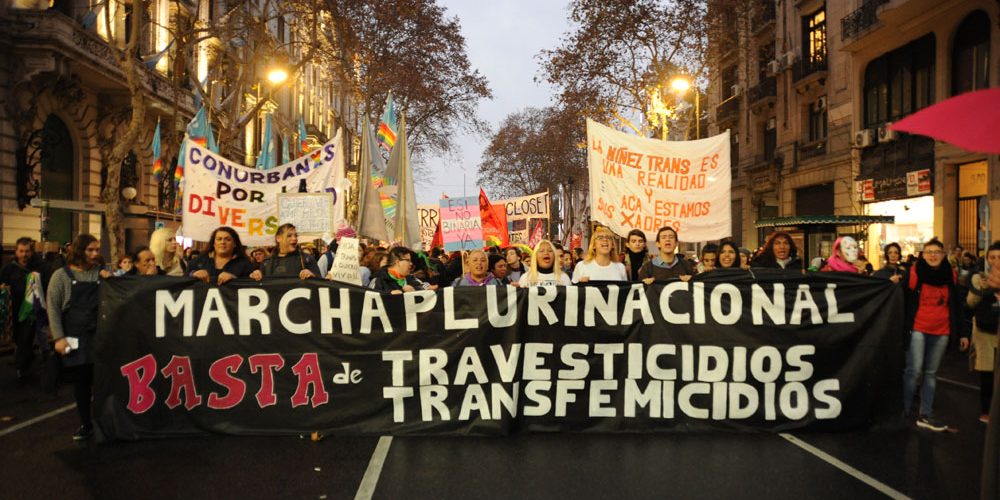
More than 5000 people at the 4th Plurinational March Stop Transvesticides and Transfemicides in Buenos Aires on International Pride Day 2019.

Share

Photos: Mariana Leder Kremer and Ariel Gutraich
The Pride march from Plaza de Mayo to Congress was anything but festive, despite the rainbow colors. It was led by a black banner: Plurinational March Against Transvesticide and Transfemicide. “While the world commemorates Pride, in Argentina we, the trans and travesti population, march to fight for our lives. This year there have been 40 transvesticide and transfemicides,” Alba Rueda, from the organizing committee of the 4th march held in Buenos Aires, told Presentes.

The figure is based on estimates from organizations for the first six months of the year, as official data is unavailable. Of those 40 transphobic deaths, four were murders, and the rest were social transphobic deaths: deaths resulting from structural violence. This means a lack of access to basic rights: health, education, and employment. “Today we know that our trans comrades are dying primarily from preventable causes. This is related to a lack of public policies, to the State's neglect of the trans population and its consequences. For every year without public policies, the mortality rate among our generations increases,” Rueda adds from the commission.
 The 4th March was Plurinational “because we recognize the coexistence of our brothers and sisters from different nations and ethnicities, their interculturalities, and we denounce the fact that violence against them is worsening,” said activist Violeta Alegre. And it was also a massive march.


Minutes after six in the evening, the march began its march from Plaza de Mayo toward the National Congress. “Sir, Madam, don’t be indifferent, they’re killing trans women right in front of everyone,” activist Lara Bertolini shouted through a megaphone.

“Yesterday was a historic event. Because while there are different political currents within trans activism, the 4th Plurinational March did something that hadn't happened in previous marches: we were mature enough to understand that we must give voice to trans youth, trans men, and other identities. We broke with the personalism of the marches. Diana Sacayán once said that if the struggle isn't collective, it ends in solitude. The other marches incorporated partisan affiliation that our document lacked. The official march document addressed safe and free abortion, access to healthcare, dignified treatment based on identity, and the Judiciary as an ossified power,” Bertolini told Presentes.
 Despite the drizzle and cold, the march stretched for six blocks along Avenida de Mayo. “Here/is/the trans resistance!” chanted the activists.


 Unlike previous years, when transvestites and trans people made up the bulk of the demonstration, this time thousands of cisgender people joined the protest. In addition to LGBTQ+ groups—which had also participated since the first march—other social and feminist organizations, as well as some political groups, were present. It was the largest march against transvesticide and transfemicide ever held in the City of Buenos Aires. An estimated 5,000 people participated.


 Daniela Mercado, a graduate of the Mocha Cellis Popular High School, marched with a photo, a sign, and a special request: justice for her friend Ayelen Gómez, murdered in Tucumán in August 2017. “I march for the visibility of trans men and the different forms of violence caused by cis men,” Santhiago Valentino Cáceres told Presentes.


Families of transgender children also marched with their banners. Gabriela Mansilla—the mother of Luana, the first child in the country to obtain her legally changed ID—from Infancias Libres (Free Childhoods), was at the back of the column, dancing and singing, with the mixture of joy and concern that is common in homes for transgender children. “Ole ole, ole olá, Infancias Libres, here we are, we want lives free from prostitution.” Their banners displayed their main demands: rights for transgender children and adolescents, childhoods free from violence and discrimination.


Every so often, the cry for those who are no longer with us arose from the crowd. “Diana Sacayán, Lohana Berkins present, now and forever.” And also the names of Azul Montoro, Marcela Chocobar, Laly Heredia, and other comrades murdered in recent years.

“For the fourth year we are organizing, and today, within the framework of the 50th anniversary of Stonewall, it is urgent to make visible the murders of transvestites and trans people. Faced with the advance of hate speech from the heteropatriarchy, we are taking to the streets,” said activist Florencia Guimaraes.
 “We are here at this 4th March to demand that the State implement specific public policies. To challenge and call upon all of society so that our deaths do not go unpunished and, above all, to achieve public mourning,” said Claudia Vasquez Haro, president of Otrans Argentina and the Federal Transvestite and Transgender Collective. She walked the final stretch of the march hand in hand with Mariana Gómez and Rocío Girat.

On the same day she was sentenced to a one-year suspended prison term for resisting arrest, Mariana took to the stage and, before the statement from the 4th March was read, thanked the crowd for their support. “We continue the fight, in the streets, all together. As Lohana and Diana said, we will never go back to jail or the closet.” Below the stage, the crowd chanted loudly: “Mariana, listen, your fight is our fight.”

With their backs to Congress, transvestite and trans activism occupied two stages: one of the organizing march, where the document was read.

There was also another side stage, with the demands of various trans and transvestite groups, sex workers, activists from the Hotel Gondolín, from the Nadia Echazú Trans Movement, and Paula Arraigada, candidate for national deputy for the Frente de Todos.


“We applaud this enormous number of comrades who are mobilizing and joining us! Because we are not indifferent to the killing of transvestites and trans people! This march began four years ago, demanding justice for our leader Amancay Diana Sacayán, because we had to take to the streets to express the vulnerability of the transvestite and trans population. And in this collective mourning, the Justice for Diana Commission was formed, and the dissident organizations overturned the historic sentence, changed the course of justice, and since 2018 we have had a historic and favorable ruling for our community: the recognition of Diana Sacayán's murder as a transvesticide!” read the statement. Say Sacayán, an activist with MAL (Anti-Discrimination Liberation Movement) and brother of the human rights defender murdered in October 2015.

The document included, among its central points, a demand to the "transphobic, racist, classist, and xenophobic" state for the deaths of trans and travesti women, especially for the social transphobic violence perpetrated against them. "We have a legal framework that addresses crimes against trans and travesti people, but what doesn't change are our realities. Statistics indicate that in these first six months of 2019, 40 of our comrades have died. Most of these deaths are PREVENTABLE," the collective stated. They denounced: "Under Macri's administration, new mechanisms of criminalization were created, such as the detention protocol for security forces and provincial laws that punish prostitution. The web of violence perpetrated by Macri and the complicit governors is sophisticated, establishing a differential value for trans people who are already affected by various forms of inequality: family rejection, lack of education, healthcare, and employment. For us, only repression remains."
 The demands also included access to justice. “Despite legal rhetoric about freedom and equality, the judicial system hides and covers up the distribution of inequality and vulnerability faced by our comrades; that's why our activism and advocacy make all the difference.” They acknowledged some progress, though still insufficient: “Today we have rulings that recognize the crime of transvesticide, as in the case of Diana Sacayán, and transfemicide, as in the case of Marcela Chocobar in the province of Santa Cruz. In Jujuy, the murder of Zoe Quispe resulted in a life sentence, as did the cases of Vanesa Zabala in Santa Fe, and Natalia Sandoval in Mendoza.”
The invisibility of these issues in the media was another point addressed:
“We are silenced by the mainstream media.”

 There was a minute of collective shouting for the transvestites and trans people “victims of this genocide”.
“We are anti-patriarchal and anti-capitalist feminists, fighting for the separation of church and state. We are Living Resistance, resisting and caring for each other so that we are not killed, so that there is not ONE LESS TRANS WOMAN,” the document concluded.

“This year there was special participation from social organizations, who reached out to support us from the very beginning of the preparations. I believe we are at the start of a social process where we are reclaiming this international day of commemoration for trans people in homage to the victims of crimes and state neglect. It is becoming part of the agenda in Argentina and a commitment for next year,” said Alba Rueda. “We are proud of the number of people who marched. That unites us as a community and strengthens our resolve in the face of these kinds of crimes and violence perpetrated by the state.”


FULL DOCUMENT 4TH PLURINATIONAL MARCH AGAINST TRANSVESTICIDES AND TRANSFEMICIDES
We are at the 4th Plurinational March against TRANSGENDER AND TRANSFEMICIDE from Argentina!! We applaud this huge number of comrades who are mobilizing and joining us! BECAUSE WE ARE NOT INDIFFERENT to the killing of transvestites and trans people!
This march began four years ago, demanding justice for our leader Amancay Diana Sacayán, because we had to take to the streets to express the vulnerability of the trans and travesti population. And in this collective mourning, the Justice for Diana Commission was formed, along with dissident organizations. We overturned the historic sentence, changed the course of justice, and since 2018 we have had a landmark and favorable ruling for our community: the recognition of Diana Sacayán's murder as a transphobic hate crime!
This ruling is historic because it recognizes that our identity is shaped by the vulnerable conditions that structure our lives. This ruling addresses all aspects—political, legal, and social. We will no longer have to beg for anything because we have this tool, which is the result of this group's struggle.
We faced, and continue to face, a great challenge: sustaining this political agenda that placed the trans and travesti movement at the forefront of democracy. And we had to pursue this agenda even though our leading figures in the trans and travesti movement were not physically with us.
To our comrades, who have been the social fighters for most of our rights, and whom we will name: KNOW THAT WE ARE HERE AND WE ARE YOUR SISTERS, that we learned from you how to do politics and how to defend our rights.
Therefore, we shout loudly: Amancay Diana Sacayán, PRESENT
Amancay Diana Sacayán, present, now and forever.
We also recognize our leader Lohana Berkins, the mentor of us all, the one who taught us that nothing can divide us, because together we carry on the struggle. She challenged a feminism that allows us to build ourselves collectively, showing us that we are political subjects. And it is no coincidence that we name Lohana, because we are the fruit of all those years of shared activism and militancy.
We will not give up on this beautiful legacy because it is a commitment we have made! That is why we shout loudly:
Lohana Berkins present,
Lohana Berkins, present, now and forever.
This is one of the many actions that social organizations take to occupy the streets and put our bodies on the line to fight against SOCIAL TRANSLIDEAL: THEY KEEP KILLING US! The violence and the system of oppression by the State and its governments continue!
We have a legal framework that addresses crimes against transgender people, but our realities remain unchanged. Statistics indicate that in the first six months of 2019, 40 of our sisters have been killed, including both transphobic murders and social transphobic murders.
Most of these deaths are PREVENTABLE and are the result of violence that places us in the most extreme social exclusion. And we know that this is a direct consequence of this government's lack of public policies. A government that doesn't invest in us.
Under Macri's administration, new mechanisms of criminalization were created, such as the detention protocol for security forces and provincial laws that punish prostitution. The web of violence perpetrated by Macri and his complicit governors is sophisticated, establishing a differential treatment for trans people, who are already affected by various forms of inequality: family rejection, lack of education, healthcare, and employment. For us, only repression remains.
We are silenced by the mainstream media and we shout here that transvesticide and transfemicide are social vulnerabilities created and sustained by the State itself: transphobic, racist, classist and xenophobic.
Despite legal discourses of freedom and equality, the judicial system hides and covers up the distribution of inequality and vulnerability towards our comrades, that is why our militancy and activism make the difference, today we have rulings that take the figure of transvesticide as in Diana Sacayán, and transfemicide in Marcela Chocobar of the province of Santa Cruz.
In Jujuy, the crime of Zoe Quispe resulted in a life sentence, as did the crimes of Vanesa Zabala in Santa Fe, and Natalia Sandoval in Mendoza.
This fourth mobilization, we want to dedicate a minute of collective shouting for all the transvestites and trans people who have been victims of this genocide. We also want to establish the foundations of the historical context of the transvestite and trans movement.
Our demands are directed against the state apparatus, especially the judicial system, which denies and resists our multiplicity of identities, directly hindering the recognition of gender and gender diversity. Therefore, the recognition of transvestite and non-binary feminine identities is a tremendous achievement, opening new horizons for interpreting the Gender Identity Law and fostering an understanding of gender multiplicity.
And in this diversity we shout: We are plurinational feminism, trans feminism, and trans feminists because we recognize our origins in Indigenous peoples, because we recognize ourselves in the popular feminism that embodies Afro, brown, and diverse bodies. And showing that feminism does not follow a single white agenda, that we are South American, trans, and trans feminist feminism. We recognize coexistence with our sisters from different nations, ethnicities, and intercultural backgrounds, and how violence is exacerbated against them.
Historically denied, excluded and expelled from spaces, but our struggle opens the way to our realities as trans and travesti, Latin American, South American, and all those who incorporate our social and political agendas to change realities in a context of reactionary advance in Latin America, that is why we say no to the IMF.
We are anti-patriarchal and anti-capitalist feminists, fighting for the separation of church and state. We are Living Resistance, resisting and caring for each other so that we are not killed, so that there is not one less trans woman.
We are present
We are committed to journalism that delves into the territories and conducts thorough investigations, combined with new technologies and narrative formats. We want the protagonists, their stories, and their struggles to be present.
SUPPORT US

FOLLOW US
Related notes


We are present
This and other stories are not usually on the media agenda. Together we can bring them to light.