

4th March Against Trans Murders: “Don’t just join us, be a part of it”
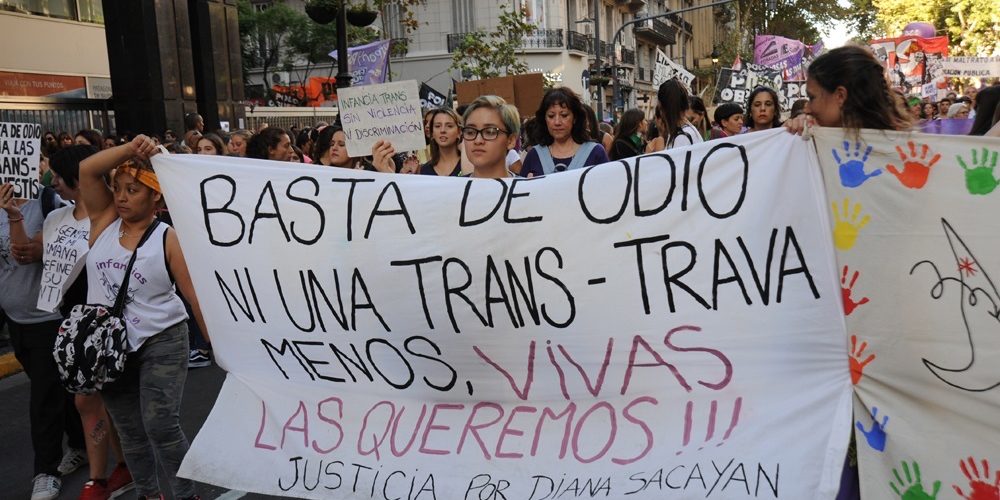
This Friday, June 28th at 6 PM we are calling for the 4th March (this time defined as Plurinational) against transvesticide and transfemicide, from Plaza de Mayo to the Congress.

Share

By Violeta Alegre
This Friday, June 28th, at 6 PM, we are calling for the 4th March (this time defined as Plurinational) against transvesticide and transfemicide, from Plaza de Mayo to the National Congress, where the stage will be set up and the organizing committee's statement will be read. Transvestites and trans people have an average life expectancy of 35 years, and those of us who aren't murdered die from lack of access to basic rights that the State denies us. We call this "social transvesticide," and this year alone, more than 30 of our sisters have already been killed for living on the margins. There are no official figures: neither for the crimes nor for the deaths, because the State doesn't care about us.
Why a Plurinational march? Let's break down the borders they've built. This march is Plurinational because we recognize the coexistence of our brothers and sisters from different nations and ethnicities, their intercultural realities, and we denounce the escalating violence against them.
Don't just join us, be a part of it.
I remember a feminist leader at a march where I was with some other women. She came up to me and said, "Thank you for joining us." I wasn't there with them; I want social justice, so this is my march too.
We say to those sectors of the women's and feminist movements who still perceive us as "other" in this struggle, that both you and we are "Ourness": a "we," a "us." This concept is made clear in "Travesti – A Good Enough Theory," by Marlene Wayar. I would add: comrades who recognized the collective and transformative power of June 3, 2015, when we took to the streets shouting "Not one less."
For Diana Sacayán and for all
We stated a few months later, in October 2015, that Diana Sacayán's murder should be recognized with her identity and the specific nature of the crime against a trans woman. This specific nature must be called by its name: "transvesticide" or "transfemicide." Driven by the Diana Sacayán Justice Commission, family members, organizations, and social groups, we supported the entire process to have the transvesticide recognized, obtaining a favorable and historic ruling on June 18, 2018.
First march against transvesticide and transfemicide
On June 28, 2016, we took to the streets for the first time to shout: “Stop the murders of transvestites and transfemicides!” We reclaimed the framework of the 47th anniversary of the heroic Stonewall uprising, but contextualized it within our own pain, our urgent cry born from the death of one of the most important figures in our movement, while also recognizing all those who were no longer with us and those who were killed for being transvestites or trans people. ENOUGH is the founding cry, it is the weariness, it is ENOUGH of killing us for being transvestites – trans people – women – gay men – lesbians – non-binary.
[READ ALSO: When the limit of feminism is trans femininities]
This Thursday, we invite everyone, because power is collective, as is the responsibility to prevent crimes against different populations based on gender, class, and ethnicity (and that's what feminism taught us). I even took it quite seriously when I wrote the following post on my Facebook:
“On June 28th, come too, you macho man , you who likes to look for us on social media, on apps, on the road, etc. You, you man, who makes superhuman efforts to escape from “your” girlfriend (or wife) because you can’t talk to her about your genital, anal, oral pleasures, etc. You, you man, who showers us with kisses and then finds it hard to leave our beds because you know you have to pretend in a world where there’s no room for your desires. March for us too, you revolutionary left-wing man… everyone should march and embrace their desires and affections more, because that’s also a way to prevent transvesticide and transfemicide.”
[READ ALSO: What we talk about when we talk about trans love]
We would love to be thousands strong. That all of us who seek social justice, autonomy to decide, the eradication of all forms of violence, and to come down a few inches to see the world from the perspective of childhood—stolen, disciplined, raped, beaten by an adult world—may also find political answers (or at least try) to ensure that future generations inherit a slightly better world.
We are present
We are committed to journalism that delves into the territories and conducts thorough investigations, combined with new technologies and narrative formats. We want the protagonists, their stories, and their struggles to be present.
SUPPORT US

FOLLOW US
Related notes

We are present
This and other stories are not usually on the media agenda. Together we can bring them to light.