

The story of Tito, the trans boy from Mar del Plata who rectified his birth certificate
On Tuesday, May 14th, at the civil registry in Mar del Plata, the birth certificate of Tito, a five-year-old transgender child, was amended. This is the step prior to issuing an ID card that reflects the gender identity he has expressed since he began speaking.

Share

On Tuesday, May 14th, at the civil registry in Mar del Plata, the birth certificate of Tito, a five-year-old transgender child, was amended. This is the step prior to issuing an ID card that reflects the gender identity he has expressed since he began speaking.
By Sandra López Maidana, from Mar del Plata
Photos: Courtesy of Marcela Golfredi (for La Capital/Mar del Plata)
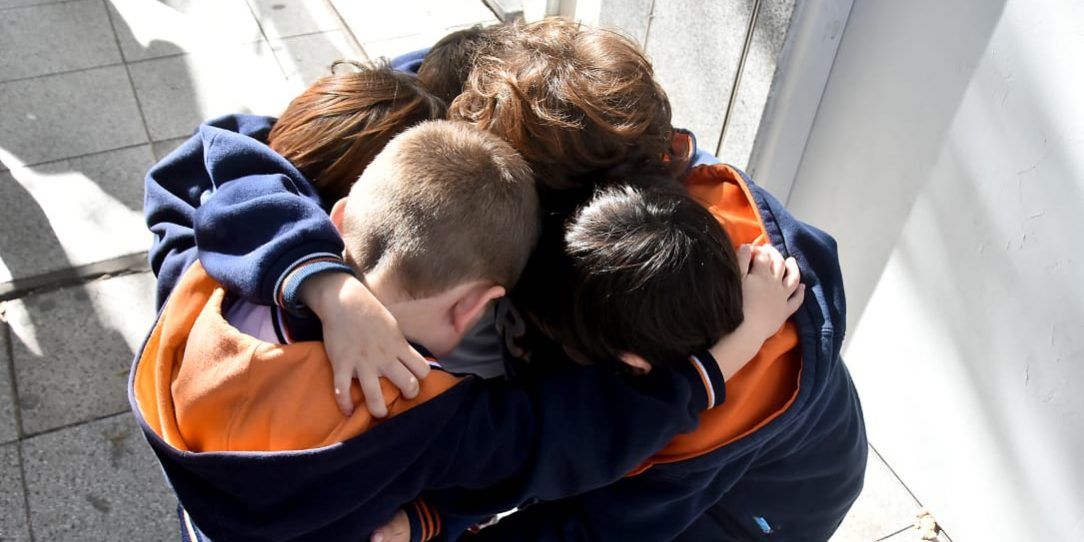
The coldest morning of the season so far drew an unusual crowd to Avenida Independencia in Mar del Plata. Among arranged couples and hurried facilitators, there was a family, companions, neighbors, teachers, children, and some members of the press. They were there to support Tito, a 5-year-old trans boy, but also Guadalupe and Matías, his mother, father, and Isabella, his eight-year-old sister. The process is much more than that. It's about the institutional validation of the child's self-perceived gender identity.
“He was always withdrawn when it came to playing and clothes,” his mother tells Presentes. “He didn’t like girls’ toys; he’d just stand there with his hands crossed. When he was a year and a half old, while I was bathing him, I asked him to tilt his head back, saying, ‘Okay, princess,’ and he babbled back, ‘Not princess, gentleman.’ I told his father, and we thought he just wanted to be different from his sister. Something normal for boys. Just another phase he’d grow out of.”
They let some time pass. Every now and then Guadalupe would try to put a dress on him. “I’m a boy,” he would reply. Then they wouldn’t speak to each other anymore. At home, they didn’t restrict his use of toys or clothes.

The challenge of psychology
This is a special family, very open-minded. Even so, they knew that this space of freedom couldn't be replicated in the outside world. They began their professional search. In their search, they encountered therapists with varying degrees of obscurantism until, through a referral, they reached Jorge Visca, a psychologist with training in sexology and gender perspective. The therapist took on the role as a challenge. Until then, he had worked with trans identity processes in adults and adolescents, but never with children. “I thought I could help this family, but I had to throw everything I knew out the window because it's a reality different from what one is trained to understand. I read, I researched, I interviewed many people, and I supervised with Valeria Paván, the psychologist of Luana, the first trans child. I did what psychological science should do to promote well-being in people.”
The task was neither simple nor standardized. “Helping people through this process isn't limited to treatment as it's typically understood in psychotherapy, but rather about being present. It's about addressing the questions that arise, the bodily changes that go unrecognized. The identity these people perceive in themselves doesn't align with their bodies.”

Therapist Jorge Visca and lawyer Claudia Vega from AMI
The process required an interdisciplinary team that included legal expertise. Jorge belongs to the organization AMI (Asociación Mundo Igualitario) and invited Guadalupe to attend a workshop led by Diana Sacayán at the Faculty of Psychology of the National University of Mar del Plata. There she met the lawyer Claudia Vega, and it was there that Guadalupe's mother learned that Tito is transgender.
“We provided legal support, waiting a while to ensure nothing would happen to her son. Regardless of the legal name change, his name had to be respected, as stated in Article 12 of Law 26743 on Gender Identity, which stipulates that a person must be respected whether or not their gender identity is reflected in their ID. Tito started asking to be called that last year, introduced himself to his classmates, and there were no problems. It's really easy with them. His teacher from last year and the school also supported the entire process,” she tells Presentes.
The mother began attending AMI workshops, which focus on raising awareness of the Gender Identity Law and the need for more public policies to reinforce its internalization. But more than reading article by article, it's about lived experience. About deconstructing what resonates. “Playing with a toy, preferring different clothes doesn't make you transgender,” the lawyer continues. “Small acts don't define identity. Identity is an internal experience; it's not something you can choose, which is why it's a transition. Mom and Dad decided that Tito would start preschool at age five and wanted to be called by the name he had chosen on his ID.” The boy is eagerly awaiting it. For Guadalupe, the ID also serves to avoid giving explanations or exposing her son to the violent questions he has already had to endure.
Accusing finger
While Tito envisions himself not as 'when I grow up' but as 'when I'm a boy,' society criticizes him. “They say we might have made him choose, but he's spent his whole life playing at being a boy. You can't force that. I didn't want a son; we were happy with our two girls,” Guadalupe asserts, almost responding to the malicious whispers she prefers to answer her children with the phrase on her tattoo: “Never let them question your freedom.”
Transgender people break with all expectations: the gender binary, heteronormative heterosexuality. Consequently, they are subjected to violence, discrimination, and pathologization. Jorge asserts that “research shows that manifestations of trans identity emerge at an early age, but because they lack a supportive environment, they repress it and conform to societal expectations. This causes immense suffering. It's believed that these children aren't mature enough to know who they are. Families and institutions that support and protect these children deserve recognition. Acceptance is protection.”

For Claudia, the key is to deconstruct ourselves. “Children aren’t born knowing that pink and light blue are assigned colors. From conception, we are stigmatized, biologized. This challenges us as a society,” she adds.
What if they regret it? The question arises from the concept of reversibility. The therapist's response is, "What would be the problem if they no longer feel and express that identity? We have teenagers who identify as non-binary. They shouldn't be pigeonholed. Gender can be fluid; it's not static. However, scientific studies don't highlight any individuals who have regretted it. There is no such thing as reversibility. It doesn't exist. Society is learning several things, such as de-genitalizing sexuality."
Tito challenges society, starting with his mother. “I had a little stone with the name in the feminine form. He told me, '…it got into your necklace and out here is Tito.' It killed me, but I kept it. The day he was going to get his ID card, he asked me how long I was going to keep it on, and I took it off.”
The day came when Guadalupe had to let go of the being she gave birth to in order to receive Tito, who gave birth to himself.
We are present
We are committed to journalism that delves into the territories and conducts thorough investigations, combined with new technologies and narrative formats. We want the protagonists, their stories, and their struggles to be present.
SUPPORT US

FOLLOW US
Related notes

We are present
This and other stories are not usually on the media agenda. Together we can bring them to light.