

Four stories of everyday LGBT hate and resistance in Paraguay
In Paraguay, a law against all forms of discrimination and a gender identity law are becoming increasingly urgent. People in the LGBTIQ+ community find no protection in the justice system when hate crimes and abuses of power are committed.

Share

By Juliana Quintana
Photos: Jess Insfrán and Paula Godoy
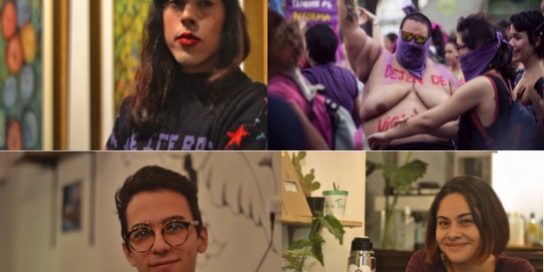
“You faggot, sit down, you’re not producing anything standing up,” Mattias Ayala’s boss yelled at him when he got up from his desk. “We don’t want faggots here, and even less so if they’re little bitches and bite the boss.” For two months, Mattias endured verbal and psychological abuse at the Bristol appliance chain, in the Capiatá branch. When he reported his boss, Carlos Cortessi, to the Human Resources department, they offered him “a transfer to another branch or to resign.” Since neither option was viable for him, the next day, they fired him.

That same day, the 18-year-old denounced on his Twitter that he was fired because of his sexual orientation. Bristol denied the claim in a statement published on social media. “They asked me to sign a contract with my severance pay. My boss pressured me for a while, and I told him: I'm not signing that because I'm not stupid. It says that by signing, I waive my rights. And my rights aren't worth 500,000 guaraníes, or all the money they could pay me,” Mattias stated.
In Paraguay, a law against all forms of discrimination and a gender identity law are becoming increasingly urgent. People in the LGBTIQ+ community find no protection in the justice system when hate crimes and abuses of power are committed. On the International Day Against Homophobia, Transphobia, and Biphobia, Presentes spoke with them to learn about their experiences of violence in the country.
The incompatibility between work and activism
Belencha Rodríguez is a translator and English teacher. Last year, she was the spokesperson for the organization Diversxs at the LGBTI Pride march held in the city of Encarnación. When they were expelled from the Plaza de Armas and Mayor Luis Yd denied them permission to use La Pérgola (across from San José beach), Belencha had to pay a high price for her public exposure and activism.
“After the march, I realized that, as a spokesperson, I was overexposed, and I made the decision to move from my home in Encarnación because people were leaving notes with messages under my apartment door. Coming out as bisexual in a conservative society is a proud decision, but I understand that I had to pay a price for it,” she said.

From then on, she was completely drained of her work ethic, received complaints from mothers who no longer wanted to send their children to study with her, and a group of religious people held a prayer vigil in front of the Virgin of Itapúa, asking her not to "brainwash their children." But the attacks didn't stop there. Belencha began receiving increasingly violent threats.
“One of the biggest threats I received was an anonymous message in my Twitter private that said they were going to impale me because I wasn’t keeping my mouth shut. They also keyed my car and left a dead pigeon inside. I started to get scared and contacted my friends; I asked them to act as a group,” she recalled.
During the #8MPy mobilization in 2017, the first major demonstration in Asunción, Belencha posted a text on one of her social media accounts with a photo in which she had the words “stop raping us” written on her body. Agustín Laje, co-author of The Black Book of the New Left and an emblem of the pro-life movement, uploaded that same photograph to his Instagram and captioned it: “Excessive self-esteem is a serious problem.”
“For me, that was the pinnacle of feminist success. I celebrated that someone like that would give me a little public shaming,” she said, laughing, “but it was an attack that the pro-life group seized upon, and they later investigated me while I was here. The thing is, since I live in a border city, it had repercussions from the conservative sphere, and I think there was a kind of alliance to have memes made about me as fat, a feminazi, and an abortionist.”
Transphobia in Asunción bars
For years, Venus Agüero frequented the Asunción bar, Poniente. She not only performed there but also spent time with her friends. Last November, there was a change in management, and one particularly memorable night, she was kicked out. Ironically, the week before, she had been at the same bar with a group of performers for an art intervention.

“I walked in, just like that, and a security guard immediately approached me and told me I had to leave because the house no longer allowed people like me in that space. It made me incredibly sad because we don't even qualify as human beings to inhabit certain spaces. That gives you an idea of how dire the situation is here in Paraguay,” said Venus, a visual artist.
The following week, along with independent activists and Cula Performance, they organized a demonstration in front of the Poniente bar to protest all forms of discrimination. That same day, the bar issued an statement expressing its disapproval of what had happened to Venus. “I don’t know how valid that retraction can be in general after putting me through that inhumane experience. I also learned that other people were expelled from that place in the same way,” she reflected.
“We support you, but don't let it show.”
Airym Sarta is a social worker and sign language interpreter. She is Colombian but has lived in Paraguay for 16 years, and says that when she interprets for deaf people and they find out she is a lesbian or have seen her with her girlfriend, they tell her, "Don't worry, we'll keep your secret."
“In the workplace, they want to force us into the closet. The invisibility of lesbianism is the greatest violence we face. As long as you don't say you're a lesbian, as long as you don't go out to march, as long as you don't become an activist, everything is fine. But once you do, coming out of that invisibility is punished,” emphasized Airym, who is also an activist in Aireana's “tatucada” (drumming group).

The problem begins when it becomes obvious that someone is LGBT. This happened to Airym when her mother was hospitalized at IPS. A group of evangelical fundamentalists invited her and her partner to pray for her mother. When they both refused and left together, the next time they saw Airym in intensive care, they offered to "cure" her and said they could find "a conversion" in them.
Stereotypes also play a significant role in job placement. “When I cut my hair shorter, people did react, saying things like, ‘That’s intense, why the change?’” Airym recounted. Belencha agrees. In Asunción, she had trouble finding jobs and experienced systemic violence. “This happens more because I’m fat than because I’m bisexual. It’s very easy to avoid acknowledging one’s sexual identity politically, but one’s physical condition can’t be hidden.”
We are present
We are committed to journalism that delves into the territories and conducts thorough investigations, combined with new technologies and narrative formats. We want the protagonists, their stories, and their struggles to be present.
SUPPORT US

FOLLOW US
Related notes
We are present
This and other stories are not usually on the media agenda. Together we can bring them to light.