

"The university must allow itself to be challenged by dissenting knowledge"
The Lohana Berkins Open Chair of Gender and Dissidence was inaugurated, a space achieved with the collaboration of LGBTI collective organizations and the Faculty of Humanities of the National University of Salta.

Share

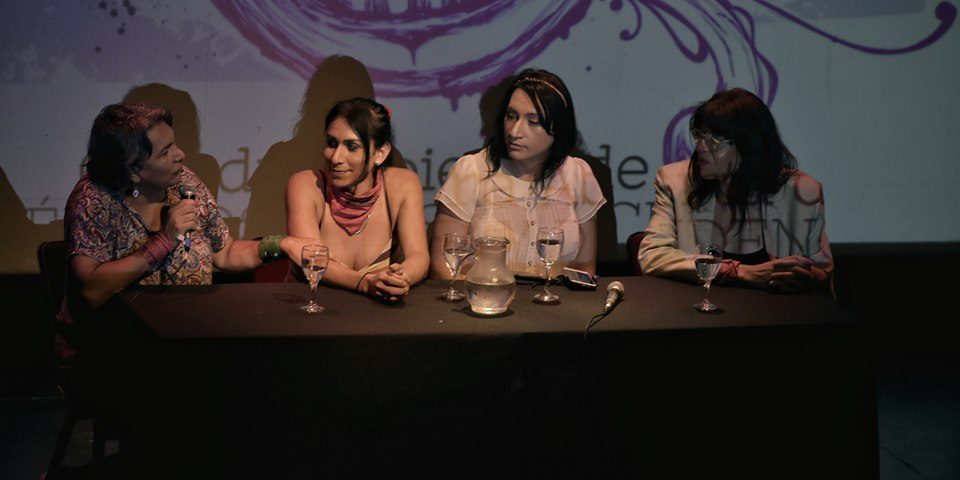
By Elena Corvalán Photos: Courtesy of Efímera Producciones The Lohana Berkins Open Chair on Gender and Dissidence was inaugurated, a space created through the collaboration of LGBTI organizations and the Faculty of Humanities at the National University of Salta. The Chair, which will be held every Friday until June 21st, is based on two main pillars: the survey of the trans population developed by MTA in collaboration with the Observatory of Violence against Women in 2016 (expanded last year), and the Trans Memory Archive, promoted locally by Mary Robles of ATTTA. Those participating in the launch included its coordinator, professor and researcher Natalia Gil; social psychologist and trans activist Marlene Wayar; Tucumán activist Claudine Gala Leguizamón; and Lourdes Ibarra, from the Damas de Hierro Foundation of Jujuy. Luisa Paz, INADI worker in Santiago del Estero and president of the Association of Transvestites, Transsexuals and Transgender People (ATTTA).
[READ ALSO: A Psychology course from a transvestite and trans perspective]
They will be professors in the new Chair, as will activists from Salta such as María Pía Ceballos, Mary Robles, and Carla Champicién, among others. They emphasized the need to promote education for trans people and mentioned the additional limitations faced by those who want to study, including police harassment, verbal and physical attacks from strangers in public, and rejection and discrimination in academic settings. Their other major demand was for a trans employment quota.Building "our identity"
Marlene Wayar closed her presentation with a challenge to the established order in universities. She recalled that, when consulted by students or professors, Lohana Berkins would often demand feedback from universities, and called for the “destruction of paradigms.” Wayar denounced “epistemological violence,” a way of rendering the other invisible, and “hermeneutic violence,” which rejects living language and prefers to adhere to the established order. “Trans people are much more complex” than this “simplistic” language, insufficient to express what it means to be transvestite, she affirmed to an audience that listened attentively and applauded repeatedly. She called for building “our identity against the terrible otherness that the neoliberal system, capitalism, has managed to construct.” Along the same lines, she proposed a transhumanist epistemology, one that accounts for the constant evolution of knowledge, “so that we don’t remain stuck in a single idea.”
[SEE ALSO: Marlene Wayar's video columns: prostitution]
“We propose an epistemology that is prostitute,” she asserted, adding that the experience she values most, due to the knowledge she acquired, is that of prostitution. “I belong to a group of people who firmly believe that the university should not only include, but also allow itself to be challenged by the insurgent popular knowledge of dissident bodies,” explained Natalia Gil, who understood that this work “has borne much fruit and (…) has provided ways to create collective knowledge that today is brought together in the Chair.”Trans Memory Archive
In the presentation, Gil described Robles as “a historian and chronicler of the community” in Salta. “We have a photographic record that we value immensely because it allows us to reconstruct the history of the community before they became visible in the 1990s. So we are essentially collecting a prehistory, and it is urgent because these people are dying. We know about the problem of the very short life expectancy of trans women, so these are urgent tasks. And what the Chair does is take these tasks that social organizations are already carrying out and incorporate them into academic knowledge to disrupt that existing knowledge and to be able to generate new collective knowledge.”[READ ALSO: Marlene Wayar's video columns: the trans perspective]
Mary Robles will be one of the professors in the Chair. “The paradox is that we were excluded from the educational system, so being part of this chair and promoting, in the future, that new educators can work on this topic, the invisibility in all sectors, social, cultural and political, is a pleasure,” she said.[SEE ALSO: The Trans Memory Archive of Argentina]
“Our primary goal is for trans voices to be heard at the university, for them to be accepted, and above all, for activists to find a space in which to channel their demands. And of course, we believe that this gesture of opening the university space to people who are not yet graduates but who, nevertheless, can be in a lecture hall and teach a class, can enable other colleagues to inhabit the university space with less fear of being subjected to violence,” Gil explained.transgender employment quota
In that context, Pía Ceballos announced that a trans job quota project would be presented at the Faculty of Humanities of the National University of Salta (UNSa), and asked those present to endorse it with their signatures. She stated that competence “is part of a heteropatriarchal system” which today, “under Macri’s administration, is expressed as meritocracy.” “Forget about competence, because no trans woman has it. The State’s responsibility is to provide for us, because they owe us everything,” added Marlene Wayar.[READ ALSO: MAP: This is the trans job quota in Argentina]
Claudine Gala Leguizamón, from the Organized Trans Freedom and Pride Association (LOTO), spoke about the attack on Lucas Gargiulo, a young trans man, in San Miguel de Tucumán on May 1st. “It was terrible to find ourselves in such a terrible situation of violence, and above all, the indifference of society and those in power,” she confided. She also recalled the murders of Ayelén Gómez, a young trans woman, in August 2017, and Lourdes Reinoso, in January 2018. “We are not citizens, or we are second-class citizens. The concept of competence is a great excuse to exclude us,” she reiterated. “We continue to be subjected to violence, we continue to be insulted, spat on in the street,” she stated, before outlining the violence that trans people who wish to study must endure. “Today, the violence we experience in Tucumán is forcing us back into the streets.” The figure of Lohana Berkins was present throughout the presentation; she was remembered through a video and testimonials about her activism and knowledge. Lohana was born in Profesor Salvador Mazza, a town located in the far north of the province, bordering Pocitos on the Bolivian side. The presentation concluded with a performance by Lorena Calpanchay, a trans woman from Cafayate who sings baguala music.We are present
We are committed to journalism that delves into the territories and conducts thorough investigations, combined with new technologies and narrative formats. We want the protagonists, their stories, and their struggles to be present.
SUPPORT US

FOLLOW US
Related notes



We are present
This and other stories are not usually on the media agenda. Together we can bring them to light.