

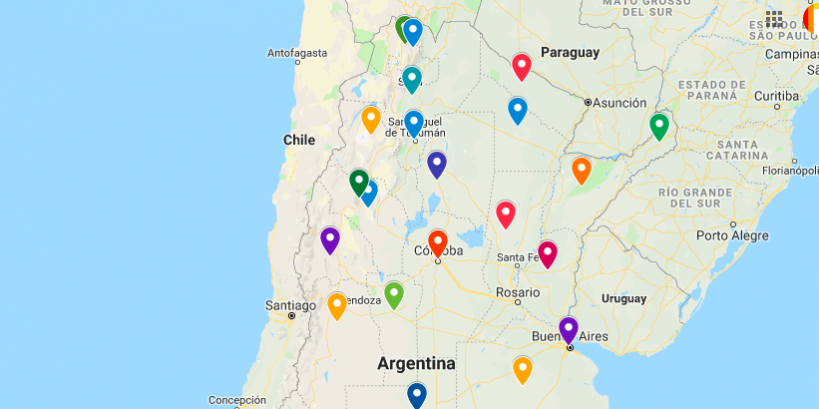
Map of the transvestite-transgender employment quota in Argentina
A national bill for a transvestite and transgender employment quota has been stalled in Congress since July 2018. Only 4 provinces have such a law, and none of them are currently complying with it.

Share

Investigation: Presentes Agency [UPDATED 8/7/2020]
Photos: Presentes Archive/Ariel Gutraich
At least eleven bills proposed guaranteeing access to work for transvestite and trans people in July 2020. Meanwhile, across the country only 5 provinces (out of 23 + City of Buenos Aires) have passed legislation to include it, but none fully comply yet.
According to a 2014 report by ATTTA and Fundación Huésped (the latest available), only 18% of transvestite and trans people have had access to formal jobs.
What is the transvestite-trans employment quota?
The trans and travesti employment quota was an initiative of trans leader and human rights activist Diana Sacayán. She conceived it as a strategy to alleviate the exclusion of her peers: 95 percent of trans and travesti people are or have been involved in prostitution. Law 14783 was passed in the Buenos Aires Province Legislature on September 17, 2015. A month later, she was murdered in her apartment in the Flores neighborhood of Buenos Aires.

The province of Buenos Aires regulated it four years later
The Transgender Employment Quota Law, number 14,783 in the province of Buenos Aires, was championed by transgender activist Diana Sacayán and passed in September 2015. A month later, the human rights activist was brutally murdered in her apartment. The implementation of the law was stalled for over four years by the government of María Eugenia Vidal, until December 5, 2019, when it was finally published in the Official Gazette.
“The public sector of the province of Buenos Aires must employ transvestite, transsexual and transgender people who meet the suitability conditions for the position in a proportion of no less than one percent (1%) of its total staff,” the publication reads.
“It was a political decision that the quota was not met,” said Say Sacayán, Diana’s brother and leader of the Anti-Discrimination Liberation Movement (MAL), before the regulation.

- The Diana Sacayán National Law project was presented by the National Front for the Diana Sacayán Law in 2016. In 2018 it re-entered Congress endorsed by the signature of more than 40 deputies belonging to six legislative blocs, at the behest of National Deputy Mónica Macha, Unidad Ciudadana.
- While the quota system remained unregulated in the province, organizations in Greater Buenos Aires and the interior of the province continued their work, promoting local endorsements and ordinances. They succeeded in getting the municipalities of Almirante Brown, Avellaneda, Lanús, Merlo, Morón, Quilmes, San Miguel, Tres de Febrero, San Isidro, Chivilcoy, Azul, Ramallo, and Mar del Plata to endorse the law. “Endorsements don't always translate into effective compliance, under the pretext that the province hasn't regulated the Diana Sacayán Law,” explains Conurbanxs por la Diversidad (Greater Buenos Aires for Diversity).
- In Pilar and Florencio Varela, specific ordinances establishing quotas were passed. However, only in the latter municipality has it begun to be implemented, and there are two transgender people working on permanent staff. For now, there are no updates or promises of compliance from the mayors.
“We know there are many transphobic mayors, and we have no contact with them. I’ve never seen a single mayor at any session where the trans quota was debated; they probably don’t even know what it is. We all experienced this setback, and so we arrive at another May Day with the trans population excluded from the agenda of unions and the State ,” says Marcela Romero, president of the Association of Transvestites, Transsexuals, and Transgender People (ATTTA) and the Argentine LGBT Federation.

What is the status of the trans job quota in the provinces?
-In addition to the province of Buenos Aires, there are four others that also approved the transvestite-trans labor quota by law.
-Santa Fe approved it on October 31, 2019.
-Chubut approved the trans job quota on May 17, 2018.
-Río Negro and Chaco followed, in September and November 2018 respectively. For different reasons, it was not implemented in any of the three provinces.

The Legislature of the province of Santa Fe determined by law that the Provincial State shall employ in its permanent, temporary and/or contracted staff, transvestite, transsexual and transgender people who meet the suitability conditions for the position, in a proportion not less than 5% of the total number of people who have proceeded to the registration rectification of sex, name and image, in the provincial territory.
While Río Negro and Chaco are still within the one-year deadline for implementing the regulations, organizations in Chubut report that the law is stalled. “It reached the Ministry of Family and stayed there. That was last year, and there’s been no progress since. Clearly, the government isn’t interested in making progress to ensure its implementation,” says Daniela Andrade, an activist and provincial representative of ATTTA in Chubut. She adds that although the law has been presented in every city in the province, it is only being implemented in Comodoro Rivadavia.
Of the remaining 20 provinces, almost all had several projects or at least one in recent years. In the best cases, they reached committee meetings, but in most cases, they didn't even get that far.
Municipalities with transvestite and transgender employment quotas

In the absence of provincial laws and thanks to the work of local activists, many municipalities approved their own initiatives that are beginning to be implemented in: Santo Tomé, Capitán Bermúdez, Chañar Ladeado, Rosario , San José del Rincón, Gálvez, San Justo, Venado Tuerto and Santa Fe City (Santa Fe); San Pedro (Jujuy); Fray Mamerto Esquiú (Catamarca); Resistencia (Chaco, before the provincial law); Bell Ville and Corral de Bustos (Córdoba); Orán and Salta (Salta); Santa Rosa (La Pampa); Cinco Saltos, Bariloche, San Antonio Oeste, Cipolletti, Luis Beltrán, Río Colorado, Viedma (Río Negro, before the provincial law); Las Heras and Luján de Cuyo (Mendoza); Villa Mercedes (San Luis); Tafí del Valle (Tucumán); Rio Grande (Tierra del Fuego), Victoria ( which in September 2019 approved a comprehensive inclusion law for trans people ), Paraná (in June 2019), Rosario del Tala (on November 13, 2019, Entre Ríos), Las Flores and Lincoln (province of Buenos Aires).
In San Miguel de Tucumán, the councilors approved the quota on July 8, 2020. The initiative allocates 1 percent of the municipality's public employment to transvestite and trans people.
Provinces without law or ordinances
Eight provinces remain without provincial laws or municipal ordinances. Among them, Neuquén and Entre Ríos have bills in their provincial legislatures; meanwhile, the City of Buenos Aires, Corrientes, Formosa, La Rioja, Misiones, San Juan, Santiago del Estero, and Santa Cruz have not yet submitted any initiatives.

Crucial ruling for the City of Buenos Aires
Although there is no law in the City of Buenos Aires, a recent ruling by the Buenos Aires courts
The court ordered the Council of the Judiciary to regulate the transgender employment quota established in the Public Policy Law for the recognition and full exercise of citizenship for Lesbian, Gay, Trans, Bisexual, and Intersex (LGBTI) people. This law was passed in 2012, the same year as the Gender Identity Law.
In her ruling - in response to a lawsuit filed by activist and lawyer Cristina Montserrat Hendrickse - Judge María Soledad Larrea urged the Head of Government of the City, the President of the City Legislature, the President of the Superior Court of Justice of the City and each of the heads of the three branches of the Public Ministry of the City to issue the relevant regulations in order to fully comply with the trans employment quota.
Universities with transvestite-trans quotas
Although not legally obligated, universities quickly responded to the demand and began implementing transgender employment quotas. One of the first was the National University of Mar del Plata, in 2017 , which already has them in place . The universities of La Pampa, Comahue, and Tierra del Fuego followed suit.
In October 2019, the National University of Rosario approved the transvestite trans job quota through a resolution that provides for the incorporation of 5% (with a minimum of 3 people) per year to fill jobs in areas of the rectorate or academic units.
If you know of any trans employment quota initiatives that are not mentioned in this article, please write to us at contacto@agenciapresentes.org
We are present
We are committed to journalism that delves into the territories and conducts thorough investigations, combined with new technologies and narrative formats. We want the protagonists, their stories, and their struggles to be present.
SUPPORT US

FOLLOW US
Related notes



We are present
This and other stories are not usually on the media agenda. Together we can bring them to light.