

The courts ordered the regulation of a transgender employment quota in Buenos Aires.
The lawsuit was filed by a trans lawyer and activist based on a 2012 law that establishes the implementation of a public policy of labor inclusion for LGBTI people.


Share

By Paula Bistagnino
The Justice ordered the Council of Magistrates of the City of Buenos Aires to issue within 30 calendar days the relevant regulations to implement in the sectors of the Judicial Power under its jurisdiction the job quota for the trans collective, established in Law 4376 of Public Policy for the recognition and full exercise of citizenship of LGBTI people .
The ruling comes from Judge María Soledad Larrea, head of the Administrative and Tax Court No. 21. It responds to a lawsuit filed by lawyer and trans activist Cristina Montserrat Hendrickse. “When I filed my claim, I was told that this law was not mandatory. I believe it is, so I initiated a class-action lawsuit requesting its implementation and an injunction, so that while the substantive issue is being resolved, trans people are hired. This ruling addresses the implementation of the regulations and sets a 30-day deadline,” explains the lawyer, who is also a plaintiff in the case.

Furthermore, Hendrickse emphasizes that the importance of the ruling also lies in its call for the other branches of government—the Head of Government of the City, the President of the City Legislature, the President of the Superior Court of Justice of the City, and each of the heads of the three branches of the City's Public Prosecutor's Office —to issue the necessary regulations to fully comply with the trans employment quota . “This is very important because the law is being violated in all three branches of government, and this is not a privilege: our life expectancy is directly related to the exclusion we face in all areas of life, and especially in the workplace,” adds the activist and lawyer.
Guarantee opportunities for decent work
Approved in November 2012, the same year as the National Gender Identity Law, Law 4376, in its Article 5, establishes that the City of Buenos Aires guarantees the implementation of a public policy of “Decent Work .” It defines this policy as: “strategies to ensure that LGBTI people have access to decent work and income-generating opportunities, integrating actions that promote job training, fostering collaboration among stakeholders to support entrepreneurship and eradicate discriminatory practices at the local level.” And it “ proposes the incorporation, in a proportion of no less than five percent (5%), of transgender people in the City’s public sector .”
According to the lawsuit, in response to requests for information from Ovistrans (Observatory of Institutional and Social Trans Violence), the Council of the Judiciary was reluctant to provide information on compliance with Law 4376, claiming that it does not register its employees by their gender identity.
“From private sources, we know that only one employee is transgender , in Judge Elena Liberatori's court, and it's unknown whether she's a permanent employee or on temporary contracts. The same is true in the City Legislature , where only one transgender person works . And in the central administration, also through private inquiries, we know that 43 transgender people work there , though it's unknown whether they're permanent employees or on service contracts. These figures are far below the 6,928 transgender jobs reported, because 138,567 people work there .”
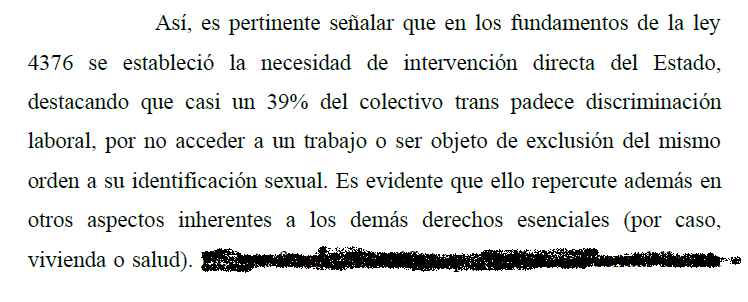
Among her arguments, Judge Larrea's ruling states that "the foundations of Law 4376 established the need for direct state intervention, highlighting that almost 39% of the trans community suffers from workplace discrimination due to being denied employment or being excluded from it because of their gender identity ." She then adds: "It is evident that this also has repercussions on other aspects inherent to other essential rights, such as housing or health. Thus, it is verified that it leads to conditions of exclusion or marginalization that require affirmative action for the effective establishment of guaranteed equality."
"The lack of decent work for trans people is a form of structural violence."
When consulted by Presentes, lawyer and activist Greta Pena, president of 100% Diversity and Rights, celebrated the ruling: “It confirms that the lack of regulations for a law is not a valid excuse for non-compliance . Rights are operational, especially human rights , and this judicial decision put things right by removing the obstacles that the various executive branches place in the way of delaying or preventing trans people from having full access to decent work,” she said.
Furthermore, she considered it " deplorable that the State continues to fail and that trans people must resort to the courts to ensure that protective laws are enforced." She concluded: "The lack of decent work for trans people is a form of structural violence. Not only do employment quota laws address this problem, but the Gender Identity Law itself guarantees the free development of the individual in accordance with their self-perceived gender identity, and this clearly includes access to employment."
We are present
We are committed to journalism that delves into the territories and conducts thorough investigations, combined with new technologies and narrative formats. We want the protagonists, their stories, and their struggles to be present.
SUPPORT US

FOLLOW US
Related notes



We are present
This and other stories are not usually on the media agenda. Together we can bring them to light.