

Five trans women accused of drug dealing were acquitted
A prosecutor is requesting the dismissal of charges against five transgender women accused of small-scale drug dealing, citing the structural violence they face.

Share

By Maria Eugenia Ludueña
Photo: Ariel Gutraich/Presentes archive. Illustration: Florencia Capella
[News updated April 18]
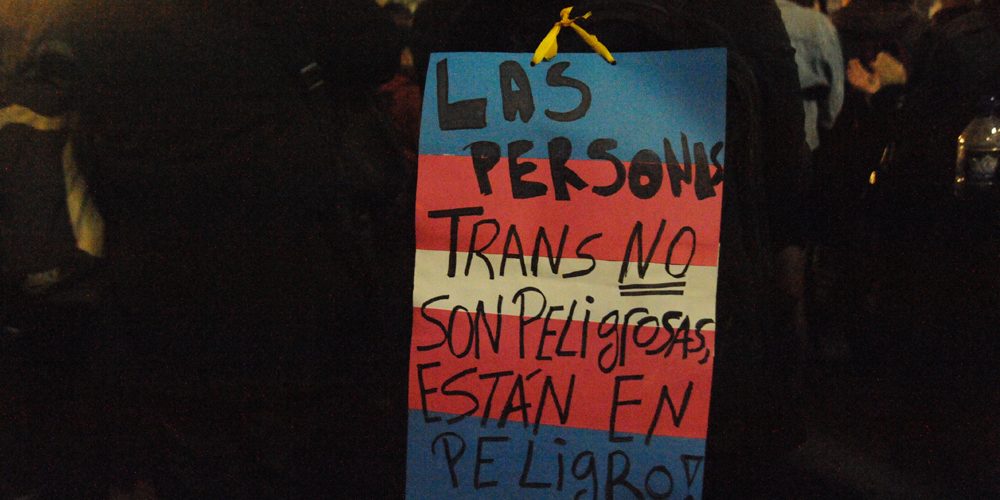
A federal prosecutor has requested the dismissal of charges against five transgender women accused of drug trafficking, arguing that their gender identity places them in a situation of extreme vulnerability and lacks access to basic rights. He also requested that the manager of the hotel where the drug dealing took place be brought to trial and that an investigation be launched into whether a criminal organization is exploiting vulnerable transgender women to sell drugs.
As a result, the National Federal Criminal and Correctional Court No. 7, presided over by Judge Sebastián Casanello, decided to dismiss the charges against them, judicial sources confirmed to Presentes. The only one of the five accused who had been detained—for failing to provide proof of a fixed address—has already been released. This is a landmark decision by the Argentine justice system, which acknowledges the "excusable necessity" under which the accused acted and recognizes the lack of rights faced by the trans and travesti community.
The opinion was signed by Franco Picardi, head of Federal Criminal and Correctional Prosecutor's Office No. 5. In its nearly 50 pages, which Presentes had access to, it cites Judith Butler (“As a variable and contextual phenomenon, gender does not designate a substantive being, but rather a relative point of connection between specific sets of cultural and historical relations”) and the Inter-American Commission on Human Rights (IACHR), but also includes numerous references to research conducted by LGBT+ organizations themselves that document the living conditions of the trans community. Among these is a study carried out by Otrans, which investigated the cases of people arrested in public for drug-related offenses.
“While only 3% of the total population deprived of liberty in the Buenos Aires Penitentiary Service is foreign, the population of foreign trans women and transvestites represents 85% of the total population of trans women and transvestites deprived of their liberty. This demonstrates the impact of double discrimination ,” says the OTRANS monitoring report, cited in the ruling.
For prosecutor Picardi, the fact that they are trans and migrants makes them targets of “profiling and police harassment.” He cites various sources that prove this. Contrary to what usually happens in the justice system ( with the exception of the ruling in the Sacayán transvesticide case ), he analyzes the dismissals requested based on the vulnerability of the transvestite/trans community and from a gender perspective . “ I believe that the context and the constructed dimension of the self-perceived gender of the women being prosecuted directly affects—as will be explained later—the charges against them,” he stated in the document.
And it adds: “While the investigation in the preliminary stage has established that “the women under investigation engaged in prostitution and, in addition, sold narcotics at the retail level under the aforementioned conditions and circumstances. This, paying special attention to the fact that the women named are transgender and immigrants. That is to say, they are, by their very nature, part of a population group of extreme vulnerability .
 “It cannot be overlooked that the history of rejection and expulsion of these women—which in turn strengthens the existing system of domination and hegemonic identities—significantly impacts their indictment, and under these parameters, I believe that this circumstance allows me to understand the main reason that irreversibly led them to the place where they find themselves today,” Picardi wrote in the document submitted on April 9. The document also addresses how the treatment of the accused trans women often violates their gender identity.
“Three of these women have prior convictions for drug-related offenses and have even been arrested for this reason, which clearly demonstrates the link between being a trans woman and laws that are repeatedly used to criminalize this population ,” the prosecutor points out. He believes that “the State must, on the one hand, address the criminal phenomenon analyzed by focusing on its complexity and the highest levels of the chain, in order to tackle the structural problem. And at the same time, it must offer non-punitive alternatives to the trans community for the free development of their identity and the full exercise of their social, economic, and cultural rights, which can mitigate their vulnerability to these criminal networks that exploit their plight for illicit gain.”
Not only does it request that the charges against all five be dismissed and that they be released, but it also asks that the General Directorate for Support, Guidance, and Protection of Victims of the Attorney General's Office (DOVIC) be given the opportunity to assist them. Furthermore, it requests that the Undersecretariat of Human Rights and Cultural Pluralism of the City of Buenos Aires be asked to provide support to the aforementioned individuals, so that they may be included in the comprehensive programs offered by that department (such as comprehensive job placement, healthcare, etc.).
The events that were investigated
The investigation began with an anonymous tip about small-scale drug dealing in the Constitución neighborhood. The tip was filed in October 2017 by the Autonomous Directorate of Drug Enforcement of the Buenos Aires City Police. The investigation uncovered a group of transgender women surviving through prostitution near a hotel. Drug sales were taking place inside the hotel. A similar situation was occurring at another hotel about 100 meters away.
The two hotels were raided in December 2018, along with a private residence. Tests determined that the seized substances were of low purity. As a result, five transgender women—four from Peru and one from Tucumán—were prosecuted. Four of them are free, but one remains in custody for failing to provide a fixed address, a point also questioned in this ruling.
Repercussions
“The prosecutor’s request is consistent and goes in the same direction as the complaints made by OTRANS ARGENTINA to international human rights organizations such as the UN, where we report the fabrication of cases, arbitrary detentions, abuses, torture and deaths of trans women and transvestites in confinement, and how this is amplified with trans and transvestite migrants from the southern cone,” Claudia Vasques Haro, president of the organization, told Presentes.
Activist Alba Rueda, from Mujeres Trans Argentinas (Argentine Trans Women), considered it a “groundbreaking ruling that addresses structural violence.” But, she warns, “it’s a rare exception within the judicial system. Citing Butler and Zaffaroni, discussing the vulnerable conditions of our trans sisters, and citing reports from LGBT+ activists are things we don’t find in the justice system. The prosecutor’s summary clearly shows how the judicial system treats us. For example, when he cites the police statement that refers to a transvestite .”
“Bringing our studies of activism into a legal ruling is something new for the judicial system. But it's an exception. What we're experiencing are policies of criminalization based on small-scale drug dealing. We're seeing how the cells in the City of Buenos Aires and in the Ezeiza prison are filling up with people as a result of the application of these laws.”
Rueda says that since the Gender Identity Law, “they can no longer criminalize us for that, but they can criminalize us for drug dealing under this law. In Ezeiza prison, most of the trans and migrant women are being prosecuted for this and haven't been sentenced. Nobody pays attention to this structural inequality. And now that it's been transferred to the City's jurisdiction (starting in January), these young women are being criminalized for this; the most vulnerable sectors are being cut off.”
“With this ruling, the justice system is applying, for the first time, a human rights perspective for transvestites and transgender people. It takes into account the differentiated impact that drug laws have on this population. It doesn't focus on whether or not they fall under the definition of a crime, but rather on their vulnerable situation, which prevents them from complying with the law,” said Greta Pena, from 100% Diversity and Rights. “In most of these cases, which represent more than 70% of the trans women arrested, the justice system places the full burden on them, as they are the weakest link in the chain, and fails to investigate either the criminal organization or the security forces.” For her, “it is a source of pride to see how the prosecutor cites the laws that have been won and the statistics and reports from Argentine LGBTI organizations. This is also thanks to the Gender Identity Law.”
We are present
We are committed to journalism that delves into the territories and conducts thorough investigations, combined with new technologies and narrative formats. We want the protagonists, their stories, and their struggles to be present.
SUPPORT US

FOLLOW US
Related notes



We are present
This and other stories are not usually on the media agenda. Together we can bring them to light.