

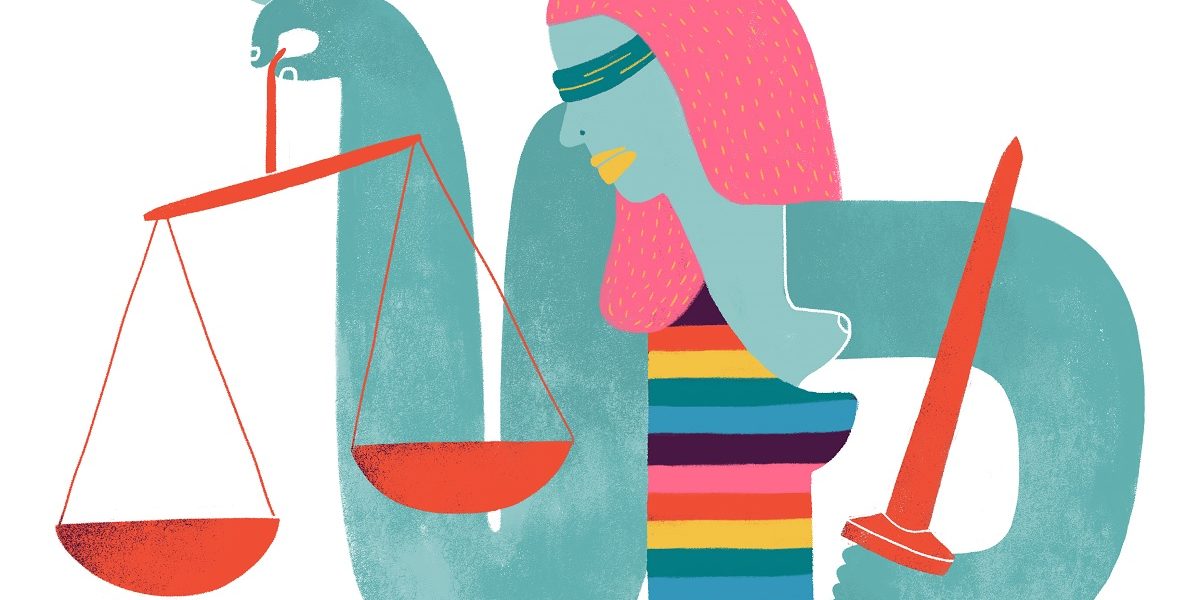
She reported a rape and the justice system did not respect her gender identity.
"They apologized, but it's not enough. It's unacceptable that citizens have to tell the justice system which laws to apply."

Share

By Cecilia González
Illustration: Florencia Capella
On the morning of February 18, Ian, a 22-year-old trans man, went to the Malvinas Argentinas Decentralized Prosecutor's Office (Buenos Aires province) to report that, just a few hours earlier, he had been raped by Cristian M., his 49-year-old friend and piano teacher.
But Ian felt a new and immediate violation of his rights. He alleges that the prosecutor's office staff did not respect his gender identity and that they referred to him using feminine pronouns at all times. Although he identifies as a trans man, the court officials drafted the complaint using his female name and, throughout the written statement, used genders interchangeably, employing terms such as "interrogated," "born," "single," "son of," or "the complainant." All of this occurred despite the fact that they were required to use masculine pronouns at the complainant's request and as stipulated by the Gender Identity Law in force in Argentina since 2012.
Carolina Abregú, the local coordinator for the feminist organization Furia Feminista in Malvinas Argentinas, explained to Presentes that they are supporting the victim and want to raise awareness that the justice system continues to violate the Gender Identity Law. She also stated that Ian needs a lawyer to pursue the complaint regarding the physical assault he suffered.
“There are no gender diversity offices in either Malvinas or José C. Paz. There are many gaps in the state system, cracks that we are trying to repair so that Ian has the desire to keep fighting and there is justice for what happened to him. Rights are violated all the time,” Abregú said.
The accused is a piano teacher whom the victim has known for years and with whom he had formed a friendship. The victim recounted that they went out together on the night of February 17th. During the early morning hours, Ian wanted to go home, but Cristian M. convinced him to go to his place in José C. Paz instead, since they had both been drinking. Ian said he arrived home dizzy and feeling unwell, and the assailant took advantage of his condition to rape him.
According to Ian, as soon as he managed to leave, he went straight to the Malvinas Argentinas Health Center. But there, he says, they refused to treat him, warning him that to receive post-rape medical care he first had to file a police report and then go to the Carrillo Hospital in Ciudadela.
In just a few hours, Ian was raped, denied medical attention, and his gender identity was not respected at the Malvinas Argentinas prosecutor's office, even though, upon arrival, he explained that he was a trans man and that his ID card with his change of identity was in process.
“The prosecutor’s office staff told her they had to use the name from her current ID, which is female, but that’s not legal . When a legal complaint is filed, it’s not necessary to present the document; they have to accept it based on the gender with which the victim identifies,” Abregú pointed out.
The activist warned that this is not the first time this has happened. Feminist Fury frequently intervenes in cases where people's gender identity is not respected.
“We want to make sure this doesn’t happen again. We went to the Malvinas Argentinas Prosecutor’s Office to complain about the treatment Ian received, and they apologized, but it’s not enough. As judicial officers, they should know and respect these matters; it’s unacceptable that citizens have to tell the justice system which laws to apply ,” he said.
Abregú specified that the criminal case for the rape suffered by Ian was transferred to the Fiscal Investigation Unit (UFI) 14 of San Martín, specialized in sexual crimes, with the number N 15-01-005604-19/00.
Argentina is at the forefront of gender identity legislation in Latin America. But Alejandro Mamani, a litigator and member of the organization Abosex, agrees that violations of the Gender Identity Law are frequent.
Invisibility of violence against trans men
“There is violence against all groups. Trans people have many problems accessing justice. There is transphobia, transphobia. And furthermore, within the community, violence against trans men is even more invisible, as in this case of complaints where self-perceived gender is not respected,” she said.
This, he added, is why dissident groups or marginalized collectives, racialized people, and even women, distrust the Judiciary because they are aware of the lack of respect to which they are exposed.
“The justice system tends not to respect self-perception. This happens, for example, to trans migrants, because to change their ID they have to change their permanent residence. There are many trans women imprisoned in jails who do not have their ID updated,” she explained.
We are present
We are committed to journalism that delves into the territories and conducts thorough investigations, combined with new technologies and narrative formats. We want the protagonists, their stories, and their struggles to be present.
SUPPORT US

FOLLOW US
Related notes


We are present
This and other stories are not usually on the media agenda. Together we can bring them to light.