

Perspectives on the verdict in the Diana Sacayán transvesticide case
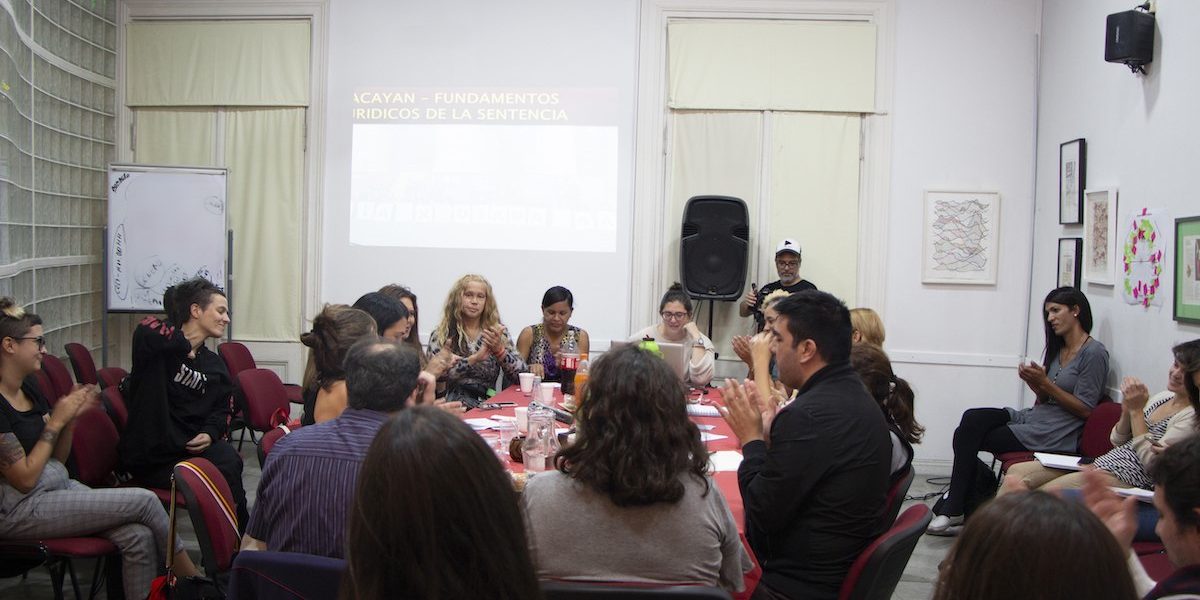
To reflect on the implications of the landmark ruling in the Diana Sacayán transphobic murder case, the Center for Legal and Social Studies (CELS), together with the Justice for Diana Commission, organized a discussion. The speakers emphasized the need to continue working with the ruling so that it continues to have a significant impact and contribute to shaping the political agenda.

Share

Photos: CELS
To reflect on the implications of the landmark ruling in the Diana Sacayán transphobic murder case, the Center for Legal and Social Studies (CELS), together with the Justice for Diana Commission, organized a discussion. The speakers emphasized the need to continue working with the ruling so that it continues to have a significant impact and contribute to shaping the political agenda.
“This ruling has much more potential. The setup is over. Now it’s time to think about how to use this decision and all its aspects,” said Say Sacayán, an activist with the organization MAL and brother of Diana Sacayán.

In addition to Say Sacayán, the following participated: Mariela Labozetta, head of the Specialized Prosecutor's Unit for Violence against Women (UFEM); Alba Rueda, trans activist and member of Mujeres Trans Argentina (MTA); Luciana Sánchez, lawyer for the family lawsuit and lesbian feminist activist; and Andrea Pochak, head of the Human Rights Directorate.
Mariela Labozetta opened the discussion by explaining how the legal proceedings were handled and how strategies were developed collaboratively to redefine the role of the Public Prosecutor's Office in this case. "The involvement of the LGBT community was an important process that involved securing a space within the justice system to address violence against the LGBT community," she said. She emphasized that responding to the trans community's need "to give this crime a specific name and to have it condemned as a transphobic hate crime" was a "great achievement."
"Our identity emerges as resistance"
Alba Rueda asked not to fall into dogmatic positions, "mainly because anti-punitive or penal abolitionist groups could look with suspicion upon this support that social organizations give to the sentence of Diana Sacayán."
“It seems to me that this apparent tension between seeking the decriminalization of trans and travesti identities and valuing this ruling appears contradictory from the perspective of some who work in law,” she said. She added, “Exclusion from the judicial system ended up being a way of criminalizing trans and travesti identities. This has been repeated throughout our history, specifically because our social and political identity arises as resistance, as a territorial struggle against institutional violence, against the residents of Palermo, against police edicts, against the municipal codes, against the criminalization of prostitution and drug dealing laws, which are current issues and how they impact our population.”

The activist said that rulings like the one in the Diana Sacayán transphobic murder case allow for a shift in the judicial perspective, moving beyond criminalization to recognize them “as victims of the structural criminalization in which we have grown up.” She emphasized that the ruling represents a social journey, a public mourning, and a call for justice that includes tools to protect the trans and travesti population. “This is because there is a wealth of data showing that our living conditions are not only social conditions, but also conditions that permeate institutions and ultimately generate this silent genocide over the years. The low life expectancy is a testament to this,” she stated.
Luciana Sánchez analyzed the judges' votes and highlighted that Calvet's opinion is more open because it "considers the social transvesticide that this murder concludes with." Regarding Báez's opinion, she emphasized that it addresses both the body and the environment in which the crime occurred. "It speaks not only of Diana's injuries and trans identity, but also delves into the location of the crime—her home, her bedroom—and addresses racism. It adds this layer of examining the intersectionality of the crime," she noted.
Andrea Pochak said that the Sacayán ruling must cease to be the exception and become the rule. “We need to develop an agenda that includes a strong influence of human rights movements within the justice system,” she stated.
We are present
We are committed to journalism that delves into the territories and conducts thorough investigations, combined with new technologies and narrative formats. We want the protagonists, their stories, and their struggles to be present.
SUPPORT US

FOLLOW US
Related notes



We are present
This and other stories are not usually on the media agenda. Together we can bring them to light.