

#24M Why is there no talk about the persecution of LGBT+ people in the dictatorship?
Sexual diversity activists have been denouncing that in Argentina crimes against LGBT+ people have not yet been made visible or punished.

Share

By María Eugenia Ludueña and Lucas Gutiérrez
On the anniversary of the coup, with a model of Memory, Truth and Justice that is an example to the world and has managed to convict more than 901 people in Argentina for crimes against humanity, sexual diversity activists continue to denounce that crimes against LGBT+ people have not yet been made visible or punished.
During the March 24th marches, some LGBTQ+ rights activists held up a sign with a number. They denounced the existence of at least 400 missing LGBTQ+ people. Where did this figure come from?
Lxs 30400
The first mention of this number appeared in 1987 in Carlos Jáuregui's book, "Homosexuality in Argentina." Then, in 1996, in an article for Nx magazine, Jáuregui elaborated: "Our community, like every minority during the dictatorship, was a prime victim of the regime. The late Rabbi Marshal Meyer, a member of the CONADEP (National Commission on the Disappearance of Persons), created during the Radical Civic Union government, told me in 1985 that the Commission had identified four hundred homosexuals on its list of ten thousand people reported missing. They hadn't disappeared because of their sexual orientation, but the treatment they received, the rabbi stated, had been especially sadistic and violent, like that of the Jewish detainees.".
The figure roughly estimated “four hundred homosexuals.” At that time, the word “homosexuals” was a way of designating all identities that were not strictly heterosexual. It included gay men, lesbians, trans people, transvestites, bisexuals, and more. The context of that figure was a number that, in 1985 and with many limitations, was just beginning to take shape, and over the years, with the denunciations, it became 30,000 disappeared persons. But the arrests and persecution of LGBT people had not begun with state terrorism.
Ivanna Aguilera is a trans survivor. She was 13 years old that afternoon in May 1976 in Rosario. It was seven o'clock, and she was with other girls in front of the Automobile Club in San Martín Square, five blocks from her house, when she saw a truck and two army jeeps approaching, as she told Presentes. “We were just discovering ourselves, going out into the streets. We were going to the square because we had met a trans girl, Poropá, the first one we had ever met. The truck stopped, and they threw us in, beating us. An older girl protected us. They took us to Battalion 121 (where a clandestine detention center operated), where I was beaten, gang-raped, tortured with electric shocks on my genitals, and left with a broken leg. All of this was accompanied by insults about my identity: faggot, queer, degenerate, you are a disease, you should be killed when you are little.”.
Ivanna recounts being held captive for 72 hours with her companions. “They dumped all of us in an open field. But one of us didn't survive,” she says. Later, Ivanna would be arrested repeatedly. “They arrested us because of our sexuality. But they never put us with our fellow political prisoners, only with the general population: rapists, criminals, thieves. And some of them abused us again. The same thing happened to the few of us who survived. Why did they take us and torture us? They never told us. We weren't part of a union,” Ivanna says.
Today she lives in Córdoba and is president of Devenir Diverse . “Trans women don’t have justice. We only started working on it a few years ago. And this genocide against our LGBTQ+ bodies didn’t end when democracy arrived. We’ve had a gender identity law for seven years. Before, we would go to a hospital and be arrested, based on police edicts created by the dictatorship.”
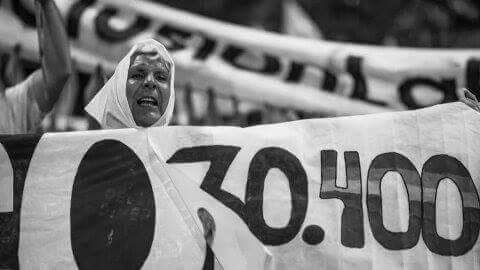
Photo: Ivanna Aguilera's personal archive
Before, during and after the dictatorship
On March 24, 2019, her group, along with other LGBTQ+ organizations, marched in Córdoba with the same demand: Transgender Employment Quotas. “Why talk about transgender employment inclusion during the week of remembrance? Because the policies of persecution against the LGBTQ+ community began systematically and in a widespread manner during the dictatorship of Félix Uriburu. An extermination plan was implemented with practices similar to, or worse than, those implemented by the Nazis since the dictatorship of Onganía,” she says.
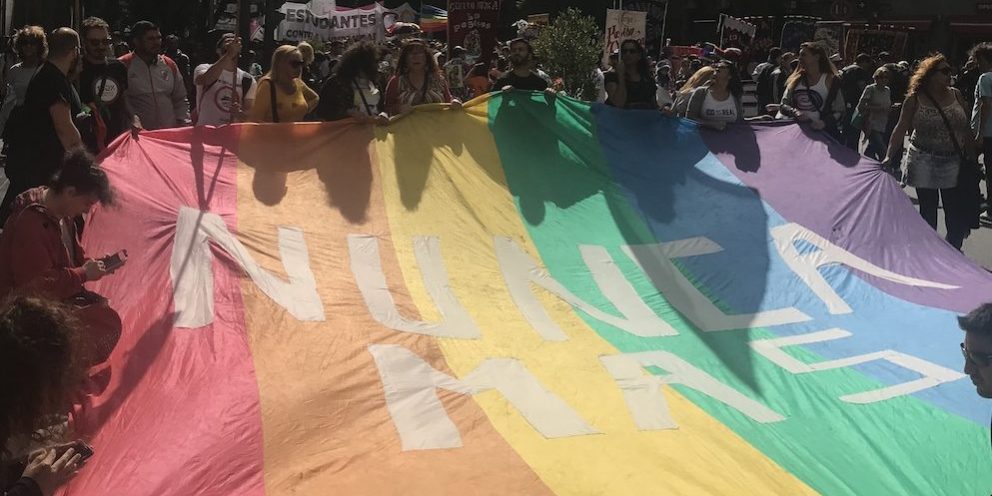
In Buenos Aires, Greta Pena, from 100% Diversity and Rights, marches with her group and other LGBTQ+ organizations, carrying a rainbow flag and the emblematic "Never Again" banner. "We want to make visible the 400 LGBTQ+ comrades who disappeared and were erased from the CONADEP report due to the influence of the Catholic Church. They are our 400 among the 30,000 disappeared," she says.
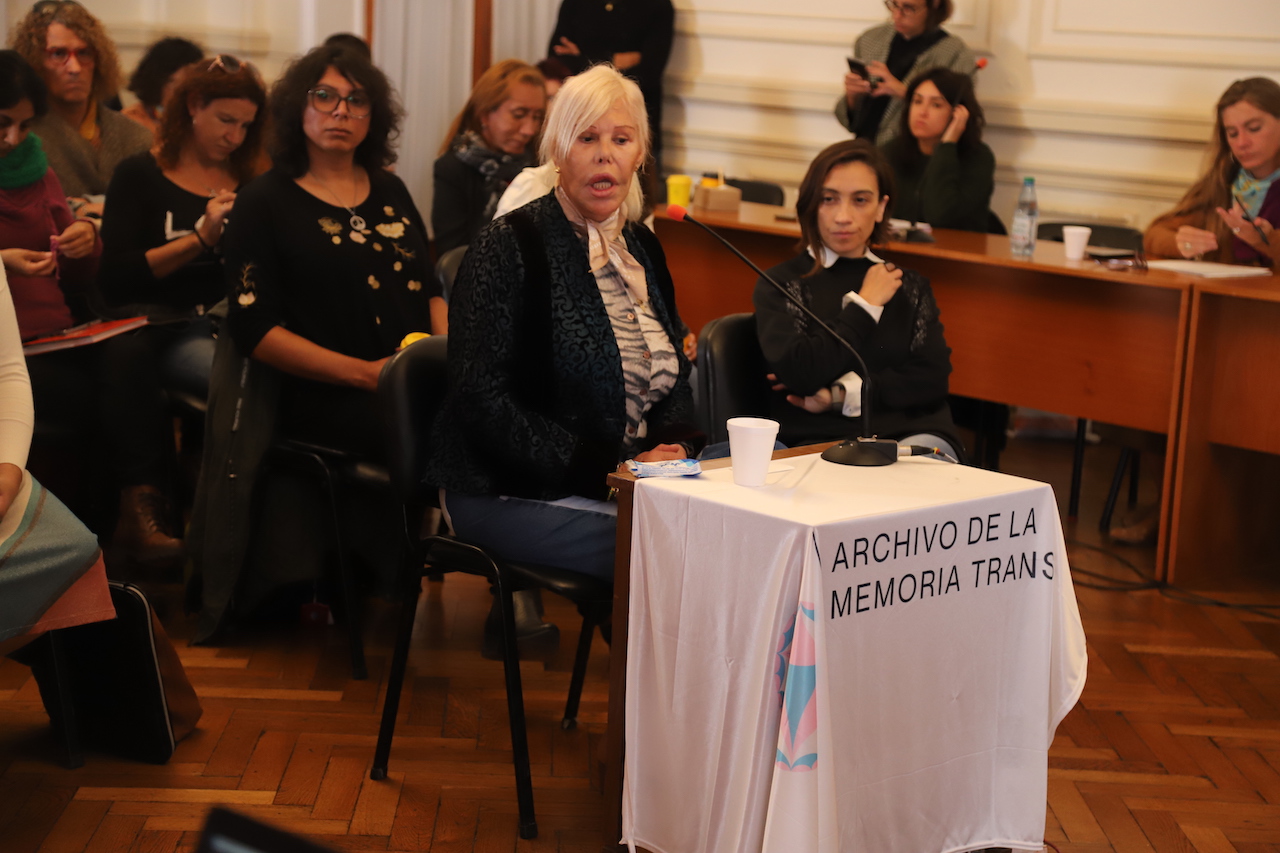
Valeria del Mar is 65 years old, a trans woman, and was held captive in the clandestine detention center Pozo de Banfield. She lives in Buenos Aires and is the Human Rights Secretary of AMMAR (Association of Sex Workers of Argentina). On March 22, Pozo de Banfield reopened as a memorial site, and Valeria was there. “It was like arriving and remembering. But it was a bright day within the 14 days of darkness I endured in there.”.
She testified twice in court about what happened during the two weeks she was kidnapped. She was taken while working as a prostitute on Route 4, Camino de Cintura, along with other women. She told the court: “I was raped almost every day, up to four times a day. I was forced to perform oral sex through the mailbox in the door, I was anally raped, without a condom, by a young police officer, and I was systematically tortured both physically and psychologically.”
At the Banfield Detention Center, Valeria was insulted because of her gender identity: “Come here, you fucking faggot, come here, you broken-ass black,” she told Presentes. “Having breasts in 1976 was a symbol of resistance against the dictatorship. That made them very angry, and they treated us badly.” Valeria continues fighting to receive reparations as a victim of state terrorism. “What witnesses can I have if all my fellow detainees are dead? It’s a struggle and a painstaking effort,” she says. In 2013, she was accepted as a plaintiff in the case concerning crimes against humanity committed at that center between 1976 and 1977.
Public morality: heterosexual and Christian
So far, in trials for crimes against humanity, little is said about the human rights violations against LGBTIQ people. “In these trials in different courts in Argentina, testimonies reveal the repression of LGBTI people. This information emerges, but the process of Memory, Truth, and Justice is complex; there is still progress to be made in making it visible. Just as it was complex to bring to light issues such as rape and sexual violence in torture and extermination centers, and the degrading treatment of women—acts that had their own specific characteristics and were not simply practices subsumed under torture. It is a task we have,” wrote Silvia Delfino, a professor at the University of La Plata, member of the Argentine League for Human Rights, and member of the Argentine Federation of Lesbians, Gays, Bisexuals, and Trans (FALGBT), in Presentes.
READ MORE: Silvia Delfino: “The LGBTI struggle is also part of Memory, Truth and Justice”
“Both ignorance and silence are politically produced. Acknowledging this can be a very important step,” says Emmanuel Theumer, an activist and professor at the National University of the Littoral. On the other hand, the acronym LGBT+ was promoted by activists some 25 years ago. “The question I think we have to ask ourselves is: Did a state repressive apparatus exist that targeted people because of their sexual orientation, gender identity, or gender expression? As has been historically denounced by sexual resistance movements and various historical accounts—some from marginalized communities, others documented in court—I have no doubt that such a “repressive government” existed, to use a criminological term. This dictatorship presented itself as the Process of National Reorganization and was based on an understanding of the heterosexual Christian family as the foundation of national defense. The repressive apparatus targeting people because of their gender expression, sexual orientation, and gender identity was articulated within the intensified plan to maintain a heterosexual-reproductive public morality.”.
“It’s not visible because we live in a sexist country.”
Eugenio Talbot Wright is 46 years old. This trans man is the son of Héctor Talbot Wright (a Montoneros militant who disappeared in October 1976) and XX. A member of HIJXS and an activist for sexual diversity, he says: “The persecution of the LGBT+ community is not visible because we continue to live in a patriarchal country that is very slowly opening its doors to new voices that heteropatriarchy has silenced. Since the 1930s, attacks and persecution against the LGBT+ community have been perpetrated by the State. Much blood has been shed. And we continue to bury our comrades.”.
Eugenio wanted the March 24th speech in Córdoba, where he lives, to be given by a trans person. It won't happen this year. “There are few trans survivors; they have an average life expectancy of 35 years. It's time their voices were heard. Especially considering the political relationship that existed between the Homosexual Liberation Front and revolutionary organizations. And we need to investigate how the dynamics of extermination against LGBT+ people operated.”.
On the other hand, revolutionary and political organizations of the 1970s held different positions regarding sexual diversity. Some considered it a kind of illness. Others saw it as an aspect that made activists more vulnerable to the annihilating power of the dictatorship.
In his biography of Viviana Avendaño (Everything Power Hates), Alexis Oliva reconstructs the life of this revolutionary militant, lesbian activist, and feminist from Córdoba, who was involved in various struggles. Viviana was imprisoned in Devoto prison during the dictatorship, where she was included in a “rehabilitation” experiment and labeled “irrecoverable.” Testimonies from those who knew her recount the discrimination and violence she suffered for being a lesbian.
Silenced LGBT+ Memories

Cristian Prieto is a journalist and works at the Provincial Commission for Memory. It was there that he discovered, in the archives of the Buenos Aires Police Intelligence Division (DIPBA), how during the last dictatorship intelligence was gathered not only on social and political life but also on sexual matters.
“With democratic governments, with dictatorships, with or without edicts that penalized us: only to straighten us out or to avoid being the rotten fruit that would invite others to rot with us,” Prieto narrates. Using material spanning from 1957 to 1998, she wrote a novel that blends fiction with real data. In 'Fichados' (Filed), those entries in the files that said things like: homosexual, effeminate, and more, bear witness to the violence to which one was exposed for not being heterosexual before, during, and after the dictatorship.
READ MORE: LGBT memories persecuted and silenced under dictatorship
Files like this exist. Testimonies exist, some taken in court, like Valeria's (and others that never reached the courts, like Ivanna's). Historical reparations exist: in 2018, the province of Santa Fe recognized 25 trans people as victims of state violence based on their gender identity during the dictatorship in Argentina. "But it's important to understand that the repressive apparatus existed both before and after the last civic-military dictatorship," says Theumer.
READ MORE: Trans historical reparation: “We, the survivors, remain”
While democracy returned to the country on December 10, 1983, with a president elected by the people, it did not reach everyone. “The repressive apparatus was structured around the defense of ‘public morality,’ sometimes explicitly targeting ‘transvestites and homosexuals,’ as well as prostitutes, but it wasn’t always so tacit. Gay activists from the CHA and the MLH (Rosario Homosexual Liberation Movement) understood this very well when they asked themselves in the mid-eighties, ‘Is this democracy?’ What they were denouncing were the codes of misdemeanors and other contraventional measures that, to put it bluntly, enabled a repressive, sub-penal system in the hands of the police,” explains Theumer.
Who is advocating for trans people?
“We marched on Sunday demanding justice for 30,400 disappeared comrades. The dissidents are also present and want justice. I could die at any moment. This needs to be known. We don't have children or family members to march for us.”.
Every year Ivanna continues to march. You can find her raising awareness of those 400 disappearances and sharing her life story: “It seems we are only witnesses to a terrorist act, but that's not the case; we were also protagonists of that infamous time. We suffered imprisonment, torture; the marks are on our bodies. What do we have to do? Prove it? We, the survivors, are here. There's a problem with sexuality. Sex in general. It's taboo to talk about sex. Here, gay men, lesbians, and trans people were persecuted. There were also workers, teachers, and students who were gay, lesbian, and trans. The documents are there. López Rega's order to the police forces for our extermination.”.
 “The public mourning activated by LGBT organizations in the face of the last dictatorship is articulated in a different way than that of Mothers and Grandmothers and Children; the claim here is not necessarily based on a biological blood relationship, but is invoked by projecting a community with which we identify and from which we demand justice for all our dead,” shares Emmanuel Theumer.
For him, the political power of the “400 disappeared” made it possible to problematize the sexuality of memory, the sexuality of suspicion, and also subversion. “And something no less important: the social complicity regarding this repressive modality and violation of rights. The memory opened by the 400 disappeared resists becoming an archive. It critically problematizes life in democracy by highlighting the continuity of state violence and the violation of the rights of people because of their sexual orientation and gender identity. I like to emphasize that this, for me, is the Never Again of the 400.”.
We are present
We are committed to journalism that delves into the territories and conducts thorough investigations, combined with new technologies and narrative formats. We want the protagonists, their stories, and their struggles to be present.
SUPPORT US

FOLLOW US
Related notes
We are present
This and other stories are not usually on the media agenda. Together we can bring them to light.