
 Support us

The first stage of Wiki LGBT Human Rights has ended.
The project for more inclusive communication developed by Agencia Presentes and Wikimedia Argentina concluded its first phase, which included activities in Buenos Aires, Tucumán and Asunción, Paraguay: four training workshops for activists and journalists, three marathons of editing content on Wikipedia in Spanish, more than 70 articles edited and 150 participants.
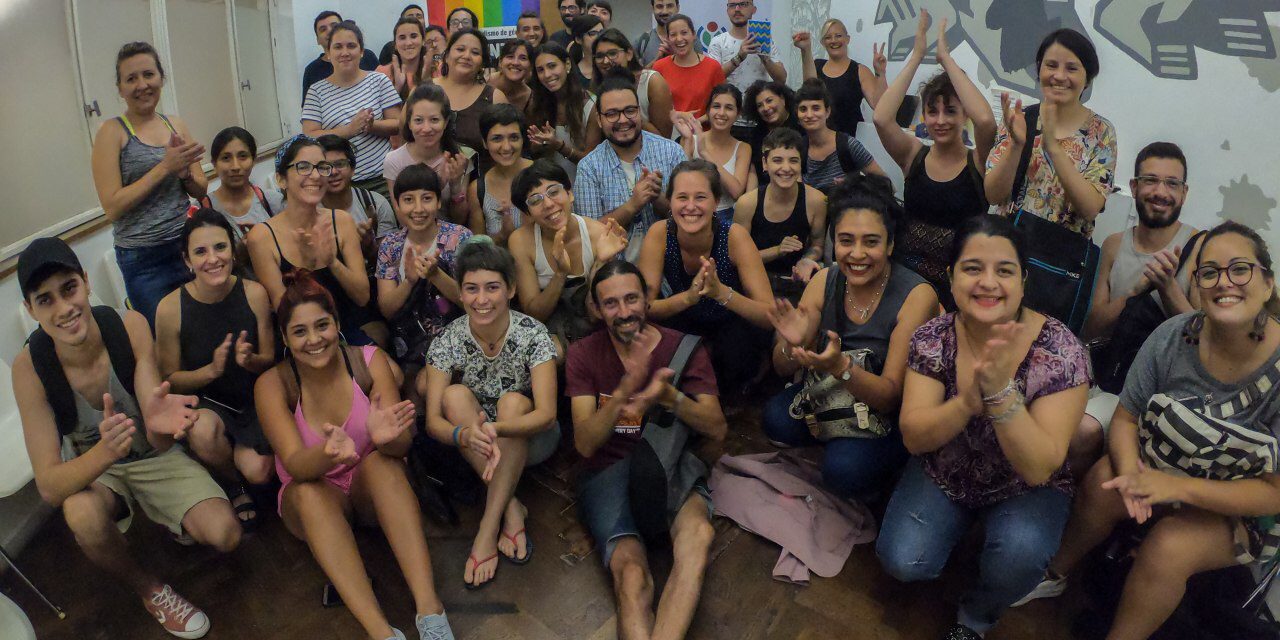

Photos: Mariana Leder Kremer / Jessie Insfrán Pérez
Agencia Presentes and Wikimedia Argentina developed the first stage of Wiki Human Rights LGBT, an initiative to train and create more inclusive communication about diversity: over six months, activities were carried out in Buenos Aires, Tucumán and Asunción, Paraguay, in which more than 150 journalists and activists participated.
This initiative is part of the Wiki Human Rights project and arises from a reality: violence due to prejudice against LGBT people in Latin America has dramatic figures: according to the Inter-American Commission on Human Rights (IACHR), every week nine people are murdered because of their sexual orientation or gender identity.
READ MORE Wiki LGBT+ Human Rights: Presents and Wikimedia edit LGBT content
In this, media violence plays a key role: the media has an enormous responsibility and it is often from there that prejudices are not only reproduced but also constructed and violence is exercised against the LGBT community.
The project between Presentes and Wikimedia Argentina was born with the conviction that access to information is a right and a tool for social change.
READ MORE Wiki LGBT Human Rights in Paraguay
READ MORE We've started editing! Wikipedia in Spanish is now more inclusive
More than 150 participants in the workshops
In this first phase of the Wiki LGBT+ Human Rights project, more than 150 people participated in training workshops for activists and journalists and editing marathons. In Asunción, Paraguay, where activities began on November 2nd and 3rd, 2018, there were 30 activists and 30 journalists; while the closing event in San Miguel de Tucumán—capital of one of the most violent and anti-rights provinces for LGBT+ people—brought together 35 journalists and 32 activists on February 22nd and 23rd, 2019.
#2YearsPresent Together with @WikiDDHH we are creating Wikipedia profiles of trans and gender-diverse activists and improving the LGBT content of one of the most visited sites in the world. 🌈🤩 pic.twitter.com/qSYCCJEB1O
— Agencia Presentes (@PresentesLGBT) November 24, 2018
READ MORE This is how the workshops and the first edit-a-thon in Tucumán went


📢🏳️🌈During 2018, @wikimedia_ar and Agencia @PresentesLGBT shared two LGBT edit-a-thons to improve the LGBT content of Wikipedia in Spanish.
📝We'll continue in 2019. If you saw an article that needs editing or you think there's missing information, let us know here: https://t.co/H2HM6GSsUh pic.twitter.com/mbkBCiKOcl
— WikiHumanRights (@WikiDDHH) January 2, 2019
70 articles edited on Wikipedia in Spanish
Wikipedia in Spanish is the largest free encyclopedia on the web, the fifth most visited site on the Internet (more than 35 million daily visits) and one of the most used sources of daily information in the region.
Content “edit-athons” are a primary objective of the project to build inclusive communication of diversity: in these collective editing marathons, articles are created and corrected on basic concepts such as sexual orientation or gender identity, new legal figures such as transvesticide, histories of struggles and biographies of LGBT role models, among others.
 In this first phase of the project, three edit-a-thons were held with 60 participants, resulting in the editing of approximately 70 articles. Two of these edit-a-thons served as closing events for workshops in Asunción, Paraguay in November 2018 and in San Miguel de Tucumán in February 2019. Some of the concepts developed and revised included asexuality, non-binary gender, pansexuality, queerness, transvestism, sexual diversity, and hate crime. Biographies of Lohana Berkins, Susy Shock, Marlene Wayar, and Carlos Jáuregui in Argentina, and Bernardo Aranda in Paraguay, were also addressed.
We are present
We are committed to journalism that delves into the territories and conducts thorough investigations, combined with new technologies and narrative formats. We want the protagonists, their stories, and their struggles to be present.
SUPPORT US

FOLLOW US
Related notes
We are present
This and other stories are not usually on the media agenda. Together we can bring them to light.