

They demand justice for Camila, a trans woman murdered after being deported from the US
Until three days ago, Virginia and Paola were complete strangers to each other, but now they have the same goal: to denounce and clarify the murder of their mutual friend, Camila.

Share

Until three days ago, Virginia and Paola were complete strangers to each other, but now they have the same goal: to denounce and clarify the murder of their mutual friend: Camila, a trans girl who migrated to the United States in 2017 due to gang threats and was murdered after being forced to return to her country.
By Paula Rosales, from El Salvador
The last memory Virginia Flores has of her friend Camila Díaz Córdova is a voice message she sent on the night of January 30, hours before she disappeared without a trace. Lack of work, gang threats, and social discrimination led Camila to emigrate to the United States in 2017. She voluntarily turned herself in to authorities to request asylum, but was deported.
Flores, a 36-year-old trans woman, clings helplessly to Camila's voice. In the audio notes, Camila explained that she was being threatened by another trans woman with whom she shared sex work on 29th Street West, a busy thoroughfare in San Salvador lined with bars, restaurants, and strip clubs.
“These days I haven’t even felt at peace. I know who that girl hangs out with (gang members), she knows that you have to keep quiet because she knows who she’s dealing with (threats),” Camila can be heard saying in her last audio message, sent to her close friend.
Camila disappeared on January 30th and was dumped in an area far from where she usually worked. The unusual silence and her failure to return home made Virginia worry about the fate of her friend, with whom she had shared the last 12 years.
She called her phone repeatedly, but she never answered. For that reason, she decided to start searching and asking around in different places. “We went around asking about her everywhere and couldn’t find her,” Virginia Flores told Presentes.
Finally, Virginia arrived at a police station in the east of the capital and the officers informed her that a unit had transferred a person with characteristics similar to those she was asking about to the Rosales National Hospital.
Camila died from the blows.
Police had received an alert about the discovery of a suspected corpse on the side of a busy highway, so officers went to the scene to investigate. However, they soon realized that the person had not been murdered, as they still showed signs of life, so they took them to the hospital.
At the hospital she underwent surgery three times, but due to the multiple blows she received, Camila did not survive and died on February 3.
Camila's case was reported as a "hit and run," however, the Legal Medicine examination, which Presentes had access to, established the cause of death as "Contused polytrauma."
“When I went to the hospital they told me it was probably a hit-and-run, and at the prosecutor’s office they told us it was a beating that Camila had received,” said Virginia, who filed a petition with the Prosecutor’s Office to investigate and clarify the case.
This is the second time Virginia Flores has suffered the death of a close friend; in May 2011, her partner Mónica Cardoso Elizondo was murdered by gangs called “maras”.

Gangs harass
El Salvador has a homicide rate of 50.3 per 100,000 inhabitants, one of the highest in the world. Most of the crimes are attributed to gangs fighting to the death for control of territories, extrajudicial killings by the police and military, and common violence.
In 2018, organizations advocating for the rights of the trans community recorded a total of 19 transfeminicides in the country, while so far in 2019, three cases have been reported.
According to the report “Waiting for Death (2016-2017)”, prepared by the Solidarity Association to Promote Human Development Rainbow Trans (ASPIDH), the LGBTI population is in a more vulnerable condition, due to discrimination, beatings, extortion, threats, displacement and the most serious cases, murders.
“Cases of hate crimes against trans women are particularly characterized by their high levels of violence: the victims’ bodies show signs of torture and humiliation, and sometimes their genitals are stoned and displayed to the public to highlight the transsexuality of the murdered person,” the document states.
Camila and Virginia had been friends for twelve years. They lived together until the Barrio 18 gang threatened Virginia, telling her she couldn't return home and that they didn't want homosexuals in their territory. Gangs have a hierarchical command structure and are extremely sexist in their rules.
Lack of work, gang threats, and social discrimination led Camila Díaz Córdova to emigrate to the United States in 2017. She voluntarily surrendered to authorities to request asylum.
Deals at the US border
Paola Artiga is a 35-year-old trans woman. She remembers meeting Camila in 2016 when they were both crossing the towns of Tapachula, Mexico, during their first attempt to cross the border into the United States.
After a year of going back and forth between Mexico and El Salvador, visiting the Basilica of Guadalupe in Mexico City, working in a clothing factory, cleaning houses and taking care of the elderly, Camila and Paola decided to try to reach the United States again in 2017.
Paola and Camila crossed the border point that divides Mexico from the United States, surrendered to US authorities on August 8, 2017, and requested humanitarian asylum.
Camila carried with her the evidence of the attacks she had suffered and the police reports that documented the threats she was fleeing from.
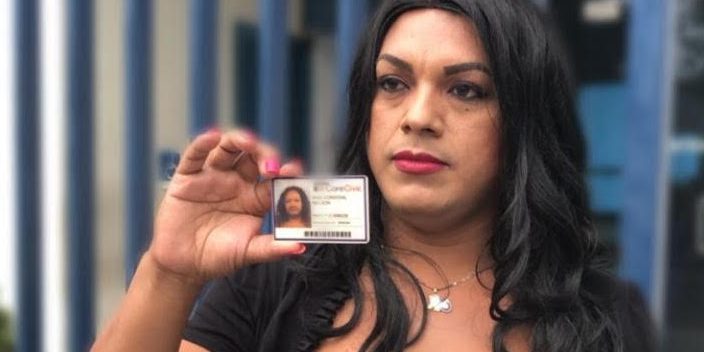
Both were detained in San Diego for three months at the CoreCivic or Corrections Corporation of America center, which is a company that owns and manages private prisons and detention centers.
The trans women were detained alongside the men because security officers told them they weren't women. The only time they shared moments in the detention center was during meals; during those times, Camila told them she felt desperate to live in that cold place.
Camila told him about the mistreatment, mockery, and harassment by the center's officers and other migrants who were in the same situation.
“The officers were always telling us, and sometimes people discriminated against us, because they said that we were men, not women, that we couldn’t be with women because we weren’t women,” Paola said.
 Forced to return to her country
 Forced to return to her country
Paola said that immigration officers pressured Camila to sign the deportation order, telling her that there were days when they didn't give her food as a method of pressuring her to agree to endorse the document that would return her to the country she was fleeing.
Camila gave in to the pressure and finally signed her deportation, despite not understanding the content of the document because it was written in English and the officers did not provide her with a translator.
Camila returned to El Salvador on November 7, 2017, two days before her 27th birthday. According to the General Directorate of Migration and Foreign Affairs of El Salvador, the United States deported 14,902 people during 2017.
One of them was Camila. She returned to the harsh streets of San Salvador and was murdered a year and three months after being released. The threats against her were carried out on January 30, 2019, the day she disappeared, was beaten, and thrown onto the road where she awaited death.
Paola cries as she remembers that her travel companion is dead.
“I don’t even want to remember because it has hurt my soul so much, I loved her like a sister, we lived through many things from Mexico to inside (the detention center) that just remembering her hurts me a lot,” Paola expressed with tears in her eyes.
Now Virginia and Paola have joined forces to demand that the Salvadoran state investigate and punish those who murdered Camila.
We are present
We are committed to journalism that delves into the territories and conducts thorough investigations, combined with new technologies and narrative formats. We want the protagonists, their stories, and their struggles to be present.
SUPPORT US

FOLLOW US
Related notes

We are present
This and other stories are not usually on the media agenda. Together we can bring them to light.