

2018: Guatemala on alert and in debt to LGBTI+ rights
2018 was a year of setbacks for LGBTI+ people in Guatemala: alert over anti-rights advance.

Share

By Pilar Salazar Argueta, from Guatemala
Illustration: Florencia Capella
In 2018, the gaps in achieving justice and equality for the LGBTIQ+ community in Guatemala were significant. This year was marked not only by a lack of political will to protect rights, but also by the predominance of actions by a patriarchal state that promotes laws that violate Universal Human Rights.
Such is the case of initiative 5272, the “Law for the Protection of Life and Family .” It was proposed on April 26, 2017, by a group of representatives, led by Aníbal Rojas Espino, who also chairs the Women's Commission in the Congress of the Republic. This initiative—which is about to begin its third reading for approval—seeks to :
- Prohibit the dissemination of information about sexual and gender diversity in public and private schools and institutes.
- The express prohibition of marriage between people of the same sex .
- Penalties of 5 to 10 years for women who decide to voluntarily terminate their pregnancy and those who have had an involuntary spontaneous abortion.
This group of representatives represents the interests of the National Evangelical Movement, which drafted the initial proposal for the initiative and gathered 30,000 supporting signatures. This is yet another indicator of the growth of evangelical churches in the country. It is considered a potential key issue in the upcoming 2019 elections.
READ MORE #Guatemala Alert over a law against the rights of women and LGBTI people
A bill to punish hate crimes
In response to this situation, Sandra Morán, the first openly lesbian member of parliament, drafted a counterproposal with her party, Convergencia : Initiative 5278, the "Law to Punish Hate Crimes." However, it has not yet entered its first debate in Congress.
What happened to the Gender Identity Law initiative?
In 2018, amidst the obstacles and direct struggles faced by the LGBTIQ community in Guatemala, Representative Morán introduced the "Gender Identity Law" initiative on February 22. It establishes the right to legal recognition and a name based on gender identity and expression.
READ MORE #Guatemala The congresswoman fighting alone for LGBT rights
However, it received an unfavorable opinion and was not considered by the full Congress. This is attributed to the fact that one of the members of the Standing Committee on Legislation and Constitutional Matters is the main proponent of initiative 5272, along with the committee's president, Fernando Linares Beltranena.
Why Guatemala is not a safe country for LGBTI people
The Inter-American Commission on Human Rights (IACHR) had already warned in 2015: “ Guatemala is not a safe country for people belonging to the LGBTI community.” To find ways to close these gaps, the first Central American Forum on the Rights of LGBTIQ People, organized by the Visibles Collective, was held in Guatemala in November.
This forum resulted in a report containing the presentations of various human rights activists in Guatemala and Central America . Among its conclusions, it identifies a setback in LGBTIQ+ rights , attributing it to a social phenomenon: the growth and influence of evangelical churches and other religious groups on the politics and institutions of the region's countries .
READ MORE: “Ideology of hate” against LGBT people is advancing in Latin America
According to the Visibles report, Guatemala has an evangelical population of 41%, the highest in Central America. The report states that from January to October 2018, 24 human rights defenders were murdered in Guatemala (according to data from the Guatemalan Unit for the Protection of Human Rights Defenders (UDEFEGUA)). Among them was trans activist Ana Greysi López.
Murders and assaults in 2018
Ana Greysi López, an activist from the municipality of Coatepeque (Quetzaltenango), was murdered in September. No media outlet covered her death. The organization OTRANS Reinas de la Noche (Queens of the Night) remembered her with this statement: “Reinas de la Noche expresses its deepest sorrow for the irreparable loss of Ana Greysi López, a trans woman from Coatepeque who in recent years collaborated closely with our organization, serving as a role model for her municipality since 2016.”
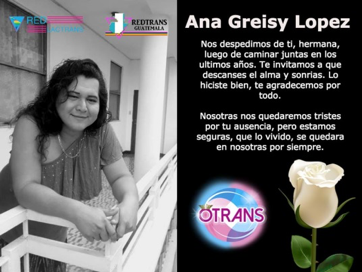 Photo: Facebook/Otrans Guatemala
Devora Ramos, originally from the Department of Chiquimula, was murdered in the early morning hours of September 22. She was also a member of the Reinas de la Noche (Queens of the Night) organization.
 Photo:Facebook/Otrans Guatemala
On November 11, the body of a 22-year-old transgender woman was found in the bushes in the municipality of Siquinalá, Escuintla Department, with a gunshot wound to the head. Only one media outlet covered the death, and it did so without any sensitivity or respect. To this day, her name has not been made public.
According to the study “Violence against LGBTI people: the case of Guatemala City” prepared by MercyCorps through the Convivimos project and Flacso: “the media are a key factor in the news that is disseminated about LGBTIQ people. This information is received by readers or viewers and processed according to the culture and ideologies in which they were socialized , making the media a vehicle for aggression and polarization or for the accurate reporting of these crimes and aggressions.
On December 21, Luis Pedro Villela and Roger Azurdia were victims of an attack in the early morning hours at a fast-food restaurant near a middle-class neighborhood, motivated by their sexual orientation. They have filed a report with the Public Prosecutor's Office, fearing for their lives. Visibles, a human rights organization, demanded that the Guatemalan Public Prosecutor's Office conduct "an effective investigation to identify and punish those responsible. We deserve a society free of prejudice and violence."
"Lack of trust in institutions"
The Human Rights Ombudsman's Office reported 28 complaints this year, 14 fewer than last year. Activists interpret this figure as "an indicator of a lack of trust in institutions or a decline in the culture of reporting," they say.
According to a source close to the matter, the Public Prosecutor's Office has included a section in its complaint forms since 2016 to specify whether the affected person is part of the LGBTIQ community. If the person is a trans woman or a cisgender/lesbian, the case is referred to the Women's Prosecutor's Office; in other cases, it is referred to the Comprehensive Victim Support Model or the Common Crimes Prosecutor's Office.
Share
We are present
We are committed to journalism that delves into the territories and conducts thorough investigations, combined with new technologies and narrative formats. We want the protagonists, their stories, and their struggles to be present.
SUPPORT US

FOLLOW US
Related notes


We are present
This and other stories are not usually on the media agenda. Together we can bring them to light.