

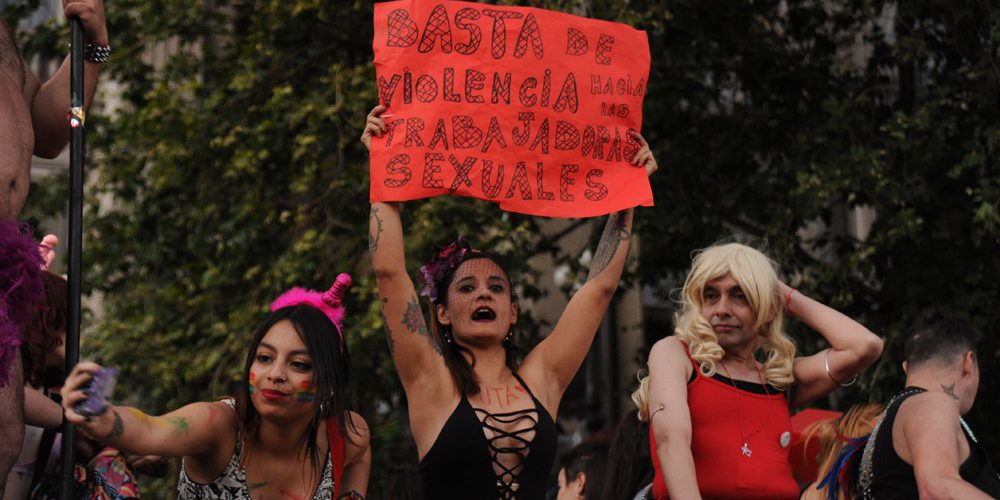
A law to provide redress for sex workers who are victims of institutional violence.
It is an initiative of the Association of Prostitute Women of Argentina (Ammar) and was presented at the request of the deputy of the Social and Popular Front Carlos del Frade in the provincial Legislature.

Share

LC
It was 1996, and Jackeline Romero and other trans, transvestite, and cisgender women were standing on the corner of Provincias Unidas and Casilda streets (Rosario, Santa Fe province) when a group of police officers got out of a patrol car. They all started running in any direction they could. Jackeline was grabbed by the hair, beaten, and a judge sentenced her to 90 days in prison. “This kind of thing happened to us,” the trans activist from Red Diversa Positiva told Presentes.
To redress the institutional violence suffered by Jackeline and hundreds of other sex workers in the province of Santa Fe, a bill has been introduced proposing a pension equivalent to twice the current minimum pension in that province. This initiative, proposed by the Association of Sex Workers of Argentina (AMMAR), was presented to the provincial legislature at the urging of Carlos del Frade, a representative from the Social and Popular Front.
[READ ALSO. Transgender Day of Remembrance: “We also want truth and justice”]
For Romero, this is a fundamental reparation because many trans women were not included in the historical reparations granted by the dictatorship, “but when it ended, many of us continued to suffer violence. I was 14 years old in '84 and I couldn't go out on the street because they would arrest me for dressing differently. I suffered a lot of things that bring back horrible memories. This law is extremely important because it redresses the institutional violence that we suffered and continue to suffer. The police still harass us, demanding bribes; we continue to be assaulted and abused by the police and the community,” she said.
According to a census conducted by INADI and INDEC in 2012, 80% of transgender and transvestite women are involved in prostitution. Seven out of ten would like to break free from this connection. Furthermore, over 80% have suffered police violence. In Latin America, the life expectancy of a transgender or transvestite person is 35 years, while in Argentina it reaches 40.
Code of Offenses
The financial compensation is intended for those who identify as sex workers and who suffered violence at the hands of corrupt elements within the provincial police force while the codes of conduct were in effect, that is, until June 10, 2010, Del Frade told Presentes. “Those who report institutional violence will be entered into a registry that should operate within the provincial gender secretariat to receive a non-contributory pension as historical reparation,” the legislator added. He clarified that this will not be incompatible with other pensions, such as the one granted under Provincial Law 13,298, which establishes a monthly pension for individuals who can prove they were “deprived of their liberty for political, union, or student-related reasons” between March 24, 1976, and December 10, 1983.
“This law denounces the hypocrisy surrounding the exploitation of women. These women bear the marks of this hypocrisy on their bodies. Democracy has failed to construct a sincere discourse about the degree of institutional violence these women have suffered. And it is very important because it aligns with three reparations: human rights, gender equality, and labor rights,” said Del Frade.
Provincial state debt
Georgina Orellano, head of Anmar, explained that some sex workers, some over 30 years old, are now facing the prospect of returning to work. They expressed concern about the potential for abuse and what policies the union could implement at the provincial level to provide redress. “They feel the provincial government owes them a debt, and this debt cannot be settled simply by repealing the codes of conduct.”
[READ ALSO: #24M “The faggots”, memoirs of the repression of gays and trans people]
The legal framework allows this bill to be introduced only in provinces where the relevant codes of conduct have been repealed. These codes are still in effect in 17 provinces. “We have to work hard to repeal these regulations that allow for the arbitrary arrest of sex workers on the streets,” she said. She added that sex workers from Entre Ríos, Buenos Aires, and Santiago del Estero are interested in learning about the bill, adapting it to their provincial regulations, and finding a legislator who can implement it.
“The State has to take responsibility. It is a debt of democracy to repair all the damage that sex workers have suffered,” Orellano added.
We are present
We are committed to journalism that delves into the territories and conducts thorough investigations, combined with new technologies and narrative formats. We want the protagonists, their stories, and their struggles to be present.
SUPPORT US

FOLLOW US
Related notes


We are present
This and other stories are not usually on the media agenda. Together we can bring them to light.