

Transgender Day of Remembrance: “We also want truth and justice”
The members of the Trans Memory Archive tell their story of exclusion, dungeons, and forced exile, but also of joy and resistance.

Share

By Paula Bistagnino
Any trans woman who is over 40 or 45 today is a survivor. There is no precise age cutoff, but there is a shared history: the 70s, 80s, and 90s were years of confinement, persecution, and exile for them. “While for the rest of Argentine society the (military) dictatorship ended in 1983, for us it continued for another 15 years,” says María Belén Correa, creator of the Trans Memory Archive.
Until 1998, Argentina had in effect the so-called "police edicts" which—among many other things—criminalized transvestism and prostitution. "These were two articles that allowed the police, in the Capital and Greater Buenos Aires, to arrest us simply for going out in the street wearing 'clothing of the opposite sex.' This tool of persecution and criminalization led us to a life of confinement and clandestinity, which in turn left us invisible in society," Correa adds.
It was during that time of resistance that her friend and fellow activist María Pía Baudracco—it was during the early years of the Association of Transvestites of Argentina, which would later become ATTTA—began collecting photos and objects to eventually create an archive that would tell their story. “Today, this ever-growing archive is much more than our memory. It is the starting point for building our truth and demanding justice. For us, who survived, and for those who did not. We too want Memory, Truth, and Justice.”
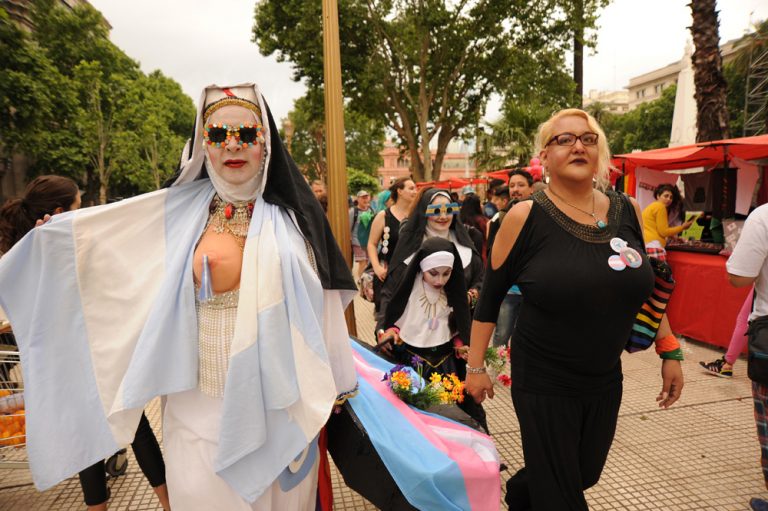
María Belén Correa at the Pride March.
What are we talking about when we talk about trans memory?
Magalí Muñiz is 54 years old and is one of the members—and a key figure—of the Archive. She grew up in Tigre, Buenos Aires province. At 14, she transitioned. “I went through everything: I was imprisoned, I was in police station holding cells, I was also in jail and in a psychiatric hospital,” she says.
For her, “trans memory” is a sum of personal and individual stories that make up a collective memory: “Each one lived what she lived, but we are all marked by the same pains and exclusions. Because all of us who lived through that time experienced more or less the same things: we crossed paths at birthdays, at wakes, on the road, in jail, at carnivals, and in exile,” she says.
“What they could never take from us was our joy,” says Ivana Dominique Bordei, who doesn’t reveal her age but does say she is a sex worker and a proud trans woman. She travels back to her childhood in Libertador General San Martín, Jujuy, to the house where she was happy until she began her transition. “Our stories are all intertwined with the same thing: if you look through our memories, it’s a cemetery. Almost all of them are dead. But we are also marked by the joy and pride of being who we are. That’s what made us survive, fight, and resist.”
Magalí agrees: “I would go through everything I went through again to be who I am.”
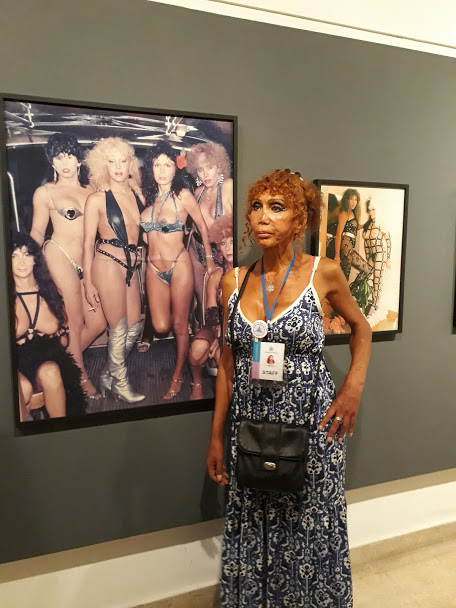
Magalí Muñiz and a photo from some carnival in the 90s.
“Exile was the freedom to walk down the street.”
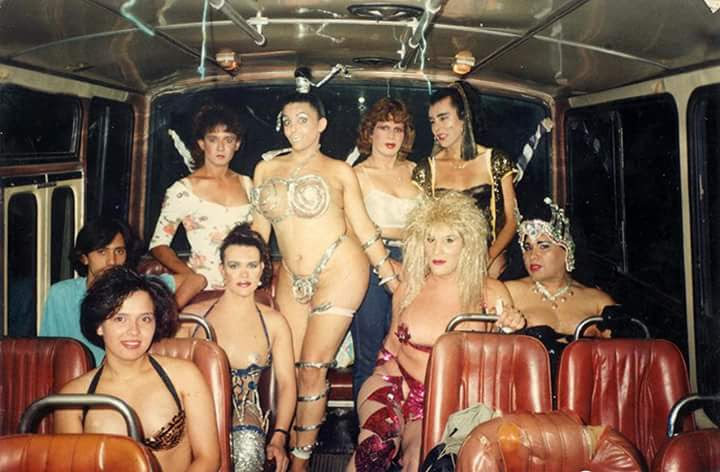
The photos from exile are joyful: they show them topless on a lake in northern Italy, asleep on a local train, having a drink in a bar, playing in the snow. “Here we couldn’t do any of those things. Because we couldn’t go out on the street. If I went out to see the snow here, for example, they could arrest me. Falling asleep on a train was almost like committing suicide. Going topless on a lake was an unattainable fantasy. In exile, we discovered freedom,” says Correa.
Carla Pericles is 64 years old and spent more than 20 years in exile in Italy. “Before I left, I didn’t know what it was like to walk down the street without thinking that I could end up in jail just for going to the kiosk to buy cigarettes.” In addition, for her, exile was an opportunity to reconstruct her own memory: and it was even during a vacation in Spain that she accidentally discovered she had been detained in a clandestine center during the military dictatorship: “On vacation in Barcelona, I went into a bookstore and found a book by Jacobo Timerman called 'Cell Without a Number,' something like that. I bought it. And that's when I discovered that the 'COTI Martínez' had been a detention center, and he wrote that when he was imprisoned there, he saw 'women of loose morals cleaning.' That was us! Because at that time we didn't have a legal status, but they took us anyway: they picked us up to clean the police station. And they wouldn't let us near a courtyard where there were skylights that emitted a foul smell. They wouldn't let us near it. Reading the book, I realized it was the basement where the detainees were held.” The “procedure” was repeated every two or three days: they were picked up, made to clean, and then released. “At least that was the case there and with the ones they took me. I’m sure there are cases of other women who weren’t released.”

In exile. (Photo: Trans Memory Archive).
Waiting for carnival
In Argentina, there was only one time a year when they could go out without risking ending up in jail: during Carnival celebrations. “Those were the only moments of total fun and freedom. Fun without fear,” says Magalí. It wasn't that they didn't have fun: within four walls, inside someone's house, or in a room at a boarding house, among themselves and protected from the police, there was always joy. But going out on the street was always a risk, even to go to the corner store or catch a bus, even without makeup or high heels. “But during Carnival… It was our day, the day we could go out and show ourselves and be free. It was a day of celebration,” says Magalí. Although she clarifies: “Up to a point, because sometimes the parade would end, the street band would finish, and there would be a van, a truck, or a bus waiting to take us away.”
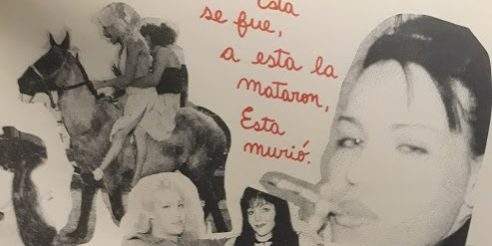
 She left, she was killed, she died
 She left, she was killed, she died
The phrase emerged while they were scanning and organizing photos: “This one left, this one was killed, this one died.” That was the name of the first major exhibition they held of the Trans Memory Archive at the Haroldo Conti Cultural Center for Memory – which operates in the former ESMA, at the end of 2017.
“It was a phrase that was also repeated among us at that time: when one was arrested, she entered the cell and when she asked about someone, there were three possible answers: “This one left, this one was killed, this one died,” says Ivana.
Carla says that working to build a trans memory—in her case, through the Archive—goes far beyond mere remembrance: “It’s a moment of rediscovery for us, often a time of reconciliation, with ourselves and with each other, but we also have the goal of justice.” And that’s why, she adds, recovering memory is a painful but also necessary task: “For those who left, for those killed by the dictatorship, for those killed by police repression. Also for those of us who went into exile to survive. That needs to be told so that all of society knows.”
Carola Figueredo, the most recent addition to the Archive, concludes: “This is a story that needs to come to light. We have to come to light. For society, which doesn't know us. Which knows nothing about us. We suffered greatly, unjustly, because society lived and continues to live with a mistaken perception of us. We want the whole truth about what we went through to be known, so that new generations can see it and continue fighting to ensure this never happens again.”
We are present
We are committed to journalism that delves into the territories and conducts thorough investigations, combined with new technologies and narrative formats. We want the protagonists, their stories, and their struggles to be present.
SUPPORT US

FOLLOW US
Related notes



We are present
This and other stories are not usually on the media agenda. Together we can bring them to light.