

Transgender employment quota: registration is now open at the Municipality of Santa Fe
The ordinance establishing, among other things, the hiring of at least five transgender people per year into local public sector jobs has begun to be implemented. Fifty people have already registered. Meanwhile, the provincial law is awaited by Victoria Rodríguez. The transgender employment quota is one of the central demands…


Share

The ordinance mandating, among other things, the hiring of at least five transgender people per year into local public sector jobs has begun to be implemented. Fifty people have already registered. Meanwhile, the provincial law is awaited.
By Victoria Rodríguez
Transgender employment quotas are a central demand of the LGBTQ+ community across the country. In Santa Fe, the provincial bill is awaiting Senate consideration, while various cities are moving forward with local regulations to guarantee this right. In the capital, for example, the Single Registry of Applicants (RUA) was opened for the first time. This is the first step established by Ordinance No. 12,522 (passed on June 28) to facilitate the hiring of five transgender, transvestite, or transsexual individuals per year by the Municipality.
Transgender individuals interested in applying should visit any of the city's Job Training Centers with their identification to complete the corresponding form. They have until December 1st to register in the RUA (Single Registry of Applicants), the tool used to determine who will participate in municipal job openings and other hiring processes starting in 2019.
“We are very pleased because these are steps being taken to expand the rights of transgender people. We are also working to ensure that everyone who registers can learn about and join the Job Training Schools, which are programs offering a wide range of educational and employment opportunities, as well as promoting rights through culture and sports,” Rocío Giménez, Undersecretary of Social Action for the Municipality, told Presentes .
The only requirement to register is being over 18 years old. A high school diploma or legal gender change on your national identity document is not required. This last point is explicitly stated in the ordinance passed by the City Council on June 28th, which was based on two proposals submitted by various local LGBTQ+ organizations. The goal is for the RUA (Single Registry of Transgender People) not only to register transgender individuals interested in employment but also to facilitate the dissemination and development of training programs that address the interests and needs of this community.
In fact, Article 6 of the ordinance establishes, among other things, that the municipal Executive must work with other agencies and with the private sector to promote access to work for trans people and to support "the labor and educational resources that are made available to transvestite, transsexual and transgender people."
To get to know the population better
The RUA (Single Registry of Transgender People) is a key tool not only for identifying job applicants but also for learning more about the city's trans population. Victoria Stéfano, a gender representative from La Poderosa (Chalet neighborhood), explained to Presentes that "it will serve as a census, allowing us to centralize information on a segment of the population that has not yet engaged with the government in any way, neither through scholarships from the Provincial Undersecretariat of Diversity nor through the Municipality's Women's Area. This allows us to begin to understand the true number of transgender people in Santa Fe."
When asked why some trans people haven't yet engaged with the government at its various levels, Stéfano suggested that, within the trans community's social consciousness, there are still doubts about whether or not it's useful to take advantage of the inclusion programs offered by governments. "On the other hand," she added, "I think there's still a lot of work to be done to stop thinking of the state as a persecutor or an oppressor and start seeing it as a tool for organizations and citizens."
Access to work
The Santa Fe Trans Roundtable has been monitoring and promoting progress in implementing the trans quota in the city since the first draft ordinances were presented two years ago. Therefore, when it was announced that registration was open, sign-ups came quickly. Fifty applicants registered in three business days. Nevertheless, Giménez estimated that the first appointments would take place in February 2019.
The regulation mandates that, each year, at least five transgender people be appointed as permanent, temporary, and/or contract staff, provided they meet the job requirements. In this regard, Stéfano noted that these new hires will be monitored to ensure, for example, that they do not end up in precarious employment with contracts that are renewed annually without being given permanent positions when they are due.
“The quota is a symbolic tool for those girls who today don't dare to begin or resume their education. At least now they can have hope that if they finish their studies they can aspire to a job. But it's also a form of reparation for the 30 years of democracy in which the State persecuted us,” the trans activist concluded.
 Half measures
 Half measures
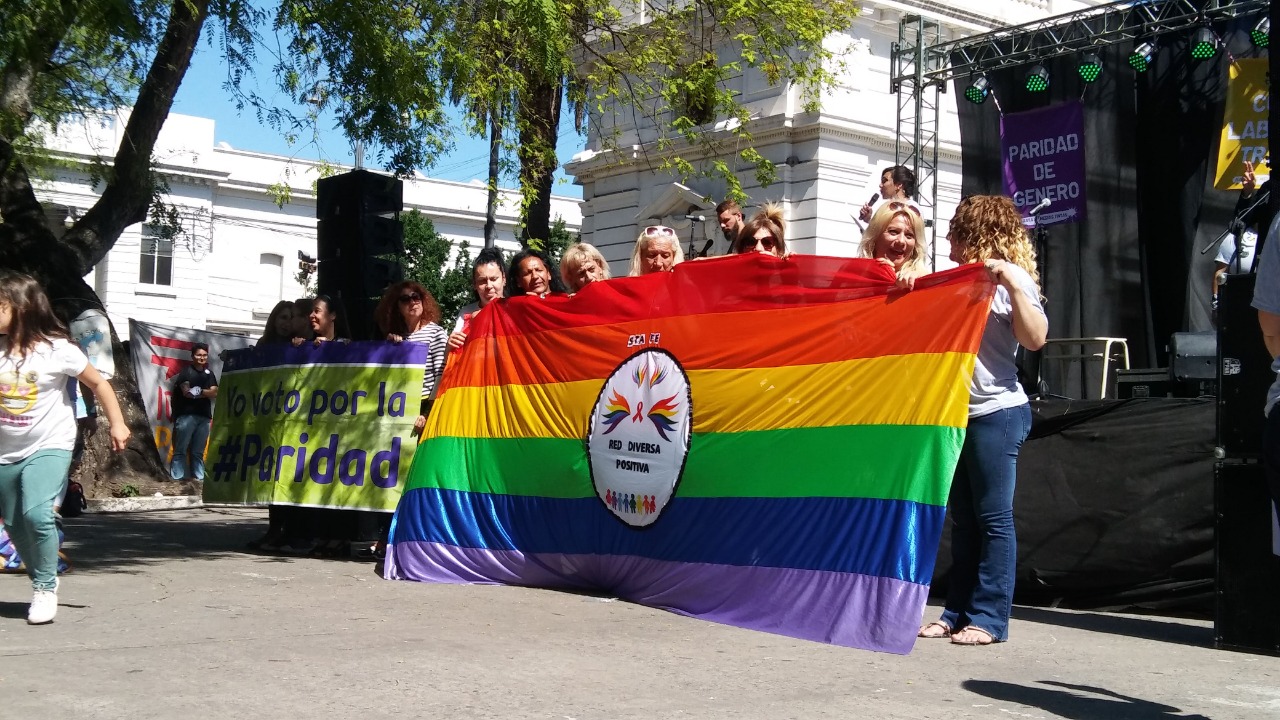
Last Thursday, the "Enough Half Measures" festival was held at the entrance to the provincial legislature, demanding that the Senate approve three laws: a trans quota, comprehensive sex education, and gender parity. The event, which lasted over six hours, brought together families and feminist and LGBTQ+ organizations to highlight that these initiatives only need the approval of the Santa Fe Senate to become enacted rights.
During the afternoon, there were musical performances, puppet shows, and theater presentations that addressed the need for laws that ensure equal opportunities for all citizens. The event also provided an opportunity to explain the content and purpose of each of the proposed laws, aiming to dispel the myths that have been circulating, particularly regarding comprehensive sex education.
The biggest criticism leveled at the Senate—comprised of 18 men and one woman—is its unwillingness to address the three bills, especially given that the gender parity bill will lapse if it is not passed this year. Unfortunately, despite it being a session day, there was no legislative activity, and only a few members of the Chamber of Deputies attended the event and expressed their support for the three bills they had already approved.
From the stage, speaking about the need to achieve a trans employment quota, the speakers declared: “We are not here seeking privilege. On the contrary, we propose this tool for inclusion, for reparation, for recognition. We hope that one day the struggle for the quota will be seen as merely anecdotal, when society as a whole can compete on equal footing for access to the right to work—a right denied to us since the birth of our nation 202 years ago.”
Single Registry of Applicants
- All trans people in Santa Fe who are over 18 years old can register.
- High school completion is not required
- Nor is it required to have the change of identity on the ID card
- The procedure is carried out at the Work Schools: Las Heras 2751 (from 8 to 14); Iturraspe and Estrada (from 8.30 to 18); Entre Ríos 4080 (from 9 to 18); Larrea 1735 (from 8 to 18), av. Facundo Zuviría 8040 (from 8 to 18); Europa 7510 (from 9 to 18); av. Teniente Loza 6804 (from 8 to 16); Aristóbulo Quiroz – Block 5 (from 8 to 14).
We are present
We are committed to journalism that delves into the territories and conducts thorough investigations, combined with new technologies and narrative formats. We want the protagonists, their stories, and their struggles to be present.
SUPPORT US

FOLLOW US
Related notes



We are present
This and other stories are not usually on the media agenda. Together we can bring them to light.