

Buenos Aires: What's happening with the 2018 Pride March?
Four organizations - CHA, 100 por Ciento Diversidad, Mujeres Trans Argentina and La rosa naranja - announced that they are withdrawing from the organizing committee of the Pride March that will be on November 17.

Share

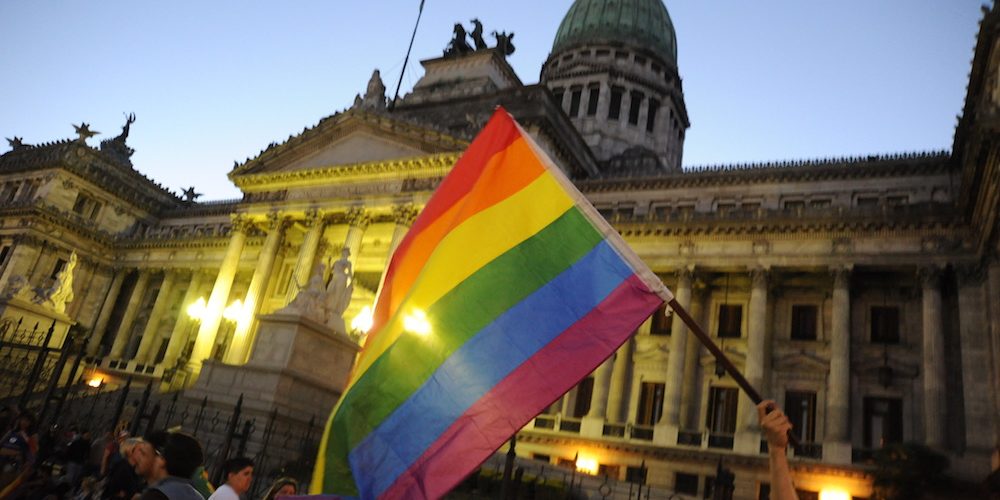
Four LGBTQ+ groups announced their withdrawal from the Organizing Committee of the 2018 Pride March in Buenos Aires. They disagree on the slogans and the direction of the March, which this year will go from Congress to Plaza de Mayo. The Organizing Committee's response and the slogans.
[News updated on October 23]
The Argentine Homosexual Community (CHA); 100% Diversity and Rights; Trans Women Argentina and the La Rosa Naranja Association announced in a statement that they are withdrawing from the organizing committee of the XXVII LGBTIQ+ Pride March, to be held in Buenos Aires on November 17, " due to the loss of the historical spirit of pride and the lack of representation regarding the substantive demands of our community."
The activists who withdrew from the Commission after the statement was released preferred not to speak in their personal capacity and to adhere to the general statement. They argued that this split is a process that began in 2016, when the march ended abruptly after attacks. This was compounded by the lack of a stage last year. But the crux of the disagreement is that the organizing committee only addressed sex workers and not transvestite and trans people who consider themselves victims of sexual exploitation and demand a transvestite and trans job quota. Transvestite and trans people in Argentina have an average life expectancy of 35 years, and 80% find prostitution to be their only means of survival.
“In this context of violence against our community and economic policies that harm the most vulnerable sectors, we are pushing for a debate on trans and travesti employment quotas in the National Congress, raising the banners championed by Lohana Berkins and Diana Sacayán, among so many other trans leaders,” reads the statement from those who withdrew. They are calling for a
festival in Plaza de Mayo on Saturday, November 10th, at 4:00 PM.
The Pride March Organizing Committee (COMO) also responded to the criticism through a statement , where it expresses: “According to our comrades in COMO there is an . ” This is not true: at the explicit request of our trans comrades, the main slogan of this March begins with “Stop the trans-travesti genocide,” and one of the agreed-upon sub-slogans prioritizes the “Approval and effective implementation of the job quota for trans-travesti people throughout the country .” What this COMO did agree on was to discard the expression “ people in situations of prostitution ,” which is highly stigmatizing and discriminatory towards both cis and trans sex workers. But this specific disagreement—between just two people in a meeting with more than 60—in no way justifies the crude accusations against this COMO, which we categorically reject, of “lack of representativeness , “loss of historical spirit , “sectarian dynamics , “not being up to the task,” or that “it alienates us from our people, deteriorates representation, and fosters the fragmentation of our struggle .
The Nadia Echazú Trans Movement, which brings together sixteen organizations and is part of COMO, also issued a statement: "We are concerned about the use of our identities, our mystique and our icons, to generate ruptures caused by third parties with not so clear purposes," it begins. And then they explain their position: “From the very first meeting of the Pride March Organizing Committee, our organizations and our front, composed solely of trans/travesti people, promoted the main slogan, ‘Stop the trans/travesti genocide.’ Understanding that it is essential to make visible the extermination suffered by our population and their short life expectancy. This proposal does not negate or supersede all the others; we continue to demand the Trans Quota Law, the Historical Reparation Law, and other laws for our community.” And they conclude: “To speak the truth, and to be present in every space where power is contested, where we are mentioned, where we are discussed, where we are considered, is the commitment we owe to Lohana, Diana, Claudia Pía, Nadia, and so many others who gave their lives so that we can live better.”
For her part, María Rachid, general secretary of the Argentine Federation of Lesbians, Gays, Bisexuals and Trans (FALGBT), agreed to speak with Presentes in her personal capacity and not on behalf of the organizing committee she is part of: “These organizations proposed a slogan that referred to women in prostitution, and the other organizations disagreed. In fact, all the trans people and sex workers disagreed with the slogan.”
Another argument of those who withdrew from the COMO was that with so many slogans – there are 22 – “there is a dispersion and the political content” of the March is lost.
In the statement released by the Organizing Committee, the response to this is that “the set of demands agreed upon by the COMO for this March on November 17th clearly expresses the historical and present demands of our community, summarized in the central slogan: “Stop the trans-travesti genocide. No to austerity, violence, and discrimination. Macri and the Church are anti-rights.” Therefore, they cannot accuse us of the COMO’s operation being “dangerous and functional to those who want to undermine our rights” when we explicitly denounce them.”
Change of direction of the route
The four dissenting organizations are also against changing the direction of the march, which historically started in Plaza de Mayo and ended at the Congress building, as a gesture of demanding rights from the Legislative branch. The organizing committee proposed reversing the route.
Regarding the change of direction, Rachid adds that this "was discussed in the first meetings" and that "while Jáuregui had previously stated that it's necessary to go to Congress because that's where laws are made, nowadays, with this political context, it's difficult for diversity laws to be passed. The important problems for the LGBT community have to do with public policies of the national government and with the Catholic Church."
The organizations that withdrew from the organizing committee argue that the Pride March belongs to everyone, not just the organizing committee, and that these changes serve the political power that "advances against our rights."
COMO, on the other hand, argues: “We can change the routes of the marches or the way we express our demands. What we cannot change is the political will, or lack thereof, to build unity in diversity, which COMO reaffirms has been and will continue to be the guarantee of our achievements. With this conviction, we continue working and calling everyone together for the 27th LGBTIQ Pride March, which we will hold on Saturday, November 17th, to once again flood the streets of Buenos Aires with all the joy, color, strength, and demands of our community.”.
What will be the slogans of this Pride March?
Slogans of the Festival in Plaza de Mayo on November 10th
All for the Diana Sacayán National Transgender Employment Quota Law.
#DiversityIsNotAdjustable
Medications and a new law on HIV, Hepatitis, and STIs.
Implementation of Comprehensive Sexuality Education!
Stop institutional violence
New anti-discrimination law to educate against sexism, xenophobia, and racism.
Organized by:
Argentine Homosexual Community – CHA.
100% Diversity and Rights
of Argentine Trans Women – MTA.
Anti-Discrimination Liberation Movement – MAL.
The Orange Rose
of Greater Buenos Aires for Diversity
We are present
We are committed to journalism that delves into the territories and conducts thorough investigations, combined with new technologies and narrative formats. We want the protagonists, their stories, and their struggles to be present.
SUPPORT US

FOLLOW US
Related notes


We are present
This and other stories are not usually on the media agenda. Together we can bring them to light.