

Protest outside the courthouse: "They kill us for being trans and the State is responsible"
Trans groups protested in front of the courthouse: "They are killing us. The state is responsible. We demand justice."

Share

By Agencia Presentes
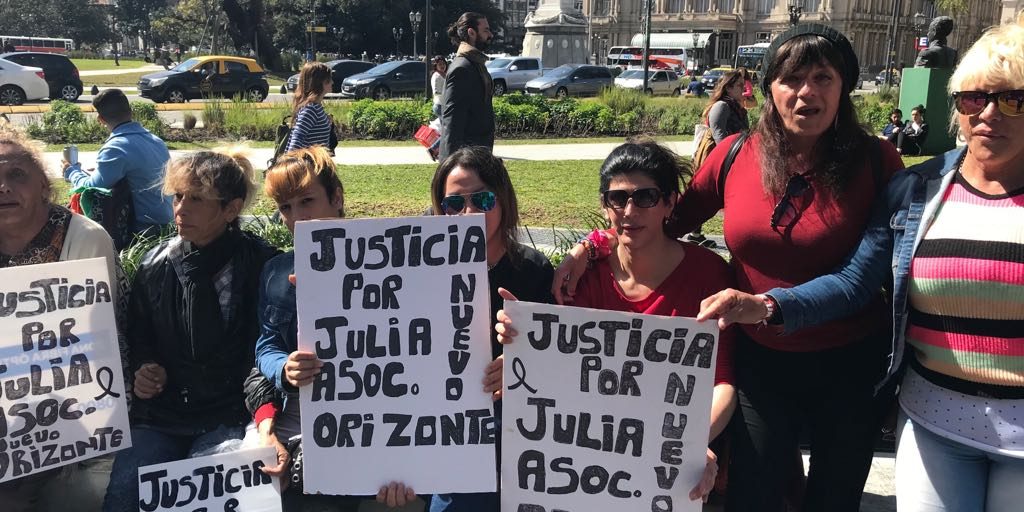
(Buenos Aires) Starting at noon, the plaza in front of the Palace of Justice in Buenos Aires was adorned with the faces of dozens of trans and travesti people murdered in the last two years . This was part of a mobilization organized by trans and travesti collectives under the slogan, “They are killing us for being trans people. The State is responsible. We demand justice.” The fences surrounding the courthouse were draped with flags in the rainbow colors and the blue and pink of the trans flag. Hanging from them were the faces and names of victims of all kinds of violence. One of the most recent victims was Julia Ponce, 65. From Tigre came her friends and comrades, who still believe her death remains unsolved. “She was a survivor, like some of us who are in our sixties. We were arrested and tortured during the dictatorship. Now they've killed her and nobody is doing anything,” her friend Julieta González told Presentes. The gathering was organized by trans and travesti collectives, grouped under the Nadia Echazú movement. “We are here to tell the State to stop killing us. What it has done to our identities is a systematic and violent genocide, which means our life expectancy doesn't exceed 40 years. Our comrades can't keep dying, and on top of that, nobody can know,” said Paula Arraigada, one of the members of Nadia Echazú. “We demand a trans job quota , but also historical reparations . And we wonder what will happen with the closure of the Ministry of Health and the lack of access to HIV medication for so many of our trans sisters living with the virus,” Arraigada added.
 “Today we are here protesting the hate crimes against trans people. We are the ones who are not against sex work,” clarified Marcela Romero, general secretary of the Association of Transvestites, Transsexuals, and Transgender People of Argentina (ATTTA) and president of the Argentine Federation of Lesbians, Gays, Bisexuals, Transvestites, Trans, and Transgender People (FALGBT).
 At the event where a statement was read, Romero was one of those who spoke, saying: “We have an absent State, without public policies for the trans population. The only thing it does is create protocols to repress us.” “We need public policies so we can live with the rights we’ve achieved.” Romero said that despite the progress brought about by the Gender Identity Law, “we are experiencing setbacks, which continue to claim the lives of our sisters who fight on street corners through sex work, but who demand to be part of the public policies we don’t see. We need to be united to tell the Justice system, ‘Enough of impunity!’”
 “They are killing us, and the State is responsible for the deaths through both action and omission,” said Melisa D’Oro. About 200 people participated in the demonstration in front of the courthouse—the same place where the historic sentence for the transphobic murder of Diana Sacayán . Among them was a group of Mothers in Struggle, members of the National Campaign Against Institutional Violence. “We are here supporting our trans sisters. The state is responsible for the deaths of these women in this slow, insidious genocide.” “We stand in solidarity with the women who are also with us, united in the struggle to stop this from continuing,” Miriam Medina, Sebastián Bordón’s mother, told Presentes.
 One of the day’s key demands was for investigations into hate crimes and for convictions for the murders of trans women and trans people, because “the killers are still walking free and attacking us in our workplaces.” The organizers reported that in addition to the mobilization in Buenos Aires, trans women living in other countries would deliver a document demanding justice to the Argentine consulates in New York, Rome, and Paris.
 “It is necessary to denounce police bribery and persecution. We’ve gone back to the 80s and 90s; they arrest us, extort us, and mistreat us. We cannot go backward; we cannot return to the misdemeanor codes that were so hard-won. It is necessary to demonstrate, to be in these places, and to be seen.” “I want to shout at these gentlemen there in the courts: the prisons are filling up with our sisters for minor offenses, to whom judges give five-year sentences, while people convicted of serious crimes are released in 24 hours,” Romero declared as she took the floor at the event.
 She recalled the history of struggle of trans and travesti collectives. “Here I see sisters from Tigre who fought inside the cells in the 70s and 80s to be released. And they are still standing here after 40 years, demanding their freedom, respect, and human rights again.”
We are present
We are committed to journalism that delves into the territories and conducts thorough investigations, combined with new technologies and narrative formats. We want the protagonists, their stories, and their struggles to be present.
SUPPORT US

FOLLOW US
Related notes


We are present
This and other stories are not usually on the media agenda. Together we can bring them to light.