

“Unstoppable”: the book that tells us about LGBTI rights in Latin America
By Lucas Gutiérrez. “Unstoppable” is an ebook that serves as an X-ray of organizations, media outlets, and the state of LGBTI+ rights in Latin America. It was published by Distintas Latitudes, and the research was led by journalist Diego Pérez Damasco, one of its editors. “Distintas Latitudes is a…


Share

By Lucas Gutiérrez
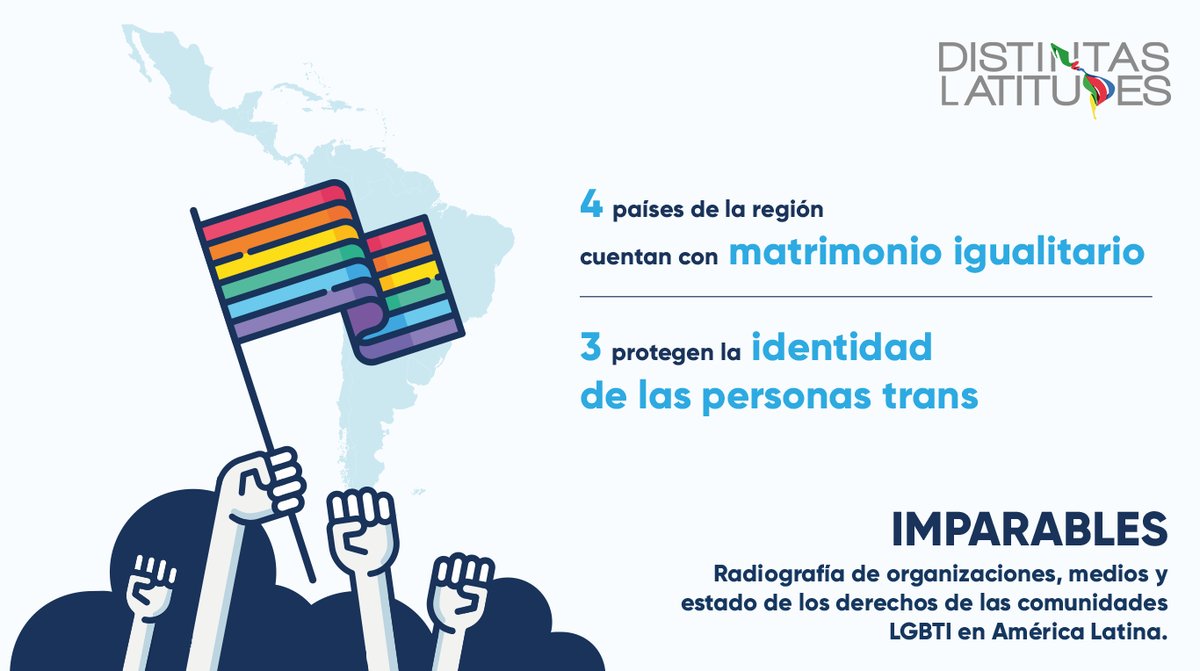
“Unstoppable” is an ebook that serves as an X-ray of organizations, media outlets, and the state of LGBTI+ rights in Latin America. It was published by Distintas Latitudes, and the research was conducted by journalist Diego Pérez Damasco, one of its editors.
“Distintas latitudes is a journalistic project whose mission is to tell the story of Latin America from within Latin America. Often the region is portrayed from the perspective of the BBC or the NY Times, and not from our own countries,” this 25-year-old journalist explains to Presentes.
Of the 20 countries analyzed, only 4 have marriage equality throughout their territory, 2 have some kind of similar legal framework, and only 3 protect the identity rights of transgender people. “I think we have to remember all the progress we've made as a driving force, but keep moving forward because otherwise we'll cease to be unstoppable,” says Pérez Damasco.
Central America
Thinking of Central America as a single, uniform entity is a serious mistake. Damasco explains that it can be viewed from two different perspectives: the northern triangle formed by Guatemala, Honduras, and El Salvador, and the southern part, which includes Nicaragua, Costa Rica, and Panama. “In legal terms, the northern triangle only has the fact that homosexuality is not criminalized, but in practice that doesn't mean much since there are no anti-discrimination laws, and they suffer just as if they were criminalized.” He continues: “Within Latin America, this is the region that generates the most people persecuted for their sexual orientation and gender identity, who must seek refuge in other countries.”
Diego analyzes each country individually and shares as many realities as there are flags. In El Salvador, more authorities recently expressed their willingness to display LGBTQ+ flags during Pride Month. “These are small, symbolic, but important steps forward.” Honduras offers no positive developments, and “in Guatemala, the risk lies in the approval of a law that would give constitutional status to marriage between a man and a woman and prohibit any future recognition of same-sex unions and abortion in any form. It’s called the 'Law for Life and Family,' and the first debate has already passed. It’s a very serious threat and precedent for the region.”
 In the southern part of the region, we have Nicaragua, which is experiencing moments of extreme social tension with more than 200 dead and over 1,300 wounded. “There were LGBTI+ institutions, but the government's alliances with evangelical and Catholic churches have limited everything,” Damasco explains about a country whose government's motto is: Socialist, Solidarity-based, and Christian Nicaragua.
Panama, Costa Rica, and other countries are revisited and analyzed in 'Unstoppable'. Among them is Belize, the Central American country that decriminalized homosexuality in 2016. Yes, two years ago. There are many countries, many realities.
The role of the State
For this Costa Rican, the presence of the State in relation to LGBTI+ populations is complex. “In the Northern Triangle, it is the enemy, sometimes even the perpetrator. In Honduras, after the coup and the resulting lack of control, the Army and the police carried out 'clean-ups.' The murders of LGBTI+ people were horrific,” he explains.
'Unstoppable' paints a picture of progress and harsh realities. In countries like Chile and Ecuador, where civil unions for same-sex couples exist, Damasco says the state hasn't fully assumed its responsibility: “Governments, legislative assemblies, and any state institution are unwilling to openly acknowledge the cost of supporting initiatives that benefit LGBTI+ populations.”
Costa Rica
In January 2018, a month before the presidential elections, the Inter-American Court of Human Rights issued its advisory opinion guaranteeing marriage equality in Costa Rica, among other countries, and the political landscape shifted. Fabricio Alvarado, the candidate for the conservative National Restoration Party (PRN), who had only 2% of the vote in November, surged to the top of the polls after speaking out against the IACHR's decision. Ultimately, in a runoff election against another Alvarado, the writer Carlos Alvarado, he lost, but his party still secured a significant presence and representation in the legislature. This outcome alarmed the LGBTI+ movement; Costa Rica was not as well off as they had thought.
“These anti-rights movements have been building their foundations. Evangelical churches are filling the void left by states, civil society, and even the Catholic Church itself, and it's very complex because they approach people and those in power with anti-scientific and anti-educational positions that not only harm human rights issues but everything in general,” Diego explains.
Unstoppable
“Although the outlook is somewhat bleak in several cases, I believe the title 'Unstoppable' reflects the significant progress made in legal terms and in terms of public perception. This progress is what has driven these anti-rights groups to such desperation, prompting them to organize in order to counteract the advance of what seemed inevitable,” says Diego, looking at the ebook that shares the experience in more than 20 countries.
The ebook is available for download on the Distintas Latitudes website. A resource for contacts and a space for connection in this reality that, if it needs anything to move forward, is to forge bonds and networks, 'Imparables' was born as both a voice and a tool. And it continues.
The work of Pérez Damasco and the Distintas Latitudes team is not finished: from now on they enter a stage of updating and adding everything that is happening in the region: "we are looking for how to convert the results into an interactive database with maps and profiles where hopefully the progress can be updated," says this team that continues working and hoping that the LGBTI+ movement continues to be unstoppable.
We are present
We are committed to journalism that delves into the territories and conducts thorough investigations, combined with new technologies and narrative formats. We want the protagonists, their stories, and their struggles to be present.
SUPPORT US

FOLLOW US
Related notes

We are present
This and other stories are not usually on the media agenda. Together we can bring them to light.