

Television and trans identity: the five forms of violence every day
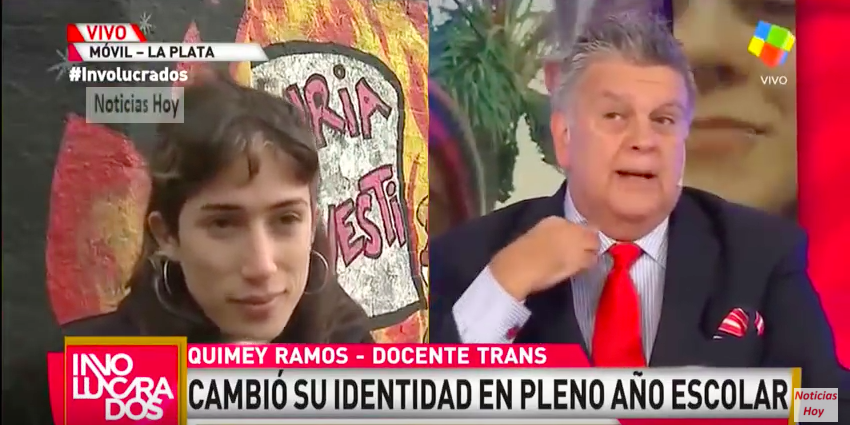
By Quimey Ramos. Last Monday, I was interviewed on the program "Involucrados" on América channel, regarding the trans character played by Maite Lanata in the Telefé series "100 Days to Fall in Love." During the program, we had a heated exchange with the panelists, mainly with Luis Ventura, an entertainment journalist who has been entrenched in television for…

Share

By Quimey Ramos
Last Monday I was interviewed on the program "Involucrados" on América channel, following the discussion about the trans character played by Maite Lanata in the Telefé series "100 Days to Fall in Love." During the program, we had a clash with the panelists, mainly with Luis Ventura, an entertainment journalist who's been entrenched in television for 30 years. This happened because he repeated some prejudices about the trans community that, not coincidentally, I've heard repeated on every program I've participated in. Why does it seem like they're suddenly interested in us?
[READ ALSO: After criticism, Scarlett Johansson will not play a trans man]
This column aims to refute some rather entrenched ideas about the trans community that are prevalent in the media. I want to demonstrate why the statements disguised as ignorance that I heard panelists so casually make are not at all naive, but rather reproduce commonplaces laden with prejudice and violence.
1- “The gender identity law can be used by criminals to conceal their identity, agreeing to undergo physical changes for their benefit”
– The answer is very simple: the ID number and fingerprints remain the same, so there is no room to use the law in this way. However, it is one of the most common arguments used to question the law and suggest the need for some entity to “regulate” it. The answer to what these journalists are asking is what happens in Spain, Canada, parts of the US, the Netherlands, Finland, and even here before the law: if you want the State to recognize you, a mental health professional must make the determination.
[READ ALSO: Gender in media dispute: “They use this to roll back rights”]
But luckily, Argentine law makes it very clear that we base our decisions on self-perception, not on what others see in us, not even what other trans people see. And despite Sergia's case (whose existence I still doubt, given that she was never seen!), I must say that I don't believe transitioning can be a privilege for anyone. I suggest that Luis Ventura and Cinthia Fernández try it one day and go out into the street.
2- “We must seek acceptance”
– This continues the previous discourse. It's the same crap, just in another part of these journalists' gut-brain process. Let's understand that the idea stems from the notion that society (the heterosexual majority), as if it were a castle, has shut us poor trans servants (the minority) out. So, we trans people have to stand in front of the castle gate and say, "Martin (or Luis), the heterosexual, will you let me in?" – "You'll get in, you'll get in, only if you take hormones."
[READ ALSO: What we talk about when we talk about trans beauty]
The idea that we must seek acceptance stems from thinking of trans people as a minority that must knock on the doors of the vast, heteronormative majority to make room for us. We are neither a minority nor outside of society: we are your aunts, uncles, lovers, children, mothers, fathers, grandparents, neighbors, etc. We are in the same geographical space, therefore not outside. But the place we occupy is on the margins, and that is the same reality as that of many others. In this, Luis Ventura was not wrong when he responded to me, “Well, you are not the only ones who have problems,” in an attempt to demand that my complaint join the queue of minorities patiently waiting to be heard. No, Luis: this “minority” experiences the same problems as many other minorities, who, if we all joined together, would constitute the vast majority. The minority that should start waiting and listening is you.
3- “Let’s celebrate that they are now represented on TV”
– It’s true that for many people, especially those far from major cities, a trans character in a series can be a way to connect with our existence. But the fact that it’s portrayed by a cis* person is unfair, not because of who can perform whom, but because, understanding how difficult it is for us to access employment (remember that we demand a trans job quota ), it could easily be a source of work for a trans actor. Furthermore, these characters are “advised” by trans people, but scripted by cis-hetero people: they are still representations of a trans life from a cis person’s perspective. A media standardization of a trans experience, from a cis perspective.
4- “You’re too aggressive”
– Any non-submissive woman who has stood up to a sexist pig knows this. It’s the historical strategy to silence you, to delegitimize your demands: to call you aggressive, intolerant, crazy. From the Mothers of Plaza de Mayo, who were called “the crazy women of the plaza,” to the current dissident and women’s movement where the “feminazi” has emerged. Let’s add a stop to the history of these insults, and pause at the forgotten corner where trans women hang out, and hear the familiar “you’re a crazy man in a wig” echoing back. The answer is simple: comrades, no room for idiots!
5 Why, despite everything, are we getting more attention now?
– There are many factors at play. But there's one I prefer to emphasize, and that's the closet: the closet as an expression that differentiates the private sphere from the public one. Trans people, unlike many gay men and lesbians (not all), haven't had the option of going into the closet, until now. Embracing our identity means always embracing ourselves publicly: from the moment we do, we become visibly present, bursting into the beauty of public space.
But lately, thanks to the advancement of gender technologies, especially hormones and genital, facial, or breast modification surgeries (implants or mastectomies), many trans people have the option of staying out of the closet. The option of not even having to identify as trans. And for it to be a secret, even from your partner (but always an inescapable truth for yourself).
[READ ALSO: When being trans “shows”]
And that's when the media, governments, and hegemonic powers embrace us: I'll give you the key to the castle, in exchange for your willingness to deny yourself. However, let's be clear: there's nothing wrong with modifying our bodies as we wish. The problem is when it becomes a paradigm, and the anxiety and sadness that this society instills in us by demanding it be done quickly and "right.".
I chose to have modified my body, but when I did it, it was more out of a desire to walk down the street feeling safe than to see my body changed. That's why it's not innocent to link the trans experience to hormone therapy, which is what journalists constantly ask about. That's why, when Cinthia Fernández asked about the physical changes, I answered that I want social change.
* person who identifies with their sex and gender assigned at birth.
We are present
We are committed to journalism that delves into the territories and conducts thorough investigations, combined with new technologies and narrative formats. We want the protagonists, their stories, and their struggles to be present.
SUPPORT US

FOLLOW US
Related notes
We are present
This and other stories are not usually on the media agenda. Together we can bring them to light.