

"In Paraguay, healthcare for trans women is clandestine."
Paraguay lacks gender identity laws, and these therapies are not offered in the health system either, so it is believed that the scope of the WHO reclassification will be even more limited in this country, where access to health for transvestites and trans people faces many barriers.

Share

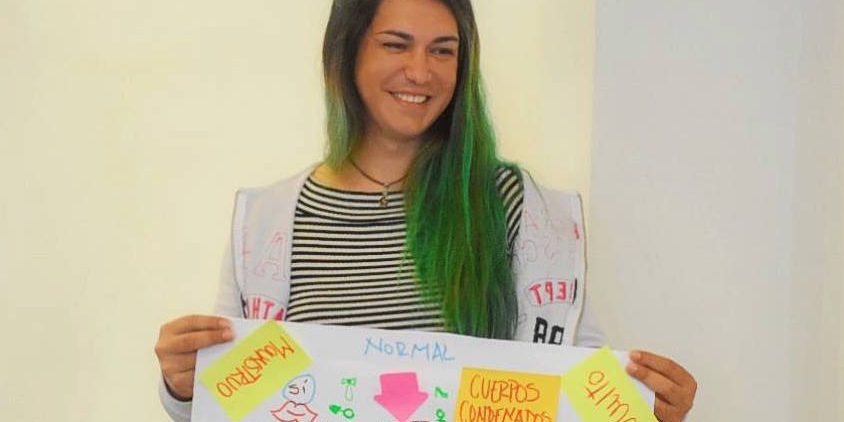
By María Sanz, from Asunción. Alejandra Grange, a trans woman, community psychologist, and member of Transitar , an organization that brings together trans and non-binary individuals in Paraguay, views with skepticism the World Health Organization's (WHO) decision to reclassify transsexuality in its International Classification of Diseases (ICD), removing it from the list of mental disorders. “I don't think it's progress in itself, because there's still no education on the subject,” she explained in an interview with Presentes. In some countries, trans women and trans people need a diagnosis of a disorder such as “gender dysphoria” to change their name or sex on official documents. It can also be a requirement to access hormone therapy or gender reassignment surgeries. Alejandra points out that Paraguay lacks gender identity laws, and these therapies are not offered in the health system either, so she believes that the scope of the WHO reclassification will be even more limited in this country, where access to health for transvestites and trans people faces many barriers.
[READ ALSO: Two trans activists fight in court for the right to their names]
Alejandra is 28 years old and has just finished her degree in community psychology. She graduated with a thesis on the psychosocial effects of sex work for transvestites and trans people. But at university, she had to face being considered ill, or referred to with masculine pronouns, from textbooks to professors and many classmates, without being accepted as transfeminine, and even less so as a transvestite, which she claims as a form of dissent from binary gender norms. “In medical discourse, a transvestite is a man who dresses as a woman as a fetish. But let's understand where this also comes from. It arises in the Latin American context, and for our demands, for our struggles, transvestite is a way of saying that I am neither a man nor a woman: I am a transvestite, I am this person, this is the construction of my identity. I don't have to undergo surgery to fit back into this binary model. I don't have to pass as a woman so that I'm accepted, and so that my fulfillment and happy ending are simply to go unnoticed. Society needs us to go unnoticed too, because otherwise we'll be out there demanding and trying to destabilize its structures,” says the activist.What the WHO says
The WHO announced on June 18th a new version of this classification (ICD-11), in which transsexuality is removed from the list of mental disorders. However, the concept of “gender incongruence” appears, defined as “a marked and persistent incongruence between an individual’s experienced gender and their assigned sex.” The WHO classifies this “gender incongruence” as a “condition related to sexual health,” and considers that it manifests in traits such as “a profound dislike or discomfort with one’s primary or secondary sex characteristics,” a “strong desire to be free of” some of these characteristics, and a “strong desire to have the primary or secondary sex characteristics of the experienced sex.”[READ ALSO: For the WHO, being trans is no longer a mental illness]
The organization now acknowledges that “there is clear evidence that transsexuality is not a mental disorder” and that “classifying it as such can cause enormous stigma for transgender people.” However, justifies the decision to keep transsexuality on the list of diseases, because “significant healthcare needs remain that can be better met if this condition is coded in the ICD.” The organization also states that, although “it is crucial to listen to the voices of people affected by gender incongruence,” the decision to move transsexuality to the sexual health section was based on scientific evidence. Alejandra, along with her colleagues from Transitar, views the WHO's position with caution. She believes that, although it is a decision made by a body composed mostly of cisgender people in positions of academic power and disconnected from the reality of gender diversity, it is also the result of decades of struggle by trans and travesti activists.Between secrecy, ignorance, and stigma
“In Paraguay, healthcare for trans women is clandestine,” says Alejandra. She explains how, if a trans woman wants to start hormone therapy, she has to find a pharmacy that will administer contraceptive injections, or learn to inject them herself. And, of course, she has to cover all the costs of the treatment. There is no medical oversight or follow-up, no Gender Identity Units in hospitals, and no specialists in these types of therapies in Paraguay. Some organizations have promoted public health services that are friendly to trans and travesti people. But, generally, when they go to a health center, they are met with stigma and pathologization. “Health services here don’t treat you like you’re mentally ill, but they stigmatize trans and travesti people. If you go to a health center, it’s because you have HIV, and they immediately tell you you have AIDS. Once, I wanted to go for a consultation, and they sent me to where they did HIV testing.” I went to the dentist again, and when I went in, the dentist told me she was scared and didn't know how she was going to treat me. She apologized."And she said they weren't going to see me. You have to put up with a private service, because if you pay they'll see you, but not in the public system," Alejandra recalls.[READ ALSO: More than 20,000 LGBT youth will be subjected to sexual conversion therapy in the United States]
If the consultation is in the area of mental health, with psychologists or psychiatrists, Alejandra says that there is only one discourse towards trans and transvestite people. “They have a pathologizing view. They immediately tell you:You're sick and we have the cure, we have a way to deal with it.”And then they give you medication. Or, in the worst-case scenario, you might run into a psychologist or psychiatrist involved in a religion, and they give you these conversion therapies, these supposed changes,” he explains. Despite the debates and reclassifications, section 18 of the principles of Yogyakarta, which aim to guide international human rights law regarding sexual orientation and gender identity, states that “regardless of any classification to the contrary, a person’s sexual orientation and gender identity are not, in themselves, medical conditions and should not be treated, cured, or suppressed.” However, these principles are not binding on States.We are present
We are committed to journalism that delves into the territories and conducts thorough investigations, combined with new technologies and narrative formats. We want the protagonists, their stories, and their struggles to be present.
SUPPORT US

FOLLOW US
Related notes
We are present
This and other stories are not usually on the media agenda. Together we can bring them to light.