

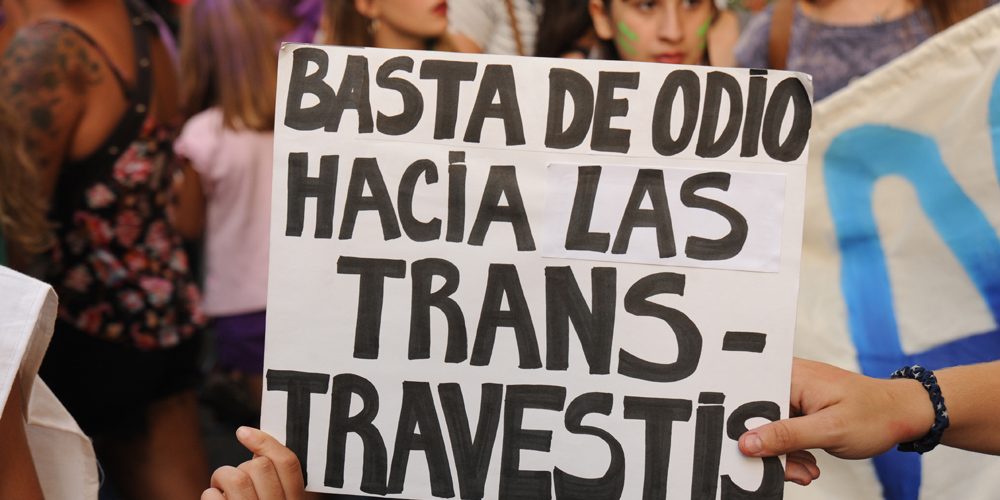
Everyone march to say: "Stop the murders of transvestites and transfemicides"
On June 28 - International LGBTIQ+ Pride Day - transvestite and trans organizations call on everyone to participate in the third national march "Stop transvesticide and transfemicide."

Share

“This historic ruling stops us in a different place, forcing us to think about moving forward,” said Say Sacayán, an activist with the Anti-Discrimination Liberation Movement (MAL) and brother of the trans activist murdered in 2015. He added: “This space, which will be unveiled next Thursday, is the result of the struggle won in the streets and is also a way of thinking about the trans movement, which is the legacy that Lohana and Diana left us.”

The slogans
“We take to the streets to shout 'Enough with the murders of trans women and transvestites, enough with hate crimes, enough with preventable deaths, enough with exclusion, enough with the persecution and criminalization of our sisters in prostitution. Enough with denying us access to work; we demand the Diana Sacayán Employment Quota Law throughout the country. We march to say enough with condemning us to death, for the effective application and respect of the Gender Identity Law, especially in the area of health, for the provision of medication to people living with HIV/AIDS, and for the approval of a law of historical reparations for trans and travesti people who are victims of institutional violence: #RecognizingIsRepairing,” says the statement from the organizing committee. They also march “to commemorate our sister, comrade Lohana Berkins, who is our guiding light in the struggle for the liberation of our community. We march to continue remembering our fighters Diana Sacayán, Pía Baudracco, Maite Amaya, and all those sisters who were taken from us.” Among the demands are also the call for acquittal for Higui de Jesús, Mariana Gómez and Joe Lemonge, and the approval of the law for legal, safe and free abortion.Genealogy of the march
Activist Florencia Guimaraes explained that the march originated from a request by Lohana Berkins. “When we first went out, our goal was to take to the streets to raise awareness of the term 'transvesticide,' but we didn't have high expectations. Today, we're surprised by how much this movement has grown and the impact it has had because, unfortunately, many of our sisters have died in the last three years, although this has been happening for a long time. Since I was a child, I've buried many of my sisters, but today these crimes have a name, they are visible, and I think this is related to the participation of trans women in the National Women's Meeting and the field research that Lohana is conducting with 'The Quest for a Proper Name' and 'Cumbia, Drinking, and Tears,'” she said. [READ ALSO: #NiUnaMenos: at least 4 transvesticides and dozens of trans deaths in 2018] Say Sacayán said that also, from a political point of view, “this march repositions us because the Pride March did not respect us when we were fighting for transvesticide and within the same feminism that also spoke of trans femicides.”A decreasing average lifespan
Guimaraes denounced the lack of official figures on the deaths of trans women and transvestites: “The State isn't interested in creating the tools for this, and we end up doing it ourselves through organizations, but it's not enough. Furthermore, we find that when our sisters die as victims of social transvesticide, their families decide how they are buried, and in many cases, gender identity is not respected at the deathbed, nor in the healthcare system, making it very difficult to keep records,” she stated. Organizations report 41 trans women and transvestites killed so far in 2018, victims of what is called “social transvesticide.” “What worries us is that life expectancy has decreased; 90% of the victims in the last two years were under 30, when the average life expectancy used to be 35,” Guimaraes explained.Also #StopTransfemicides
This year, the march's name changed: #StopTransMurders was joined by #StopTransFemicides. “The march against trans murders reclaims the history of the trans movement, and this has historical value in terms of struggle and strength in the social sphere. Trans people, in general, live our identities through the trans struggle in Argentina, and it is crucial to find spaces to name ourselves. This is inherent to trans feminism, which is about respecting diversity under a single umbrella of struggle. Trans femicides don't tell a different story than trans murders; they respect the identity framework of individuals, and these are not reversible categories, but they are common agendas in the fight against discrimination based on gender identity,” said Alba Rueda, a leader of Mujeres Trans Argentinas (Argentine Trans Women).Federal scope
This year's march has a strong national character: there will be demonstrations in the cities of Rosario, Paraná, Santa Fe, San Luis, Salta, and Jujuy. In Buenos Aires, the meeting point will be at 6:00 PM in Plaza de Mayo, from where the march will proceed to the National Congress. "It's important that trans and gender-diverse women take ownership of this march because we are the ones who suffer this genocide," said Guimaraes.


 ]]>
]]>
We are present
We are committed to journalism that delves into the territories and conducts thorough investigations, combined with new technologies and narrative formats. We want the protagonists, their stories, and their struggles to be present.
SUPPORT US

FOLLOW US
Related notes


We are present
This and other stories are not usually on the media agenda. Together we can bring them to light.