

Gay performer charged with "exhibitionist acts"
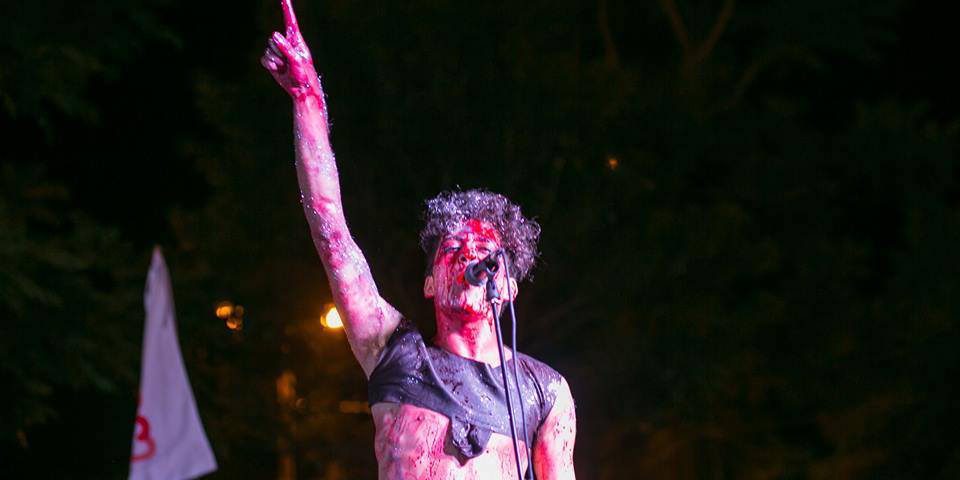
The Paraguayan Prosecutor's Office charged performer Bruno Almada Comas with alleged "exhibitionist acts" after he participated in an LGBTI festival in Asunción on May 17, on the occasion of the International Day against Homophobia, Transphobia and Biphobia.

Share

By María Sanz, from Asunción. Prosecutor Carmen Bogado, of Criminal Unit No. 8 in Asunción, has charged Bruno Almada Comas with alleged "exhibitionist acts ," based on Article 132 of the Paraguayan Penal Code , which punishes "exhibitionist acts that cause considerable disturbance or significantly upset another person." The Code does not define what constitutes an "exhibitionist act," but it mandates a fine, which can be substituted with "appropriate treatment." For now, the prosecution has requested that the artist be formally notified of the charges against him and that alternative measures be applied, such as the obligation to appear before the Criminal Court of Guarantees once a month, reside in a specific location, and post bail.
[READ ALSO: Controversy in Paraguay over the presence of children at an LGBTI festival]
Almada Comas told Presentes that he learned of the charges through the media. “When I found out, I felt vulnerable. I didn't expect the media frenzy surrounding my performance at the festival to be so profound, nor the repercussions it has had. It seems to me that I can't exercise my freedom of expression, and I felt affected by that.” Comas defended his performance, titled “Don't Kill Me, Paraguay,” which aims to denounce the discrimination, harassment, violence, and rejection that many LGBTQ+ people experience in Paraguay. For the performance, the artist uses elements such as whips and artificial blood, and a recording of real audio of insults directed at lesbian, gay, bisexual, and transgender people.Children living on the street
The performance prompted concern from the National Secretariat for Children and Adolescents, which filed a complaint against the organizers of the festival, promoted by the LGBTQ+ organizations Somosgay and Lesvos. The complaint, which began with evangelical groups, was accompanied by photographs and videos of the festival showing the presence of minors. “The most serious fact is that, in one of the videos, an adult touches his genitals in front of the children.”SNNA head Ricardo González stated, referring to Comas's work. Regarding this, Somosgay issued a statement where she clarified that “the children present at the event were not summoned or brought by either the Association or those present, but rather happened to be in a common, public space, the Plaza de Armas in Asunción.” Many of these children live in that plaza, next to the Paraguayan Congress, because They were forced to abandon their homes, which were flooded after the Paraguay River overflowed its banks., while others are members of a indigenous community displaced from their lands for more than six months, and remains camped at that location. Comas, for her part, maintained that at no point during her performance did she undress, much less touch her genitals. “My work is not exhibitionist in any way. I was even very careful to create a piece that would be appropriate for the context we were in, although I had no prior knowledge that it would be like this: with the presence of children affected by disasters and homeless children, who were sharing the event with us,” she stated.An attempt to criminalize LGBTI activists
Comas believes the charges against him are part of an attempt to criminalize LGBTQ+ activists. “I think this charge is targeted. Look at carnivals, where many bodies are exposed, and many children participate. But anything related to LGBTQ+ people is being persecuted in Paraguay. This time I'm the one who has to put my body on the line, but the dangerous thing is that these charges are becoming normalized,” he said.[READ ALSO: #HateCrimes2017: More than 400 reports of violence against LGBT people in Paraguay]
Somosgay's statement points in the same direction. “Without a doubt, we are facing one of the most visible examples of the Paraguayan state's institutionalized homophobia, and our organization will mount the appropriate defenses and pursue all corresponding legal actions before national and international courts, if necessary,” the organization stated, referring to the accusations made by the SNNA. The misuse of criminal statutes to prosecute LGBTI rights defenders in the Americas is one of the concerns expressed by the Inter-American Commission on Human Rights. in a 2015 report. Among these criminal offenses, he cites some such as "public incitement to commit crimes, the glorification of crime, and illicit association," although he does not refer to cases in which the criminal figure of exhibitionism has been used.Pressure from fundamentalist groups
The Inter-American Commission on Human Rights (IACHR) also warns in that report that “the criminalization of LGBT human rights defenders does not occur solely in the context of countries that criminalize consensual same-sex sexual relations, but is also observed in other countries in the region where defending the rights of LGBT people is not well received.” In that sense, lThe Human Rights Coordinator of Paraguay (Codehupy) warns in its 2017 report on the human rights situation that the country led the anti-LGBT rights stance that year at the assembly of the Organization of American States. The report also highlights the “pressure that fundamentalist groups exert on public authorities,” constantly making “a pejorative use of LGBTI identities, labeling them as sick and threatening to Paraguayan children.”We are present
We are committed to journalism that delves into the territories and conducts thorough investigations, combined with new technologies and narrative formats. We want the protagonists, their stories, and their struggles to be present.
SUPPORT US

FOLLOW US
Related notes



We are present
This and other stories are not usually on the media agenda. Together we can bring them to light.