

Controversy in Paraguay over the presence of children at an LGBTI festival
The National Secretariat for Children and Adolescents (SNNA) of Paraguay issued a statement rejecting “the use of children and adolescents” in the Kiss-In Festival, held this Thursday in Asunción, in commemoration of the International Day Against Homophobia, Transphobia, and Biphobia. They warn that the festival organizers could face fines or prison sentences.

Share

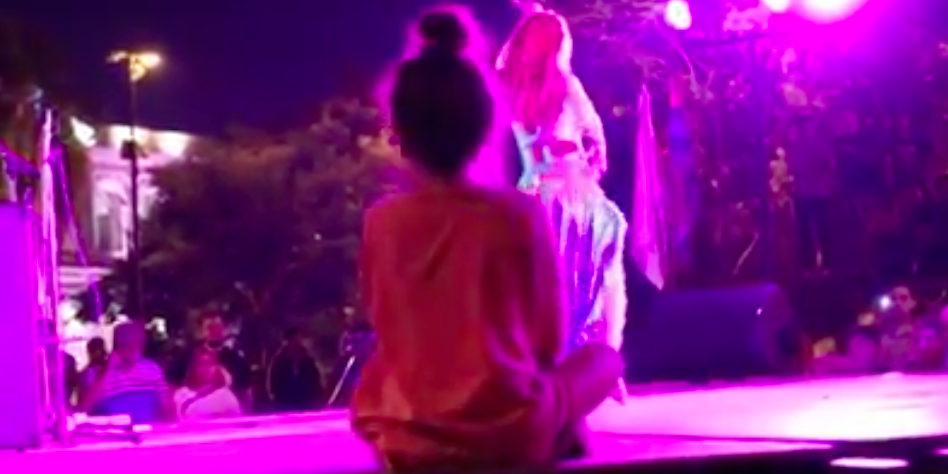
By María Sanz, from Asunción. Every May 17th, for several years now, the organizations Somosgay and Lesvos have organized a Kiss-In, an event where gay and lesbian couples exchange kisses and displays of affection as a way to assert their right to express their affection and sexual orientation in public. They do this in commemoration of the International Day Against Homophobia, Transphobia, and Biphobia, which marks the date in 1990 when the World Health Organization stopped classifying homosexuality as a mental illness. This year, the Kiss-In took place in the afternoon, as part of an arts festival featuring artists, musicians, drag queens, and performers. As usual, the chosen location was the Plaza de Armas, next to the Paraguayan Congress. Since the end of 2017, several Indigenous families, evicted from their lands and left without a place to live, have been camped out in this area as a form of protest. These families are joined by groups of people who live in the flood-prone areas of Asunción, known as the Bañados, and who each year are forced to abandon their flooded neighborhoods and move to precarious houses made of wood and sheet metal, set up in the city's plazas and parks, such as the esplanade in front of the Asunción Cathedral, near the event venue. Among these families are many children who, on Thursday afternoon, were drawn by the lights, music, colors, and stage of the Besatón Festival and came to participate in the activity.
Preachers insulting
At the same time, in another corner of the plaza, groups of Christian preachers set up loudspeakers and directed insults and provocations at the LGBTQ+ people participating in the festival, something that has happened in previous years. They also filmed different moments of the festival with their cell phones, including the moment when several gay and lesbian couples kissed on the stage, where a group of children were playing. The videos were shared on the social media profiles of the Movement for Life and Family of ParaguayThey referred to the festival as a “children’s kiss-in” and “child abuse in flagrante delicto.” The video they released shows belly dancers, drag queens, and performers, among other artists. It has been shared over 700 times, has accumulated more than 25,000 views, and has received hundreds of comments, most of them expressing hatred and insults toward LGBTQ+ people. The Paraguayan Secretariat for Children and Adolescents reacted to the release of this video. with a statement in which it considers “the use of children and adolescents as a means to claim the rights of third parties unacceptable,” referring to the demands of LGBTI people. The statement cites two articles of the Paraguayan Penal Code which condemn “exhibitionist and obscene acts that offend people’s modesty,” and “homosexual acts against minors,” referring to “sexual acts between an adult and a person of the same sex between the ages of 14 and 16.” In Paraguay, the minimum age of sexual consent, within the framework of marriageThe legal age of consent is set at 16 for men and 14 for women. However, for same-sex relationships, the minimum age is raised to 17. The head of the National Secretariat for Children and Adolescents (SNNA), Ricardo González, told the media that the videos of the Kiss-In recorded yesterday... They have been sent to the Public Prosecutor's Office to open an investigationHe warned that the organizers of the Kiss-In Festival They face fines and prison sentences for "exhibitionism and performing sexual acts in front of or with children"He declared thatThe most serious fact is that, in one of the videos, an adult touches his genitals in front of the children.”A performance to denounce homophobic hatred
The head of the National Secretariat for Children and Adolescents (SNNA) referred to the performance “Don’t Kill Me, Paraguay,” by Paraguayan artist Bruno A. Comas, which was part of the festival program. The artistic intervention seeks to symbolically denounce the daily aggression suffered by LGBTQ+ people in Paraguay, as Comas explained to Presentes. To this end, the artist uses elements such as whips and artificial blood, while real audio recordings of homophobic, lesbophobic, and transphobic insults, taken from media outlets and social networks, play in the background. “I think the work is quite provocative; it creates a metaphor about what it is like to live in a society like ours, with so much repression and violence directed at us,” Comas stated. He admitted that the content of the intervention “is not suitable for young children,” but affirmed that he took “precautions at all times to ensure it wasn’t excessive.” “The children would come up and ask what the blood was, or they would just keep playing. I didn't see anyone who felt uncomfortable or hurt, or any children who were scared. As a performer, I manage those fears, and at the end of the performance, I ended up playing with them. I saw them curious, very engaged with what was happening. It was an intense performance, but also quite playful. It's a shame that they want to distort what happened,” said Comas. Regarding the most controversial moment of the performance, in which, according to the head of the SNNA, the artist touched his genitals in front of the children, Comas asserted that it was actually a gesture to remove the glitter from his pants, which he throws at the end of the piece. “There was nothing sexually explicit. It was a very measured show. I think the SNNA is trying to deflect attention from why these same children they claim to protect have been living on the streets for so many months,” the artist stated. Regarding this, the head of the SNNA told the media this Friday that, As long as there are indigenous adults coming to Asunción, there will be children on the streets. ]]>We are present
We are committed to journalism that delves into the territories and conducts thorough investigations, combined with new technologies and narrative formats. We want the protagonists, their stories, and their struggles to be present.
SUPPORT US

FOLLOW US
Related notes



We are present
This and other stories are not usually on the media agenda. Together we can bring them to light.