

#8M Why the feminist struggle must also be LGBT+
The feminist struggle is intrinsically linked to the LGBTI struggle, since transphobia and homophobia are forms of gender-based violence. This is the opinion of Alexandra Hernández, an activist with the Equal Marriage movement in Peru

Share

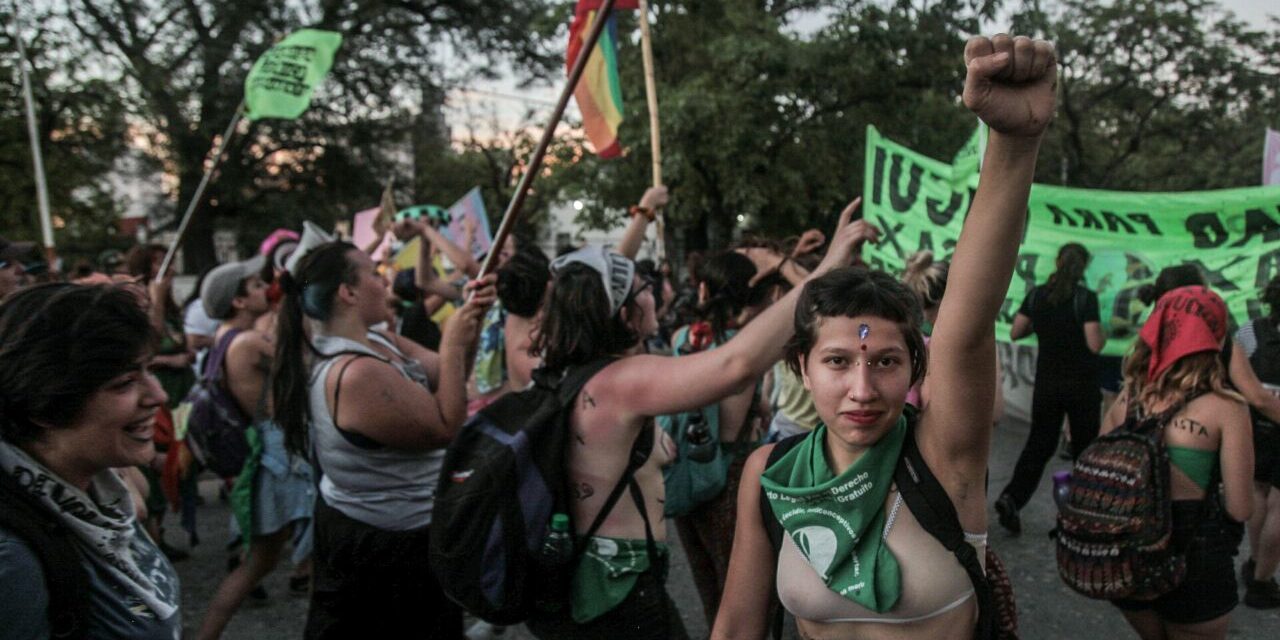
By Alexandra Hernández, from Lima. Photos: Presentes archive/Jessie Insfran Pérez and Aime Martínez. Every March 8th, the feminist strike is celebrated, reminding us of the history of women's struggle for the recognition of their existence and their rights. Although it's a date that many brands and companies take advantage of to gain popularity under a misunderstood "women's day" by offering flowers, gifts, deals, and discounts, the date commemorates a fight against the historical discrimination suffered by those of us who identify as women or are perceived as such. However, in this history of demanding rights, many figures have been made invisible because their ways, behaviors, or bodies don't align with the hegemonic idea of "being a woman." Let's think about the feminist struggle: what kind of demands are the most popular? What kind of bodies become representative of this struggle? Which feminists appear in the media? What form of struggle is celebrated, and what form is labeled as aggressive and lacking in strategy?

Intersectionality in the feminist struggle
When we think of "woman" (or when the media thinks of woman) hegemonic stereotypes are activated, erasing those forms of femininity or feminized bodies violated by the hierarchical system that imposes gender. Yes, patriarchy is a system that is important to define, identify, and deconstruct. But sometimes, even from a feminist perspective, we forget that it is not the only system that operates on people. He racism, classism, homophobia, and transphobia They transform the experiences of different forms of femininity. Thus, the experience of a middle-class cisgender woman is different from the experience of an Afro-Latina transgender woman in the face of male violence. History has taught us that access to resources places us at different starting points in society. This type of analysis, which broadens the vision of feminism to one that is more inclusive and in line with reality, is called intersectionality. We cannot articulate a struggle that seeks to eradicate gender oppression without recognizing that it is part of a larger system of hierarchy and discrimination.
Race, class, and sexuality are aspects of people's identity that modify their experience with gender. And LGBTIQ+ people are those who, par excellence, challenge the norms of patriarchy.
History has taught us that access to resources places us at different starting points in society. This type of analysis, which broadens the vision of feminism to one that is more inclusive and in line with reality, is called intersectionality. We cannot articulate a struggle that seeks to eradicate gender oppression without recognizing that it is part of a larger system of hierarchy and discrimination.
Race, class, and sexuality are aspects of people's identity that modify their experience with gender. And LGBTIQ+ people are those who, par excellence, challenge the norms of patriarchy.
 Intersex people, queer people, transgender people, and those whose behaviors and feelings fall outside heteronormativity, form a group of bodies that rebel against the mandate of the sexist order imposed upon us at birth. The idea of gender transition implies questioning the rigid assumption that gender identity is a fixed and stable attribute over time. This is something that conservatism and biological determinism tirelessly proclaim (“one is born a woman or a man, there is no third sex”), but which is constantly proven, by our very existence, to be a mistake. We exist, and that is enough to prove that the rigidity of sexuality is false.
Therefore, it is logical that The feminist struggle is intrinsically linked to the LGBTI struggle, given that Transphobia and homophobia are forms of gender violence.
How to make the feminist struggle inclusive?
Feminism is a movement that seeks to change the patriarchal paradigm of society, with many strategies and forms. Homogenizing feminism is imposing on it the very rules it seeks to break.
Talking about only two sexes or genders, speaking only from heterosexuality or cisgenderism, or making invisible the experiences of racism or of certain populations in order to "avoid separatism" is a way of erasing the intrinsic diversity of the feminist movement.
Intersex people, queer people, transgender people, and those whose behaviors and feelings fall outside heteronormativity, form a group of bodies that rebel against the mandate of the sexist order imposed upon us at birth. The idea of gender transition implies questioning the rigid assumption that gender identity is a fixed and stable attribute over time. This is something that conservatism and biological determinism tirelessly proclaim (“one is born a woman or a man, there is no third sex”), but which is constantly proven, by our very existence, to be a mistake. We exist, and that is enough to prove that the rigidity of sexuality is false.
Therefore, it is logical that The feminist struggle is intrinsically linked to the LGBTI struggle, given that Transphobia and homophobia are forms of gender violence.
How to make the feminist struggle inclusive?
Feminism is a movement that seeks to change the patriarchal paradigm of society, with many strategies and forms. Homogenizing feminism is imposing on it the very rules it seeks to break.
Talking about only two sexes or genders, speaking only from heterosexuality or cisgenderism, or making invisible the experiences of racism or of certain populations in order to "avoid separatism" is a way of erasing the intrinsic diversity of the feminist movement.
 Recognizing differences does not imply separatism: all those affected by gender-based violence have a story to tell and an experience shaped by their place in the world. Ensuring that our spaces of struggle include all femininities and bodies violated by sexism is a way to promote diversity and give less privileged voices a space to be heard. The feminist struggle is a fight for liberation from all forms of gender oppression, in all its diverse manifestations. No agenda is more important than the other; however, there are voices in feminism that capitalize on the struggle focused on only one type of woman, and only one type of body and oppression.
As feminists, we have an obligation to examine and acknowledge whether we fall into racist, homophobic, transphobic, and classist discourses that are normalized in society. Recognizing them is part of the path toward a more egalitarian society; ignoring them is to fall into the same oppressive practices we claim to fight against
Recognizing differences does not imply separatism: all those affected by gender-based violence have a story to tell and an experience shaped by their place in the world. Ensuring that our spaces of struggle include all femininities and bodies violated by sexism is a way to promote diversity and give less privileged voices a space to be heard. The feminist struggle is a fight for liberation from all forms of gender oppression, in all its diverse manifestations. No agenda is more important than the other; however, there are voices in feminism that capitalize on the struggle focused on only one type of woman, and only one type of body and oppression.
As feminists, we have an obligation to examine and acknowledge whether we fall into racist, homophobic, transphobic, and classist discourses that are normalized in society. Recognizing them is part of the path toward a more egalitarian society; ignoring them is to fall into the same oppressive practices we claim to fight against
We are present
We are committed to journalism that delves into the territories and conducts thorough investigations, combined with new technologies and narrative formats. We want the protagonists, their stories, and their struggles to be present.
SUPPORT US

FOLLOW US
Related notes

We are present
This and other stories are not usually on the media agenda. Together we can bring them to light.