

Transfemicide in Santa Fe: Her neighborhood mourns her and demands justice for Cuqui Bonetto
Early Thursday morning, Adriana Bonetto was murdered in her home in Rincón, Santa Fe. The main suspect is a man with whom she had been in a relationship for several months. Family and friends of the trans woman are demanding justice and organizing a march for next week.


Share

By Soledad Mizerniuk and Victoria Rodríguez, from Rincón, Santa Fe
On Wednesday, Adriana Cuqui Bonetto, a 45-year-old trans woman , woke up early, as usual. She fed her seven poodles, cuddled them, and said goodnight. She left her house in the Los Espinillos neighborhood of San José del Rincón—7 km from the city of Santa Fe—on her motorcycle to go to work. She was the second trans woman in the city to change her ID card after the Gender Identity Law was passed. For several months, since leaving a job at a local nursing home, she had been caring for an elderly man in Colastiné Norte, a neighborhood a couple of kilometers from her house. She returned in the late afternoon and sat in the yard playing with her dogs. They were like her children. Later, her goddaughter, Sofía Mansur, came over to share some mate and chat. “Her life was caring for her poodles and working,” her goddaughter told Presentes. That evening, they each went home. Sofia, her mother—"who is like a sister to Cuqui"—and the rest of the family live next door to Adriana. Around midnight, Mayra—one of Cuqui's neighbors—heard noises in the street. She looked out the window and saw Cuqui enter the house with a man. The man's head was covered with a hood. Although she couldn't see his face clearly or learn his name, it wasn't the first time she'd seen him arrive. He'd been visiting her for about a year. Cuqui was private about that part of her life and never mentioned him. "A few hours later, I was with Mayra and heard some noises at Cuqui's house. At first, it didn't seem like anything too unusual. But after a while, we heard the gate slam and saw the guy speed away on his motorcycle."
 Cuts on the face, neck, and chest
 Cuts on the face, neck, and chest
When they went outside, they told Presentes, they saw that the front door was open and the dogs had also come out. That was even stranger. The inside of the house was dark. They knocked, but Adriana didn't answer. They entered slowly through the kitchen and dining room and went to the only bedroom. “As soon as I walked in, I saw blood on the floor. So I yelled to keep everyone else from coming in, and we called the police,” Mayra said. She added, “From what they could see later, Cuqui had many cuts on her face, neck, and chest.” The police station is five blocks from the house. The officers arrived quickly. They entered the bedroom and found Adriana naked, lying next to the bed in the fetal position, hugging a pillow, and covered with a yellow sheet. “If we had gone when we heard the first noises, maybe we could have saved her,” her goddaughter lamented. Police personnel from the 14th District Police Station and the Homicide Division of the Investigative Police worked at the scene. The case was assigned to Homicide Prosecutor Ana Laura Gioria.
[READ MORE: Transvesticide: a trans woman was murdered in Santa Fe, she was 45 years old ]
Mayra and Sofía recounted that the perpetrator took Adriana's motorcycle, cell phone, and other belongings. They also saw bloodstained clothing in one of the house's sinks, leading them to believe the killer cleaned himself up after the attack.
Judicial sources told Presentes that they are not currently investigating it as a hate crime, despite the brutality highlighted by the initial witnesses to this publication.
The neighborhood organizes a march for Cuqui Bonetto
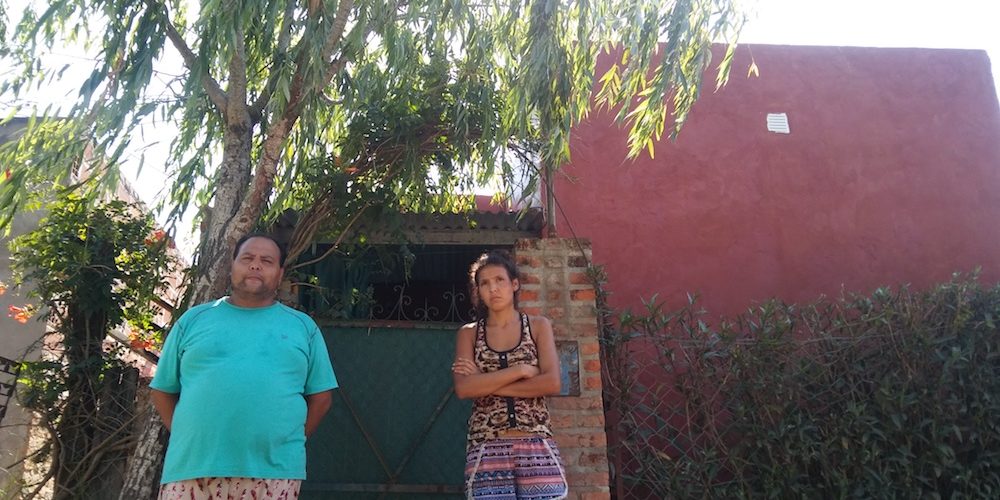
The residents of Los Espinillos all know each other. Most, like Cuqui, have lived in the area for over 10 years. They look out for each other and help each other out. Today, no one is quite recovered from what happened. They've already started organizing a march for next week. They demand that the crime be solved.
“I want justice. I'm going to fight until I get it. I want that guy behind bars. She didn't deserve something like this,” said Sofía. She added, “That they would do this to her for money is incomprehensible. She was a humble woman who worked hard to make ends meet.”
“I'm that simple,” she introduced herself on her Facebook profile. And that's how those who knew her describe her: reserved, a loyal friend, hardworking, with a green thumb and a knack for cooking—her fried empanadas made the whole block's mouths water—and a devoted mother not only to her chosen family but also to her dogs (the poodles she spoiled rotten with ice cream and cuddles).
From Rincón's main square, the dirt road narrows, eventually becoming a path that disappears into the reservoir, just meters from where Adriana lived. Her block is short, and the houses are close enough to see and hear, without shame, the private lives behind closed doors. From the corner of Juan de Garay and Inés Álvarez, you can see the bubblegum pink facade of what was her lifelong home. It had a chain-link fence for security. But, as in most of the femicides and transphobic murders that occurred in Santa Fe, the killer entered her home with her help.
For years, she worked countless shifts and 24-hour watches at the nursing home where she was employed, to replace the walls of her small thatched-roof shack with more solid bricks. She even bought a beautiful white aluminum door for the front entrance. In the patio, a dozen hanging plants filled the eaves with fresh air, creating a space where she would sit and drink mate. Fabián Ramírez, one of her friends, recalled yesterday that she once kept chickens on the dirt floor and a couple of parrots indoors.
Somewhere in the corner, her jewelry boxes remain, filled with costume jewelry and makeup, remnants of a time when she had more social outings. Now, after working all day, she would arrive home so tired at night that all she wanted was to sit down for a while, eat, and sleep. Still, she was happy because she had recently been able to trade in her old motorcycle for a new one, the one her murderer stole.
Yesterday, sitting in a circle in the patio next to hers, her adopted nephews waited for the autopsy to finish and for her body to be taken away to the funeral home at the entrance to the former town, near Provincial Route 1. Their anguished faces softened a little when the youngest members of the family arrived with sand in their hands, squabbling over change to buy apple juice. But the pain hung heavy in the air, and so did the demand for justice. A march in her name is being organized. Not one more trans murder. Adriana Bonetto, present.
We are present
We are committed to journalism that delves into the territories and conducts thorough investigations, combined with new technologies and narrative formats. We want the protagonists, their stories, and their struggles to be present.
SUPPORT US

FOLLOW US
Related notes

We are present
This and other stories are not usually on the media agenda. Together we can bring them to light.