

How does the Inter-American Court of Human Rights' decision to respect LGBT rights affect Peru?
Peru is one of the few countries in the region that does not guarantee any rights to LGBTIQ people. But that could change after the historic statement from the Inter-American Court of Human Rights.

Share

By Esteban Marchand. This beginning of the year brought good news for LGBTIQ people in Latin America. On January 9, the Inter-American Court of Human Rights (IACHR) issued an advisory opinion stating that the rights of same-sex couples and transgender people are protected by the American Convention on Human Rights. The IACHR's opinion came in response to a request from the Costa Rican government. The IACHR's ruling is binding and applicable to all countries that have signed the Pact of San José, including Peru. Peru is one of the few countries in the region that does not guarantee any rights to LGBTIQ people. But that could change after the IACHR's historic statement. "There can be no more legal debate, and that is essentially what the Court is doing. There is no legal debate to deny or advance the guarantee of LGBT rights," Brenda Álvarez, a lawyer with the Center for the Promotion and Defense of Sexual and Reproductive Rights (Promsex), told Presentes.
[READ ALSO: Peru: Congress approved the repeal of Decree Law 1323 that protected the LGBTI population]
The institution submitted its written observations to the Inter-American Court of Human Rights (IACHR) and also participated in the hearing, “primarily to make it known that the rights of LGBTIQ people are not guaranteed in our country,” says Álvarez, who adds that they are “quite pleased” with the opinion issued and hope to continue working to implement the IACHR’s decision throughout the country. From the judicial perspective, there has already been a positive response. The president of the Judiciary, Duberlí Rodríguez, told the EFE news agency that “Peru must respect the IACHR’s decision on same-sex marriage.”The obligation of judges
For Bruno Fernández De Córdoba, a lawyer and LGBTIQ activist, the next step for judges is to correctly apply the Court's decision in all proceedings. If the state powers fail to comply, “a complaint can be filed with the Inter-American Commission on Human Rights, which could then be referred to the Inter-American Court of Human Rights, where the Peruvian state's international responsibility for not recognizing the rights of LGBTIQ people could be determined,” Fernández De Córdoba explains.[READ ALSO: #HateCrimes2017 Peru: main violence against LGBTIQ+, from the State]
Following the Inter-American Court of Human Rights' announcement that it will review the recent humanitarian pardon granted to Alberto Fujimori, many of the former dictator's supporters claimed that the international body was merely trying to "annoy Peru." It is not unreasonable to think that this same argument will be used by those who oppose the recognition of LGBTQ+ rights.Peru will have to comply
“Withdrawing from the Inter-American Court of Human Rights is a risk in countries with such weak democratic institutions as Peru. It is a real risk, and now more than ever it is important that LGBT people and allies defend Peru's continued membership in the Court at the national level,” warns Brenda Alvarez. However, Fernández De Córdoba points out that “it must be noted that the advisory opinion was issued while Peru was a signatory to the Pact of San José.” In other words, the Court's decision is not retroactive, and Peru would have to comply with it. “Even if an extraordinary session were convened tomorrow and it were decided that Peru would withdraw from the Court's jurisdiction and the American Convention, the effects of that decision would take a year,” the lawyer adds.An impact on society
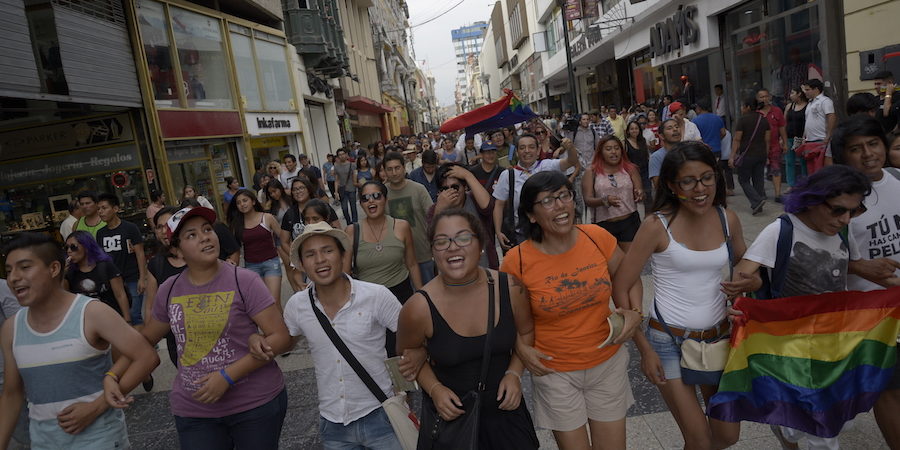
From civil society, the celebrations of human rights groups are evident. “We know that the acceptance of equality for same-sex couples and transgender people in Peru still faces much opposition, but we are sure that soon our society and our State will be able to reconcile ideological and religious differences to embrace full equality for everyone,” comments Gabriela Zavaleta, representing the Matrimonio Igualitario Perú (Más Igualdad) collective. Another effect of this decision is its impact on society: “especially on people who are neither entirely for nor against it. For them, these decisions have a significant impact because they represent progress in what a high international court has stated,” adds Bruno Fernández De Córdoba. Civil organizations like Más Igualdad will seek to capitalize on this moment to the fullest by raising awareness of cases currently in the courts, such as Oscar Ugarteche'sIn addition, marches in favor of equality will be held throughout the year.We are present
We are committed to journalism that delves into the territories and conducts thorough investigations, combined with new technologies and narrative formats. We want the protagonists, their stories, and their struggles to be present.
SUPPORT US

FOLLOW US
Related notes
We are present
This and other stories are not usually on the media agenda. Together we can bring them to light.