

LGBTI activists from the region met in Guatemala: "We are facing a scenario that alarms us"
More than 80 activists from the region gathered from November 16-19, 2017, in Guatemala City for the VII Regional Conference of the International Lesbian, Gay, Bisexual, Trans and Intersex Association for Latin America and the Caribbean (ILGALAC). Focusing on the rise of fundamentalist groups that reinforce hate speech through what they call “gender ideology,” the meeting provided a space for reflection and the exchange of strategies for building a future of freedom, equality, and solidarity.

Share

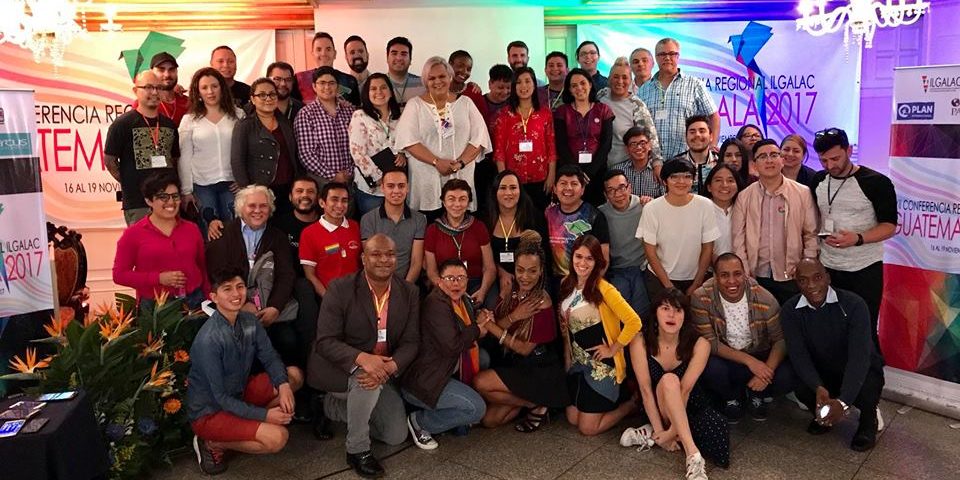
Photos: ILGALAC. More than 80 activists from the region gathered in Guatemala City for the VII Regional Conference of the International Lesbian, Gay, Bisexual, Trans and Intersex Association for Latin America and the Caribbean (ILGALAC) . Focusing on the rise of fundamentalist groups that reinforce hate speech against what they call "gender ideology," the meeting was a space for reflection and the exchange of strategies "for building horizons of freedom, equality, and solidarity," the organizers stated in their call for participation. The conference took place from November 16 to 19, 2017. Representing Argentina as panelists and moderators were Sasha Sacayán, a leader of the Anti-Discrimination Liberation Movement (MAL); Darío Arias and Ivana Gutiérrez, representing Conurbanos por la Diversidad (Suburbanites for Diversity); and Pedro Paradiso Sottile, executive director of ILGALAC. The meeting's final document called for justice for the transphobic murder of activist Diana Sacayán, killed in 2015. It also denounced the increase in social and institutional violence in Argentina; the non-compliance with gender identity laws and employment quotas for transvestite and trans people; the dismantling of public agencies; the elimination of policies for recognition and social inclusion; and the attempt to pass religious laws or to suppress specialized prosecutor's offices dealing with violence against these groups.
[READ ALSO: Organizations and activists condemn the detention protocol for LGBT people]
"We are facing a scenario that alarms us."
“Our continent, and our region in particular, is experiencing a surge in ultraconservative sectors that threaten the secular state, the well-being and rights of the population in general, and especially of women and LGBTI people in each of our countries. After a historic period of significant progress in various countries through the approval of laws protecting and recognizing our community or the repeal of regulations that criminalize our identities, we are once again facing an alarming global and regional scenario. The proliferation of anti-rights groups, the rise of religious and political fundamentalism, the increase in persecution of LGBTI people and human rights defenders, the rise in hate crimes and violence against our community, and the rise of conservative governments that strongly impact our region call upon us to define a clear and precise strategy to reject all attacks against our community and to more forcefully promote the fulfillment and guarantee of human rights,” stated the organizers of the meeting in their call to action. “It was a historic meeting, the first of its kind held in Central America, one of the regions most affected by fundamentalism and violence against people based on sexual orientation, gender identity, and its diverse expressions,” he told Present Paradiso Sottile celebrated the work and diverse activities carried out at the meeting, as well as the agenda and thematic areas that will be priorities for the new Council and the Regional Office. “It is a source of pride to see our regional organization and networks grow and strengthen from an inclusive and human rights perspective, with a clear stance to confront the onslaught against our rights, which the Guatemala Charter so forcefully reflects,” she said. Criminalization and violence against LGBTI people and human rights defenders; best practices and policies in favor of LGBTI rights; and the region's role in the recognition of LGBTI rights in the Universal and Inter-American Human Rights mechanisms were some of the key topics addressed in the workshops, panel discussions, and plenary sessions held at the Barceló Hotel, the meeting's venue. Ivana Gutiérrez from Conurbanxs x la Diversidad said: “We share the situation of setbacks in Argentina since the government of Mauricio Macri came to power, which is expressed through the dismantling of public policies, the increase in violence against trans and travesti people, and the lack of implementation of policies such as the gender identity law and the trans travesti labor quota law.
[READ ALSO: Advancement of LGBTI political leadership in Latin America and the Caribbean]
Sasha Sacayán highlighted the concern over the rise of political and religious fundamentalism under the guise of a so-called "gender ideology." Darío Arias, who was elected Secretary General for Latin America and the Caribbean, said: "We face an enormous challenge at a difficult juncture for our countries, where the advance of the right wing is shaping a new 21st-century Operation Condor that targets our social, economic, and political rights. We hope to rise to the occasion in every arena where we must fight this battle."

We reproduce the Letter from Guatemala City – November 19, 2017
In a profoundly regressive regional context, in which we face serious violations of our human rights and democracies and strong criminalization of human rights defenders in Latin America and the Caribbean, more than 70 activists and human rights defenders of lesbian, gay, bisexual, trans and intersex people met at the VII Regional Conference of the International Lesbian, Gay, Bisexual, Trans and Intersex Association for Latin America and the Caribbean, ILGALAC, from November 16 to 19, 2017 in Guatemala City for reflection and exchange of strategies for building horizons of freedom, equality and solidarity. We observe with concern the rise of various conservative and fundamentalist sectors that reinforce violence and incite hatred through what they call 'gender ideology'. Reaffirming our commitment to the fight against all forms of discrimination, especially that based on sexual orientation, gender identity, gender expression and sex characteristics, from the sovereignty of our peoples and identities: We reject all forms of bias-motivated violence, specifically those perpetrated against lesbian, gay, bisexual, trans, and intersex people, such as: genital mutilation, reparative therapies, corrective rape, legal systems that criminalize sexual orientation, pathologize gender identity and sex characteristics against the free will of each person, public pronouncements that incite hatred against LGBTI people in the mainstream media, as well as school bullying based on sexual orientation and gender identity and expression, hate crimes, and femicides; thus affecting the exercise of all human rights. We recognize and condemn the multiple forms of discrimination that generate inequality based on gender, age, race, ethnicity, creed, health condition, migratory status, socioeconomic status, and any other factor that affects women, youth, people experiencing homelessness, people with disabilities, migrants, and LGBTI indigenous people in a differentiated way. We highlight the region's role in building agreements and instruments that defend the human rights of the LGBTI population in regional integration spaces and in international and regional human rights mechanisms, such as the Yogyakarta Principles, the Montevideo Consensus, as well as in the creation of the figure of the independent expert; we recognize the achievements in legal matters and social inclusion in Latin American and Caribbean countries and demand that states: Consolidate and operate policies that guarantee the human rights of LGBTI populations. Promote and pass laws that protect LGBTI populations, guaranteeing us the same rights as the rest of the population Implement treaties and multilateral development agendas for the enjoyment of the highest standard of rights. Guarantee education policies specifically designed to modify social and cultural patterns of behavior, counteract prejudices and customs, and eradicate practices based on stereotypes of LGBTI people that can legitimize or exacerbate prejudice-based violence, urging them to adopt measures to guarantee the continuity of LGBT people in formal education systems; as noted by the IACHR in its preliminary report on “Poverty, Extreme Poverty and Human Rights in the Americas” of 2016. To allocate and facilitate access to resources, for the guarantee and defense of our human rights. We call upon the United Nations Human Rights Council to adopt measures to protect the rights of LGBTI people, to pass an urgent and immediate resolution to ensure regular reporting to the Council on the situation of our rights, and to guarantee an end to violence and discrimination based on sexual orientation, gender identity, and sex characteristics in UN member states. We also call upon our States to lead these processes. Given the renewed crusade by anti-rights groups and religious fundamentalists who, through a strategy of delegitimization, have labeled our activism as “gender ideology,” including new arguments specifically targeting trans children (for example, sex education in schools, use of uniforms in bathrooms), it is necessary to increase the representation of trans people within the LGBTI movement's discussion spaces. Therefore, we believe it is essential that trans organizations have more and better tools, and greater access to funding, to strengthen local activism in order to prevent setbacks in hard-won rights and ensure their effective implementation. We support the peace process in Colombia, and we demand that the peace agreement respect the inclusion of LGBTI people who are victims of the conflict. We warn about the setbacks and threats to the exercise of citizenship and basic rights for LGBTI people in Guatemala and urge that freedoms be guaranteed through inclusive public policies and legal frameworks. We express our concern regarding Judgment 0076/2017 of the Plurinational Constitutional Court of Bolivia, which, in Article 3, declares the unconstitutionality of paragraph II of Article 11 of Law 807 on Gender Identity, specifically the phrase "the change of given name, sex designation, and image will allow the person to exercise all fundamental, political, labor, civil, economic, and social rights, as well as the obligations inherent to the assumed gender identity." This declaration of unconstitutionality represents a historic setback in the recognition of human rights for the country, the region, and the world, given that the Plurinational State of Bolivia is a member of the Human Rights Council. We urge the reversal of this decision, as the State's role should be to guarantee rights, not to restrict them. We reiterate our strongest condemnation of the economic, commercial, and financial blockade that the United States government has maintained against the Cuban people for more than half a century, and of which our lesbian, gay, bisexual, trans, and intersex brothers and sisters on the island are also victims. We also express our concern regarding the international interference and destabilization efforts against the democratically elected government in Venezuela and call for dialogue and peace to end the economic war against the people of this nation, which also affects LGBTI people. We observe with concern the setbacks in the Federative Republic of Brazil, where the terms “gender identity” and “sexual orientation” have been removed from the National Common Curriculum Framework (BNCC). There, conservative political and religious sectors are leading the “Schools Without Parties” initiative, promoting bills aimed at prohibiting the teaching of certain topics in education, including gender and sexual orientation. We critically note the situation in English-speaking Caribbean nations where laws persist that punish our identities with prison sentences. We also urge greater support from Central American governments, expressed in the form of more concrete actions against discrimination based on sexual orientation and gender identity. We condemn the actions that the National Front for the Family has carried out in Mexico with the aim of obstructing and eliminating access to human rights for women and the LGBTI population, and which at the same time has exacerbated an atmosphere of hatred through its statements. We denounce the increase in social and institutional violence in the Republic of Argentina, as well as the non-compliance with gender identity laws and employment quotas for trans and gender-diverse people, the dismantling of public agencies, the elimination of policies for recognition and social inclusion, and the attempt to pass religious laws or to abolish specialized prosecutor's offices for our community. We demand justice for the transphobic murder of Diana Sacayán, a trans activist from Argentina brutally killed in 2015 and former Deputy Secretary General of ILGA's Trans and Gender Identity Commission. From that perspective, we point to the intrinsic and inseparable relationship between education, research and culture, which should be reflected in the policies of Latin America and the Caribbean. We advocate for alliances and cooperation between our organizations and other social movements that defend human rights and social justice, and we recognize the need to strengthen cross-sectoral agendas. We are committed to promoting and ensuring the participation of young people and older LGBTI people, and we also commit to advocating for the visibility and strengthening of their participation in the public sphere of our countries. We reaffirm the importance of the human rights framework, secularism, and Latin American and Caribbean solidarity for building peace and social and gender justice. The next conference in 2019 will be in Colombia.]]>We are present
We are committed to journalism that delves into the territories and conducts thorough investigations, combined with new technologies and narrative formats. We want the protagonists, their stories, and their struggles to be present.
SUPPORT US

FOLLOW US
Related notes


We are present
This and other stories are not usually on the media agenda. Together we can bring them to light.