

Shock in Honduras: Four LGBT people murdered
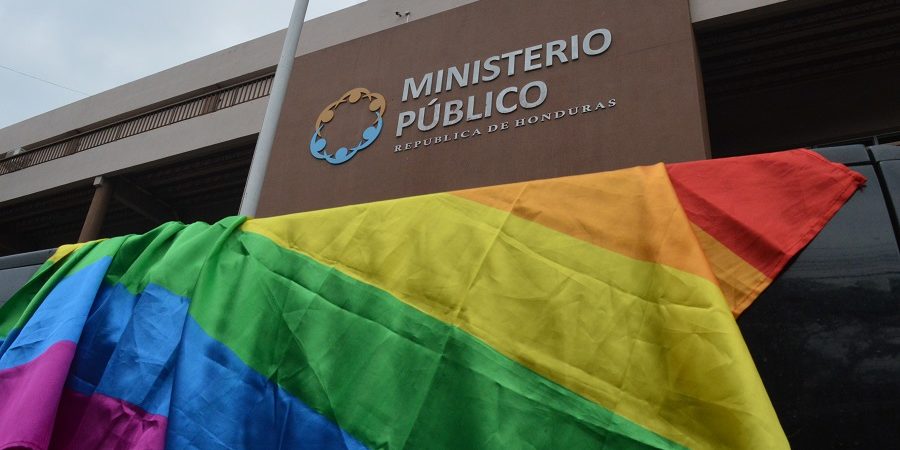
Three people who had been reported missing by their families a few days ago were found murdered Friday night in a swamp in Puerto Cortés, a coastal tourist city on the Caribbean coast in northern Honduras. Yesterday afternoon, also in the department of Cortés, the body of a transgender woman was found in the municipality of San Manuel, María Luisa.

Share

Jennifer Avila Reyes , reporting from Tegucigalpa. Photos: Presentes Archive. Three people who had been reported missing by their families a few days ago were found murdered Friday night in a swamp in Puerto Cortés, a coastal tourist city on the Caribbean coast in northern Honduras. Yesterday afternoon, also in the department of Cortés, the body of a trans woman was found in the municipality of San Manuel, María Luisa. Civil society organizations link these crimes against LGBTI people to the rise of hate speech, which is growing as the November 26 elections approach. With these victims, the number of LGBTI people murdered so far in 2017 has reached 31, according to information provided to Presentes by the Cattrachas Observatory. The first three victims had been missing for five days and were found in an advanced state of decomposition in a swamp in the Buenos Aires neighborhood. They showed signs of torture and their hands were bound . It wasn't until Saturday, after a series of forensic examinations, that the victims were identified as Jennifer López, a transgender woman; Jorge Antonio García, a gay man; and another person who remains unidentified. Jennifer and Jorge lived in San Pedro Sula, 55 kilometers from Puerto Cortés. Their bodies remain in the San Pedro morgue.
[Why Honduras is one of the most dangerous countries for LGBTI people]
The Public Prosecutor's Office in this town informed Presentes that the investigation into the triple homicide is being handled by the High-Impact Homicide Unit of the Special Prosecutor's Office for Crimes Against Life, a special team from the Technical Agency for Criminal Investigation (ATIC), and the Police Directorate of Investigation (DPI). These agencies are collecting evidence and taking statements. They have also ordered the inspection of security camera footage from locations near where the bodies were found. However, this information is being kept confidential. Authorities reported that the bodies were taken to the morgue in San Pedro Sula, where DNA testing is being conducted for full identification. Regarding the fourth victim in San Manuel Cortés, no official statement has been released, but it has been confirmed that she was stabbed to death.Hate speech is on the rise
The non-governmental organization Red Lésbica Cattrachas condemned the murders and linked them to the rise of hate speech in the lead-up to the elections in Honduras. “The public had been warned that, due to the hateful comments made by Marlene Alvarenga, there would be hate crimes, and that is what happened with the deaths of three transgender women,” the organization stated in a Facebook post. Marlene Alvarenga is a presidential candidate in Honduras for the Anti-Corruption Party (PAC). Last week, she made homophobic comments in the media, including on national television. Alvarenga stated that “women have sexual rights within the framework established by law, which is between a man and a woman. But if they wanted to have rights between two women, that is, lesbian or gay marriage, Marlene Alvarenga is totally against it because it is an aberration. And because God was the one who first created man and woman and established the family. Therefore, we would be against these sexual aberrations,” she publicly declared. as you can see in this video. Furthermore, the candidate anticipated that if she wins the elections, she will promote a project for Honduras to "cease being a secular country," in order to "place God as the only supreme being so that He can direct the life of every Honduran.""The most violent years against the LGBTI community"
According to Erick Vidal Martínez, a congressional candidate for the Opposition Alliance against the dictatorship and a member of the Diversity in Resistance Movement, the most violent years against the LGBTI community coincide with the years of greatest political activity. “The 2009 coup d'état unleashed 28 murders. In 2012, the year of the internal elections, there were 28 murders. And coincidentally, we've almost reached the figures from those years because in 2017 there have already been more than 26, and this is happening when the LGBTI community has greater visibility,” Martínez stated. He is also a human rights defender and works at the Center for Research and Promotion of Human Rights (Ciprodeh). He added that since 2009, due to pressure from various international bodies, such as the Office of the United Nations High Commissioner for Human Rights and the Inter-American Commission on Human Rights (IACHR), the Honduran state should have made progress in establishing protocols and protection mechanisms. “The Supreme Electoral Tribunal has not sanctioned politicians from any party who have made homophobic speeches. This not only makes people participating in politics more vulnerable, but it also affects low-income members of the community, people who are often not even organized. Trans people are particularly disadvantaged because these murders are often linked to sex work or illicit activities, without considering that the state has a responsibility to prevent violence and impunity, which in our cases reaches 92%,” Martínez stated.
"Let's not incite hatred; we live in a secular state."
Northern Honduras is one of the most violent regions in the country. The two cities with the highest homicide rates are San Pedro Sula and La Ceiba, while Puerto Cortés has a relatively low rate of violence. Therefore, the triple murder is somewhat surprising. Stephanie Bueso, a candidate for Congress (Broad Front) representing Cortés, called on other politicians: “Let’s not incite hatred. Let’s remember that we live in a secular state; religions shouldn’t interfere in politics. I, too, love God, despite my sexual orientation,” she told Telenoticias.[READ MORE: The trans candidate who fights against discrimination and violence]
“This is the first time a criminal act of this nature has occurred, involving three LGBT individuals. We regret this because it does not bode well for the country,” Hugo Maldonado, president of the Committee for the Defense of Human Rights in Honduras (CODEH), told the Honduran news network Telenoticias, regarding the triple murder in Puerto Cortés.2017 has already seen more crimes against LGBT people.
 Kendra Jordany
San Pedro Sula-based LGBT rights activist Kendra Stefani Jordany told the same news channel, “It can’t be ruled out that it was because of who they are. I was quite surprised and afraid of living in this country, that it could happen to me. We constantly demand justice for all the cases.” The Inter-American Commission on Human Rights (IACHR), in its report, Honduras: Human Rights and Coup d’état, has expressed its deep concern about the murders of transgender people in Honduras, particularly considering that seven transgender people were allegedly murdered in a two-month period in 2011. In the last 10 years, Honduras has been the scene of crimes against 262 members of the LGBTI community, according to the Observatory of the lesbian organization “Cattrachas.” With these four deaths, the organization now reports 31 LGBT people murdered so far this year. That's more violence than in 2016 and in other election cycles.
Honduran media are reporting on these deaths without respecting the gender identity of the victimsCalling transgender people "gays," using a name other than their self-perceived gender identity, and using discriminatory language towards LGBTI groups.
Kendra Jordany
San Pedro Sula-based LGBT rights activist Kendra Stefani Jordany told the same news channel, “It can’t be ruled out that it was because of who they are. I was quite surprised and afraid of living in this country, that it could happen to me. We constantly demand justice for all the cases.” The Inter-American Commission on Human Rights (IACHR), in its report, Honduras: Human Rights and Coup d’état, has expressed its deep concern about the murders of transgender people in Honduras, particularly considering that seven transgender people were allegedly murdered in a two-month period in 2011. In the last 10 years, Honduras has been the scene of crimes against 262 members of the LGBTI community, according to the Observatory of the lesbian organization “Cattrachas.” With these four deaths, the organization now reports 31 LGBT people murdered so far this year. That's more violence than in 2016 and in other election cycles.
Honduran media are reporting on these deaths without respecting the gender identity of the victimsCalling transgender people "gays," using a name other than their self-perceived gender identity, and using discriminatory language towards LGBTI groups.
We are present
We are committed to journalism that delves into the territories and conducts thorough investigations, combined with new technologies and narrative formats. We want the protagonists, their stories, and their struggles to be present.
SUPPORT US

FOLLOW US
Related notes

We are present
This and other stories are not usually on the media agenda. Together we can bring them to light.