

Proudly Torta: Lesbians, trans and bisexuals marched at the ENMChaco
For the first time in 32 years, the lesbian march and festival were on the official program of the event.

Share

By María Sanz, from Resistencia.
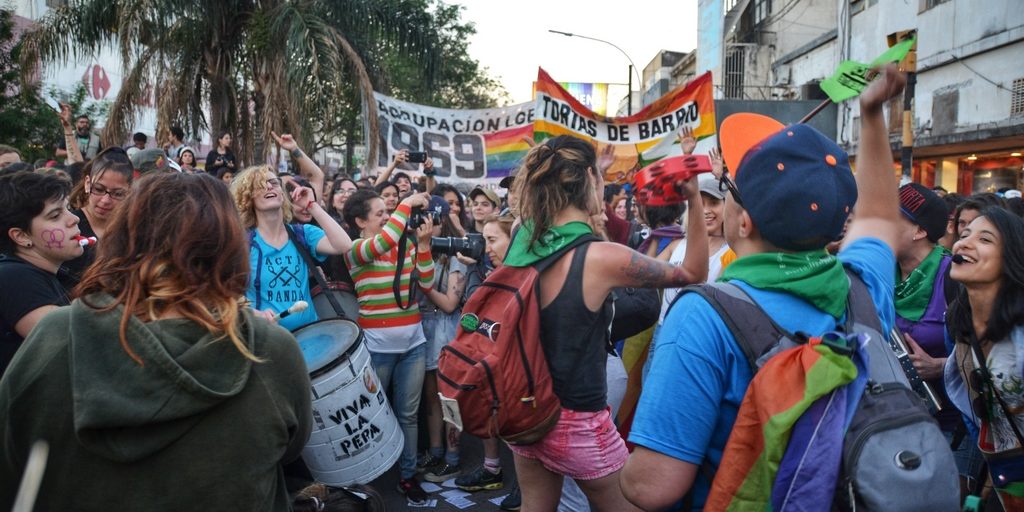
Photos: Jessie Insfran Pérez. Hundreds of women participated in the "Proudly Lesbian" march at the 32nd National Women's Meeting, which began this Saturday in Resistencia. Lesbian, trans, and bisexual feminists warned of the growing criminalization of lesbians and drew attention to the recent arbitrary arrests in Buenos Aires and Resistencia. For the first time in 32 years, the lesbian march and festival were included in the official program of the event. The march departed from downtown Resistencia shortly after 7:00 p.m., at the end of the first day of the National Women's Meeting. To the rhythm of drums and in a festive atmosphere, the marchers protested against criminalization, demanding greater visibility and greater freedom to express affection in public. Chants against repression and the government of Mauricio Macri were heard, as well as chants in favor of legal, safe, and free abortion. The name Higui de Jesús was repeated on signs and banners, which emphasized and reminded everyone that Higui was attacked for being a lesbian and imprisoned for defending herself against that attack by a gang of men. For Nélida Canulo, from the organization Las Safinas of Venado Tuerto (Santa Fe), the march serves as a platform for lesbians to demand “all rights, and for all women to be empowered.” “Those of us who are here are the ones who could come, and we traveled a whole day to get here. But there are others who couldn't come, and we have to share everything we've learned with them. That's why we march,” she said.
 “Lesbians present,” announced a large purple banner to passersby on the busy Arturo Illia pedestrian street. It was held by two members of the La Fulana collective, an organization of lesbian and bisexual women from the City of Buenos Aires. Daniela Serín, an activist with La Fulana for seven years, told Presentes that she participates in the Proudly Lesbian March because of her “political identity.” And that she has participated every year.
 Serín noted that this 32nd edition of the Encuentro (Meeting) marks the first time this march has been included in the official program. She considered it "part of the achievements of the lesbian community." However, she asserted that "there is still much to be done" regarding the visibility of lesbians. She cited the example of two cases of police harassment against lesbians in recent weeks: the arrest of Mariana Gómez for kissing her partner, Rocío Girat, at the Constitución train station in Buenos Aires, and the threats made by a police officer to a lesbian woman kissing another woman in a plaza in Resistencia a few days later.
Daniela Serin (The Fulana)
“The fact that something as commonplace as a kiss generates so much social outrage makes you rethink how much we still have to do. We have some rights enshrined in law, such as same-sex marriage or the gender identity law, but there is still much to be done socially,” Serín reflected.“Here we can kiss without fear”
Dayana Guiot, 27, was threatened by a police officer in Resistencia. Yesterday, she participated in a march with her fellow members of the organization Horda de Lesbianas (Lesbian Horde). Walking beside her was Iris Yacuria, the woman who was kissing Guiot when the officer approached. “We were in the plaza when a police officer came and asked us to leave, arguing that it was a family-friendly place and there were children present. I refused because I know my rights. But after a brief discussion, he threatened to arrest us,” Guiot told [the news outlet]. Present. The threats occurred just two weeks ago, a few days after Mariana Gómez's arrest in Buenos Aires. “Police repression is rampant. And now we're simply afraid to walk past a police officer for fear of being arrested. But today Iris told me she wasn't afraid to go out. That here at this march we can kiss without fear, because we're all united,” Guiot said.

“We have to take to the streets”
Antonela Diriso, from Bisexual Feminists, declared that “we have to take to the streets,” because that is where lesbians and bisexuals experience the most violence. “We have to take to the streets so we can kiss in front of whomever we want,” she affirmed. Her colleague, Selene Rodríguez, added that Argentina is facing a “neoliberal onslaught” that is “trampling on the rights of women’s dissidents and diverse femininities.” She also said that the recent arrests and police threats are a response to “a right-wing political climate” that seeks to “snatch away the rights and demands won through struggle.” “We cannot allow this, and that is why we are here to resist. The right wing benefits from a family model based on monogamy, one that is functional for capitalism. The traditional model in which a man and a woman have children and work to support them. We, the dissidents, lesbians, bisexuals, are disruptive because we do not conform to those models of affection and desire, and that is not convenient for them to continue reproducing capitalism and patriarchy,” she emphasized.
 Another participant in the march, Bárbara Oliva, who runs a comprehensive sexual health counseling service in Malvinas Argentinas, lamented the lack of adequate medical care for lesbians. “The State continues to marginalize us, and society is not prepared for us. That's why we're here, so they'll start listening to us,” she emphasized. The Proudly Lesbian March concluded with a music festival in Plaza Belgrano, marking the end of the first day of the National Women's Meeting (ENM), which will end this Monday with the closing ceremony. Earlier in the day, at the opening of the historic and unique event, Nuria Benítez, from Horda de Lesbianas (Lesbian Horde), had pointed out, during the reading of the inaugural document, that we are experiencing a rise in lesbotransphobia. At that time, the transfemicide of Aldana Palacios in Resistencia in 2014 was also remembered. Sofía Díaz, a trans woman and member of the organizing committee, said that trans people continue to suffer oppression and discrimination in health and education. She also denounced Resistencia for not regulating the trans employment quota. She called for Higui's acquittal. And she closed her speech with "Lohana Berkins, present."]]>
We are present
We are committed to journalism that delves into the territories and conducts thorough investigations, combined with new technologies and narrative formats. We want the protagonists, their stories, and their struggles to be present.
SUPPORT US

FOLLOW US
Related notes

We are present
This and other stories are not usually on the media agenda. Together we can bring them to light.
Beautiful note and beautiful march, it's a luxury to be able to march with such a rhythm.