

A police officer in Tucumán assaulted her for being trans: she recorded it with her cell phone
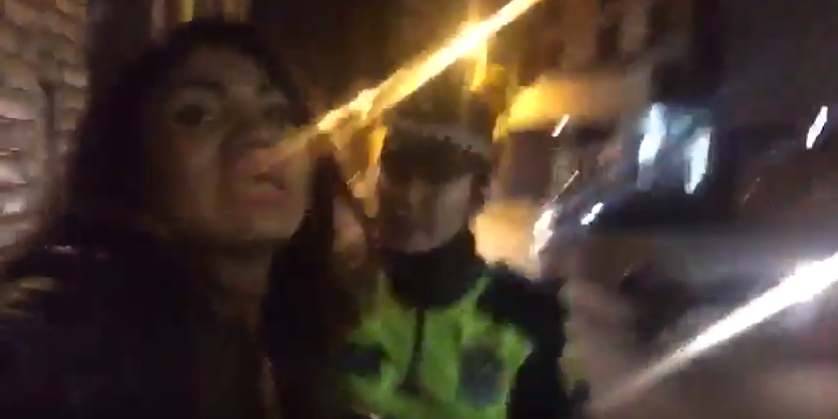
In the early morning of September 30, Aracely Figueroa, 26, was on the corner of Buenos Aires and Crisóstomo Alvarez streets in the city of San Miguel de Tucumán. A police officer approached her and physically, psychologically, and verbally assaulted her because of her gender identity.

Share

By María Eugenia Ludueña Archive photos and AF video In the early morning hours of September 30, 26-year-old Aracely Figueroa was standing at the corner of Buenos Aires and Crisóstomo Alvarez streets in the city of San Miguel de Tucumán. A police officer approached her and physically, psychologically, and verbally assaulted her because of her gender identity. Aracely reported the incident to the First Police Station. "I was discriminated against, and she treated me as if I were worthless the entire time," she stated in her complaint. She demanded that action be taken against the officer, adding, "A homophobic person cannot be part of the police force." “I was on the corner where I’ve hung out for years. Luckily, I had my cell phone and I started recording what happened,” Aracely told Presentes. “Get out of here, you fucking faggot.” “Wait, girl. What’s wrong with you?” Aracely says he asked her. “Get lost, you disgust me. People like you shouldn’t exist.” “Speak to me properly. Just because you have a badge and a suit doesn’t mean you can talk to me like that.” “Die.” “Respect me.” Aracely told Present She pulled out her phone: “I couldn’t film everything, but I did see the police approach me and forcibly take my phone. Then they hit me, grabbed my hair, pushed me, and threw me against the wall. I fell on my arm, which had recently been operated on, and where they put pins in after a fall. I have bruises that prove the blows.” More patrol cars arrived. “First, three female officers tried to grab me. Even the duty officer came. There were about ten officers. They asked me not to press charges. But I know my rights. I’m not a criminal. Six months ago, a woman was dragged from that corner to have her purse stolen. Where were they then?”
"I go out into the street because I have no other choice."
“I left here for so many reasons!” Aracely sighs, half angry, half sad. She was born in Tucumán. “I’ve been trans since I was very young, since I was 12. My family always supported me. At 16, I decided to go to Buenos Aires; I was going to be ruined here. They tried to rape me, and I escaped. After a month and a half there, things went so well that I had surgery and got implants. Then I traveled through Europe, Chile, Mexico, Panama, and Venezuela. The first time with a client. Then I got the hang of it and kept traveling alone. I saw the world through work.” Aracely returns to Tucumán to visit her family once a year. This time she came back earlier than expected “because I fell, broke my elbow, and they had to operate on my arm.” “I go out on the street because I have no other choice. I finished elementary school, but they required me to dress as a boy to go to high school, so I dropped out.” "I've worked for years on the corner where this happened. I sit here, I'm not bothering anyone. There's no school or church nearby that would prevent me from being there. I don't draw attention to myself. I was still recovering from surgery, but I have to work because I have to eat," she told Presentes."A homophobic person cannot be in the police force."
She says she had never experienced violence so directly. “The police made me slam against the wall. I told her, ‘Hey, I’ve had surgery, don’t hit me.’ If she had asked me nicely, it would have been different. But she came to assault and discriminate against me. A homophobic person shouldn’t be in the police force.” When she asked for the name of the officer involved, they told her it was Cuevas Vallejo. That’s the name on the complaint. Aracely says that after the incident, which was caused by the police, the other officers accused her of resisting arrest and threatened to detain her. “They made me sign a form for resisting arrest. I shouldn’t have had to sign it, but they told me that if I didn’t, they would hold me for a week at the police station.” When she was released, she filed a complaint against them. “They messed with the wrong girl. Recently here in Tucumán…” They killed Ayelén, "One of the most beautiful women from Tucumán. Years ago, the police had already raped her and she reported them," he said.[READ MORE: Transvesticide in Tucumán: Ayelén Gómez was found at the Lawn Tennis Club ]
Through a lawyer, Aracely asked the Ministry of Justice and Human Rights to request information from the police station regarding the complaint of injuries, mistreatment, and discrimination.What happens at night in Tucumán
Aracely's video was shared and flooded the WhatsApp groups they had created to look out for each other, to check that everyone was there. "Aracely's case shows what life is like at night in Tucumán," says Mahia Moyano. She's about to turn 30 and is one of the members of a new organization: LOTO. "Since the Ayelén's murder “The trans women from the Open Doors Trans Education Center (Cetrans), where I’m finishing high school, and other activists and independent women, organized ourselves,” says Mahia, the standard-bearer for Cetrans. She’s finishing high school and plans to study Literature. LOTO: Organized Trans Freedom and Pride. One of the new group’s urgent tasks, in addition to training its members on their rights, is to support reports of police violence. “The police take over the streets at night and abuse their power, especially against trans women who work on the streets and also in the most vulnerable neighborhoods. But I must say that lately we’re suffering attacks from all sides, not just from the police. Also from public agencies and hospitals,” says Mahia. Photo: Ignacio López/Presentes Archive



1 Comment