

#MEDIA How to tell the story of diversity: LGBT stories in the first person
Diverse families and gender identities take center stage in Zoom to LGBT Rights, an initiative of the Ombudsman's Office. Here you can watch six audiovisual productions designed and starring organizations representing sexual diversity.

Share

Diverse families and gender identities take center stage in Zoom to LGBT Rights, an initiative of the Ombudsman's Office. Here you can see six audiovisual productions designed and narrated by LGBTQ+ organizations. How can we include the voices and perspectives of LGBTQ+ people in audiovisual media? How can we do so without stigmatizing them or turning them into something "curious" or "exceptional"? How can we build pluralistic, non-discriminatory, and democratic communication that incorporates a gender perspective? These were some of the questions that drove Zoom to LGBT Rights, the initiative presented by the Ombudsman's Office after intensive work with civil society organizations that fight for the rights of lesbian, gay, bisexual, transvestite, transgender, and intersex people. The results premiered yesterday. Six audiovisual productions on family diversity and gender identities: two radio pieces and four videos, all produced in conjunction with the Ombudsman's Office and featuring the organizations 100% Diversity and Rights, the Association of Transvestites, Transsexuals and Transgender People of Argentina (ATTTA), the Mocha Celis Trans Popular High School, Conurbanos por la Diversidad, the Trans Art Cooperative, and the Argentine Federation of Lesbians, Gays, Bisexuals and Trans (FALGBT). Each organization was responsible for the design, production, and creation of their piece.
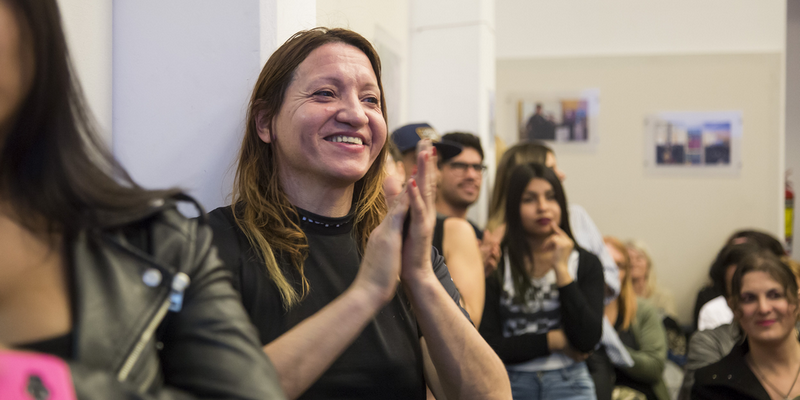
 Yesterday, the headquarters of the Ombudsman's Office (responsible for promoting, disseminating, and defending the right to democratic communication for audiences of audiovisual media throughout the country) was filled with the activists who participated in these productions.
Transgressive Visibility: Trans Art Cooperative

"It is important to make visible and inform, to highlight what we are and to be who we want to be," said the Trans Art Cooperative before presenting their news program, produced by trans people.
Love transforms: Suburbs for Diversity
“We need these kinds of proposals,” said Juampi, from Conurbanos por la Diversidad (Suburbs for Diversity).The media can work against us and generate discriminatory views. This diverse family is a project of love; these are the stories we need,” she said. The piece, originally intended for radio, tells the story of a non-heteronormative couple.Integrated: ATTTA
Vanesa and Julián presented this piece that poses the question: what would it be like to live in a world that discriminates against you? They especially thanked the families who helped make the spot "and the transition." "We are looking for new representations in our activism spaces," they said.All families with all rights: One hundred percent diversity and rights
“Diverse families exist; they weren’t created by laws,” said Greta Pena of One Hundred Percent Diversity and Rights. “The Ombudsman’s Office is a crucial organization for the LGBT community,” she emphasized.
Reality My Way: Mocha Celis Trans Popular High School
The members of Mocha Celis explained that their video was inspired by the reality they experienced in previous decades, especially during the dictatorship. "They would arrest us for anything, even just to buy bread." Many things have changed, they emphasized. "But girls from the provinces are still arrested by the police for anything."
Trans aunt: FALGBT
The story of Vida, a trans woman, and her niece Clarita, is told in radio format and talks about family ties. "Since its creation in 2012, the Ombudsman's Office has worked for inclusion and collective equality. For some months now, the institution has been weakened, as it does not have an Ombudsman; however, the team has taken on the task of moving forward with the same convictions as its origins," said María José Guembe, director, before the presentations began. He recalled that in addition to receiving complaints that They object to media discourses for violating rights, and manage solutions to repair and balance voices; the work of the Ombudsman in the dispute of meanings also involves proposing new representations. To that end, Zoom formed an alliance with LGBTI organizations and "relied on the sexual diversity movements, which contributed their experience, sensitivity and ideas."
 Romina Coluccio, from the The Ombudsman's Office's Training and Promotion Department reported that between 2015 and 2016, the agency worked on a Guide for Responsible Journalistic Treatment of Gender Identities and Sexual Diversity. They also raised the need to advance public policies for the social inclusion (material, symbolic, and representational) of people in the LGBTTTIQ community (lesbian, gay, bisexual, transgender, transvestite, intersex, and queer). Zoom emerged along this path, "as "A specific policy to raise awareness of rights and collectively adopt good communication practices," Coluccio said. The work was carried out between May and August. "For the Ombudsman's Office it was an innovative experience, a path of joy, work and effort. "We're premiering six productions, starting in May and continuing until the end of August with all of them." .
 Throughout the screenings, the same question was repeated several times: Where is Santiago Maldonado? His photo remained facing the audience during the event. Justice was also demanded for Diana Sacayán—Darío Arias of Conurbanos reminded everyone that the trial is imminent—and for Ayelén Gómez, the former student of Mocha Celis school murdered three weeks ago in Tucumán.
Photos: Ombudsman's Office]]>
Throughout the screenings, the same question was repeated several times: Where is Santiago Maldonado? His photo remained facing the audience during the event. Justice was also demanded for Diana Sacayán—Darío Arias of Conurbanos reminded everyone that the trial is imminent—and for Ayelén Gómez, the former student of Mocha Celis school murdered three weeks ago in Tucumán.
Photos: Ombudsman's Office]]>
We are present
We are committed to journalism that delves into the territories and conducts thorough investigations, combined with new technologies and narrative formats. We want the protagonists, their stories, and their struggles to be present.
SUPPORT US

FOLLOW US
Related notes
We are present
This and other stories are not usually on the media agenda. Together we can bring them to light.