

#PublicConsultation: LGBTI policies stalled in the region, according to complaints.
At the Fifth LGBTI Public Consultation, convened by the Institute of Public Policies on Human Rights (IPPDH) of MERCOSUR, more than 70 organizations from the region analyzed and debated how states protect the rights of lesbian, gay, bisexual, transgender, and intersex people. Stagnation and setbacks were discussed, and concrete proposals were made for more and better public policies that guarantee these rights.

Share

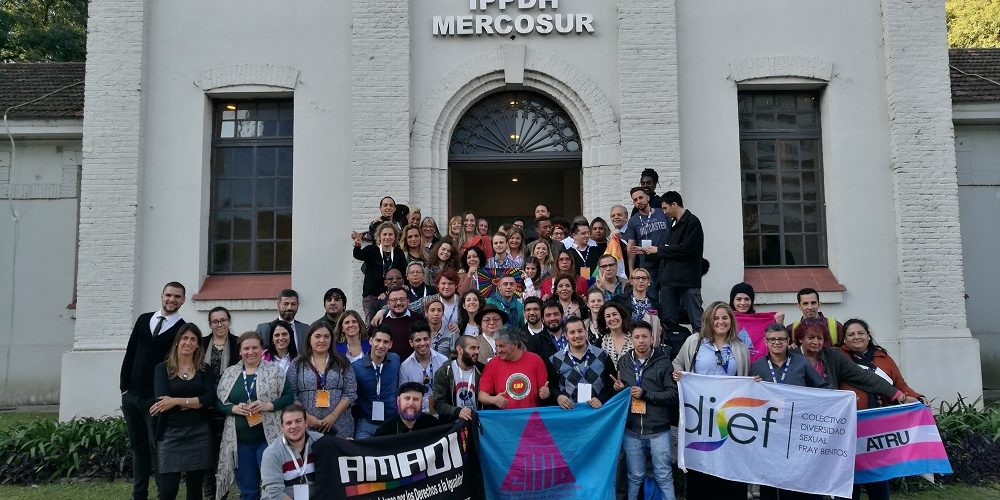
At the Fifth LGBTI Public Consultation, convened by the MERCOSUR Institute of Public Policies on Human Rights (IPPDH), more than 70 organizations from the region analyzed and debated how states protect the rights of lesbian, gay, bisexual, transgender, and intersex people. Stagnation and setbacks were discussed, and concrete proposals were made for more and better public policies that guarantee rights for all. Activists from sexual diversity organizations and movements in Argentina, Brazil, Paraguay, and Uruguay made their voices heard at the LGBTI Public Consultation convened by the MERCOSUR Institute of Public Policies on Human Rights (IPPDH). The hearing—the fifth in a series of consultations inviting civil society, and the first focused on issues concerning lesbian, gay, bisexual, transgender, and intersex people—was held at the Institute's headquarters, on the grounds of the former ESMA Memory and Human Rights Space, in the City of Buenos Aires, on August 17. How can the rights of LGBTI people be protected? What efforts should the States of the region coordinate? These were the questions that guided the day's discussions in its various sessions. More than 70 representatives from civil society organizations, authorities from MERCOSUR countries, and international organizations participated.
 The morning included individual presentations and plenary sessions. In the afternoon, participants worked in groups on key themes such as justice, work, health, families, memory, truth, justice and historical reparations for LGBTI people, and politics, among others. The event concluded with a sharing and exchange of insights on each of these themes. There was also time to tour the facilities of the building that housed a clandestine detention center emblematic of state terrorism.
"Paraguay is not making progress on human rights"
Adriana Peroni, representing the lesbian organization Aireana (Paraguay), spoke about the human rights situation in Paraguay and critically noted, among other things, that the government itself, through its representatives, has publicly stated that "Homophobia does not exist in Paraguay." "How can they create public policies for a population they consider nonexistent?" she asked. She also denounced her country's failure to guarantee the rights of incarcerated individuals, especially lesbians, who are denied access to sexual relations within prisons because they are required to present a marriage certificate—a requirement not imposed on heterosexuals, Peroni explained. Yren Rotella, also Paraguayan, from the organization Panambí, stated: “Paraguay is not making progress on human rights. We feel it firsthand. There are no public policies aimed at LGBTI people. We are concerned about the impunity surrounding the crimes committed against so many trans women.”
 [READ MORE: Public consultation: How to guarantee the rights of LGBTI people in Mercosur?]
The main concerns
Most of the organizations present shared the concern about the stagnation of public policies on the rights of LGBTI people in the region (In the case of Argentina, the discussion focused on the lack of or cuts to budgets and programs), hate crimes based on gender identity or sexual orientation, and the violence perpetrated when judicial investigations into crimes against LGBTI people stall. From the Puertas Abiertas Trans Educational Center in Tucumán, one of its members, Claudia, addressed those present about the recent transphobic murder of Ayelén Gómez. "Ayelén's is not the first transphobic murder in Tucumán, but it is the first where voices are being raised demanding justice," she emphasized.More institutional violence, fewer policies
From One Hundred Percent Diversity and Rights, Ricardo Vallarino stated: “We are concerned about the increase in institutional violence, especially against trans people. We only have one case of transphobic murder that is progressing through the justice system, that of Diana Sacayán. Many hate crimes go uninvestigated.”From Conurbanos por la Diversidad (Suburbanites for Diversity), Darío Arias spoke of "a breaking point in the progress made in Argentina." "There are denialist views and hate speech that encourage some sectors to feel they can attack LGBTI people. This coexists with a dismantling of LGBTI public policies and an increase in institutional violence against transvestites and trans people.""We are concerned about institutional violence, especially against trans people," says Ricardo Vallarino @100_porciento #LGBTIPublicConsultation pic.twitter.com/7yfwBAKA5N
— Presentes Agency (@PresentesLGBT) August 17, 2017
Claudia Vega, from AMI (Association for an Equal World), proposed: “We must leave here with a declaration of emergency. In Argentina, we are a leading country in terms of LGBTI rights, but there has been a regression and a dismantling of policies by the current government.” Later, in an interview with Presentes, Vega elaborated on how Argentina’s setback impacts other countries in the region, where LGBTI people are more vulnerable in terms of legal protections.[NOW] "We are seeing an increase in hate speech and impunity; they feel they can attack LGBTI people," Darío Arias said at the #LGBTIPublicConsultation pic.twitter.com/2C1lquPSmE
— Presentes Agency (@PresentesLGBT) August 17, 2017
 Sasha Sacayán, Diana's brother and a leader of MAL (Anti-Discrimination Liberation Movement), shared the idea of the increase in violence: "Not only has institutional violence increased, but all types of violence. We believe there has been a dismantling of the public policies we have achieved. Our organization is based in the greater Buenos Aires area. Something as simple as gender-friendly clinics has been eliminated in our region. Many of our members today do not have access to healthcare because they continue to be expelled from these places."
 Walter Torres, from the Diversity Roundtable of Río Cuarto (Córdoba), stated: “I would like the officials who were present at the opening to stay and listen to us. It has been said that Argentina is a leading country, but we have to ask ourselves how to move from legal equality to real equality.”
Conclusions by axis
Regarding specific topics, these were some of the ideas and proposals discussed: Access to and enjoyment of rights and spaces for political representation: participants spoke of the urgent need to guarantee social security for older transgender people. They also discussed the exchange of technical and parliamentary strategies among the countries of the bloc. Memory, truth, justice, and historical reparations for LGBTI people: demands included incentives for studies on memory recovery and public policies directed toward the armed forces and security forces. The creation of specialized prosecutor's offices was also called for.
 Education and health: Pathologizing views were condemned. Proposals for ongoing diversity training for educators were heard, and demands were made for compliance with the Comprehensive Sex Education Law (Argentina) and for progress toward the effective implementation of gender identity laws (Argentina). Right to decent work: Protection and access to employment were requested for all people in the region, including those living with HIV, and for efforts to combat discrimination against migrants. The urgency of implementing the trans employment quota was discussed; in the province of Buenos Aires, this remains only a matter of law, without yet being regulated.
 Human mobility, culture, and ethnicity: the importance of inclusive migration policies that consider LGBTI migrants was discussed. Diverse families: one of the most relevant issues: guaranteeing means for family formation and non-discriminatory adoption laws (regardless of marital status, sexual orientation, or gender identity). The need for states to develop strategies for MERCOSUR citizens who have access to same-sex marriage in Argentina but reside in other countries where it is not legal was also addressed.
 Politics: Emphasis was placed on public budgets and funding for public policies for LGBTI people. States were asked to guarantee funding lines for the participation of LGBTI organizations. The IPPDH reported that the Public Consultation "also served as a space for exchange and collaboration between social organizations and international bodies that have incorporated LGBTI issues into their agendas." Among those present were Diego Beltrand, Regional Director for South America of the International Organization for Migration (IOM); Michelle Di Nissa, of the United Nations High Commissioner for Refugees (UNHCR); Eugenia Carbone of the Auschwitz Institute; Carlos Passarelli, Director of UNAIDS; and Miguel Mesquita of the IACHR. State representatives included Diego Borisonik, Director of Comprehensive Sexual Diversity Policies of the Secretariat of Human Rights and Cultural Pluralism of Argentina; Felipe Lopes, from the Brazilian Embassy; and Carolina Eymann, from the Ministry of Foreign Affairs.
 In the morning, at the opening session, Marcelo Ferreyra, from Akahata (Argentina), had highlighted the importance of the contribution that these public consultations make to civil society: and of “Regional coalitions to prevent all forms of discrimination and intolerance.”
]]>
In the morning, at the opening session, Marcelo Ferreyra, from Akahata (Argentina), had highlighted the importance of the contribution that these public consultations make to civil society: and of “Regional coalitions to prevent all forms of discrimination and intolerance.”
]]>
We are present
We are committed to journalism that delves into the territories and conducts thorough investigations, combined with new technologies and narrative formats. We want the protagonists, their stories, and their struggles to be present.
SUPPORT US

FOLLOW US
Related notes


We are present
This and other stories are not usually on the media agenda. Together we can bring them to light.
1 comment