

Being Indigenous and LGBT in Honduras: Gaspar Sánchez's Two Flags
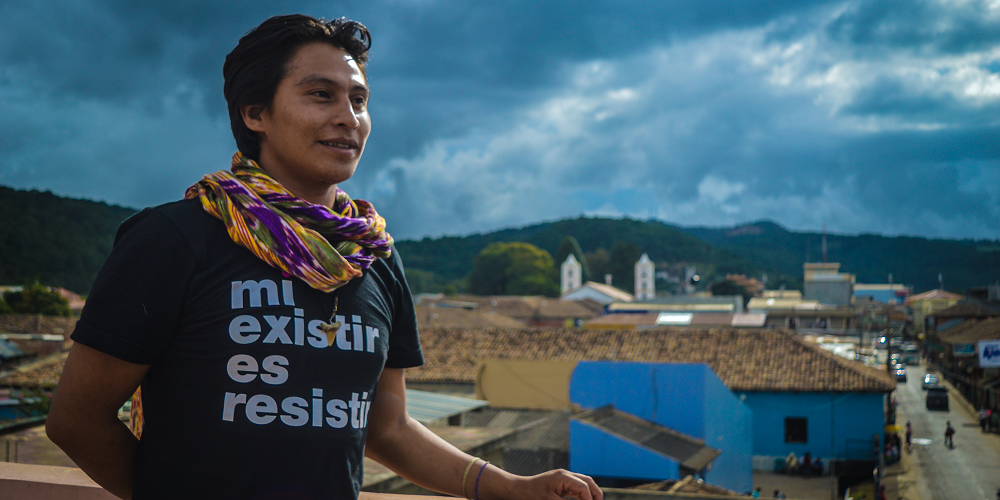
Gaspar Sánchez became a human rights activist alongside Berta Cáceres, the Honduran social leader assassinated in 2016. She encouraged him to live freely as a man. At 24, Gaspar proudly waves the rainbow flag and the Wiphala of the Indigenous peoples. He is one of the young Lenca people who keeps the legacy alive: the fight for the environment, Indigenous identity, and sexual diversity.

Share

Gaspar Sánchez became a human rights activist alongside Berta Cáceres, the Honduran social leader assassinated in 2016. She encouraged him to live freely as a man. At 24, Gaspar proudly waves the rainbow flag and the Wiphala of the Indigenous peoples. He is one of the young Lenca people who keeps the legacy alive: the fight for the environment, Indigenous identity, and sexual diversity. By Jennifer Avila Reyes , from La Esperanza. Photos: JAR. At age 7, Gaspar Sánchez realized he didn't fit into the heteropatriarchal society he was born into. He was a Lenca boy, from one of the most marginalized Indigenous communities in Honduras, living in poverty in La Esperanza, a town 191 kilometers from the capital, Tegucigalpa. “I knew it from the age of 7, I knew I liked people of the same sex, but I didn't say anything.” His act of rebellion was deciding he didn't want to go to school anymore. He was 10 years old when Berta Cáceres, the social leader assassinated on March 3, 2016, became like a second mother to him. She immersed him in the school of human rights activism. This led Gaspar to
COPINH (Civic Council of Popular and Indigenous Organizations of Honduras), which fights, among other things, for environmental protection and the preservation of Lenca culture. COPINH was founded by Berta Cáceres in 1993. It was there that Gaspar learned to fight not only to defend his rivers but also against racism and homophobia, because COPINH defines itself as anti-patriarchal and anti-racist. To earn a living, Gaspar sold donuts on the street and in the afternoons went to the organization. “When you’re little, you can’t decide for yourself. So when I turned 18, I broke free. I started dyeing my hair, dressing the way I liked, and a lot of my classmates told me they couldn’t believe it. But Berta told me not to be ashamed and encouraged me,” says Gaspar, now 24.
 Mural in homage to Berta Cáceres in La Esperanza.
Gaspar’s home, where he spends very little time, is located on land that was reclaimed by Indigenous people 10 years ago. As he walks down a pitch-black street in the Buenos Aires neighborhood of La Esperanza, Gaspar remembers that when he was a child, all of this was just overgrown scrubland, without electricity or running water. An inaccessible place where he and his seven siblings grew up.
“When I told my mom, ‘I’m gay,’ she worried about what people would say. But I told her that didn’t matter, that this was who I was, and that I wasn’t the first or the last to come out,” he recounts.
His mother, he says, suffered greatly. She gave birth to 14 children, six of whom died from illnesses she could never diagnose because there was no hospital in the village where she lived. Gaspar is the youngest, the only one still living at home.
For two years, one of his older brothers wouldn't speak to him. "Forget you're my brother if you're like this," he told him, until he understood he had to accept it.
The fear of what others would say translated into violence. On his forehead, Gaspar bears a scar from a blow inflicted by a neighbor who began harassing him after he questioned the way power was wielded in the community. Feeling threatened, the man attacked him because of his sexual orientation, culminating in an extreme act of aggression: a blow that split his forehead.
Mural in homage to Berta Cáceres in La Esperanza.
Gaspar’s home, where he spends very little time, is located on land that was reclaimed by Indigenous people 10 years ago. As he walks down a pitch-black street in the Buenos Aires neighborhood of La Esperanza, Gaspar remembers that when he was a child, all of this was just overgrown scrubland, without electricity or running water. An inaccessible place where he and his seven siblings grew up.
“When I told my mom, ‘I’m gay,’ she worried about what people would say. But I told her that didn’t matter, that this was who I was, and that I wasn’t the first or the last to come out,” he recounts.
His mother, he says, suffered greatly. She gave birth to 14 children, six of whom died from illnesses she could never diagnose because there was no hospital in the village where she lived. Gaspar is the youngest, the only one still living at home.
For two years, one of his older brothers wouldn't speak to him. "Forget you're my brother if you're like this," he told him, until he understood he had to accept it.
The fear of what others would say translated into violence. On his forehead, Gaspar bears a scar from a blow inflicted by a neighbor who began harassing him after he questioned the way power was wielded in the community. Feeling threatened, the man attacked him because of his sexual orientation, culminating in an extreme act of aggression: a blow that split his forehead.
[READ MORE: This is the map of homophobia in the world]
Gaspar reported it to the police and the Public Prosecutor's Office. He has also filed complaints against police officers with the Human Rights and Ethnic Affairs Prosecutor's Office for preventing him from visiting fellow prisoners simply because he has long hair and wears tight clothing. He is not afraid; he knows it is his right to report the incident and not be discriminated against. In 2012, Gaspar began working at Radio La Voz Lenca, a community radio station that the organization uses to share the realities of this indigenous group, which numbers barely 600,000 inhabitants in Honduras. An impoverished people living in a rich territory, but one controlled by a select few.
Indigenous and LGBT, double discrimination
Gaspar says that when he decided to come out, he found a space within the organization where he could grow, learn, and be heard. Now he's part of the general coordination team and is in charge of issues related to sexual diversity. He learned all of that at COPINH, in addition to the defense of natural resources, the struggle for which Berta was killed in the resistance against a hydroelectric project built on a sacred river of the Lenca people. “When they killed our comrade, we couldn't accept it. Now we continue this struggle because by killing Berta they thought they would end COPINH, but it didn't,” says Gaspar. Today, on his radio program The voice of wiphaláShe talks about human rights, about the double discrimination experienced by indigenous people who are also LGBTI and therefore carry a double stigma, and seeks to organize a community in that small, still sexist town.
“We gave it the voice of wiphalá “Because the flag of Indigenous peoples is multicolored, like our LGBTQ+ flag, because that’s who we are—diverse,” explains Gaspar, who flies both flags not only in Honduras, but also in several Latin American countries, or Abya Yala, as he calls it. In October 2017, he will tour several cities in the United States to speak about sexual diversity and Indigenous peoples.
Today, on his radio program The voice of wiphaláShe talks about human rights, about the double discrimination experienced by indigenous people who are also LGBTI and therefore carry a double stigma, and seeks to organize a community in that small, still sexist town.
“We gave it the voice of wiphalá “Because the flag of Indigenous peoples is multicolored, like our LGBTQ+ flag, because that’s who we are—diverse,” explains Gaspar, who flies both flags not only in Honduras, but also in several Latin American countries, or Abya Yala, as he calls it. In October 2017, he will tour several cities in the United States to speak about sexual diversity and Indigenous peoples.
"There is no room to celebrate pride, we demand that they don't kill us."
“It’s sad to know that we are so far behind, that we live in a country where when We hold gay pride marches; what we demand is that they don't kill us.. There is no room to celebrate who we are. “I was once at the Pride parade in Cuba and it was so beautiful, a space to show love, to introduce couples, to let loose. In Honduras, we ask that our rights be respected because that's what happens; we experience a lot of discrimination,” she says. Honduras is one of the most violent countries in the world. After a coup in 2009, the homicide rate rose to 90 per 100,000 inhabitants. “Report on violent deaths of the LGBTI community 2017”The lesbian organization Cattrachas reports that between 1994 and 2017, 153 violent deaths against people were recorded in Honduras, of which only 54 cases have been brought to court.
"A world where we all fit"
Gaspar's utopia is to organize a community of multicolored flags in La Esperanza, so when he arrives from his tours accompanying Lenca communities in resistance he visits Candy, a girl trans A very cheerful woman who spent her entire childhood and adolescence working as a farm girl with her father. When she transitioned out of the workforce, she decided to start her own business, a beauty salon. There, Gaspar has invited several young men and women to meet and talk about human rights and the possibility of organizing. Only two show up. Gaspar tells them about his experiences, explaining that discrimination isn't normal and that together they can confront it. Candy wants to join, even though she says her skin has thickened from so much harassment; it doesn't hurt her anymore. But Gaspar dreams of having a space where everyone is equal. “My utopia is that we live in a world where everyone fits in, that’s what I want,” says Gaspar as he packs his backpack to leave again and continue fighting with his multicolored flags. Flags that speak of the vital energy of Indigenous peoples, connected to Mother Earth, and also of diversity as something completely natural.]]>
We are present
We are committed to journalism that delves into the territories and conducts thorough investigations, combined with new technologies and narrative formats. We want the protagonists, their stories, and their struggles to be present.
SUPPORT US

FOLLOW US
Related notes
We are present
This and other stories are not usually on the media agenda. Together we can bring them to light.
I had the pleasure of meeting Gaspar (and taking a couple of photos of him). He is an extraordinary person and full of strength.