

#PERU LGBT series and videos on the internet, against sexism and transphobia
Peru's first LGBT web series, "Don't Mess With My Boyfriend," already has a large audience eagerly awaiting its second season. It's not an isolated phenomenon: videos showcasing open relationships and films starring trans people, like "Without a Vagina, I'm Marginalized," are also popular. While television barely includes sexual diversity, often relegating it to the category of "curious characters," online, LGBTQ+ identities are building new frameworks for identification and positive reference.

Share

Peru's first LGBT web series, "Don't Mess With My Boyfriend," already has a large audience eagerly awaiting its second season. It's not an isolated phenomenon: these new Peruvian productions include videos showcasing open relationships and films starring trans people, such as "Without a Vagina, I'm Marginalized." While television barely includes sexual diversity, often relegating it to the category of "curious characters," online, LGBTQ+ identities are building new frameworks for identification and positive reference.
By Esteban Marchand, from Lima
Photos: EM
Until a few years ago, television was the primary platform for entertainment and the perpetuation of stereotypes, but today the internet is beginning to change some of the rules of the game. In Peru, new audiovisual productions are gaining ground, bringing LGBTQ+ issues to the forefront. They are communicating sexual diversity to audiences with a different approach than that promoted by the majority of legislators.
While the opposition parliamentary group in Peru has managed to obstruct measures to protect LGBTI people from violence and guarantee their rights—such as Decree 1323 —the audiovisual arts are experiencing the opposite. Thanks to platforms enabled by new technologies, projects are circulating that seek to showcase diversity in all its forms and colors.
Presentes spoke with a non-binary artist who has a music video dedicated to diverse love, the screenwriter of a gay-themed series, and the star of the first comedy film that tells the story of a Peruvian trans woman's journey. They discussed representation in the entertainment industry as a crucial element in shaping diverse identities, building role models, stereotypes, and prejudices.
“So much love and so ashamed”
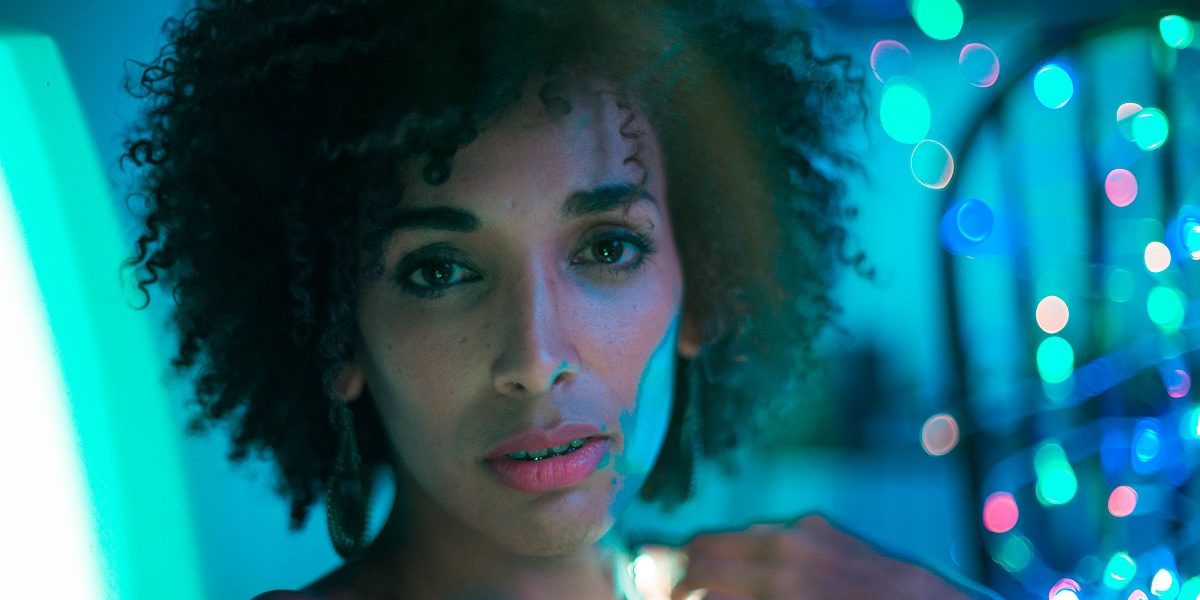
Merian prefers not to define themselves: neither man nor woman, but rather a non-binary person (NBP). On LGBTQ Pride Day, they presented a music video for "Cardo o Ceniza" (Thistle or Ash), a song by the renowned Peruvian singer-songwriter Chabuca Granda, with an innovative approach. The song tells of a forbidden, intergenerational love between a man and a woman. "So much love and yet so ashamed," the lyrics say. In Merian's video, people of diverse ages and sexual orientations openly display their affections, free from stereotypes of any kind.

Meiran prefers not to define herself as a man or a woman, but as a non-binary person.
She received many comments highlighting the beauty of humanity. “It’s the story we humans end up repeating era after era: prohibiting some form of love, censoring it, judging it, and saying it’s wrong and sinful,” Merian told Presentes. Through this video, she wanted to talk not only about the encounter between people through love but also through desire and the body.

“It’s really important to start reclaiming bodies, in a context where we’re told that a body must be a certain way to be beautiful. Or you can’t be fat, dark, or brown,” Merian says. She firmly believes that the fight for LGBTQ+ rights doesn’t unfold in isolation from other struggles: the feminist struggle or the fight against racism.
Don't mess with my boyfriend.
"Don't Mess With My Boyfriend" is a fictional web series. Its title is a nod of resistance to the "Don't Mess With My Kids" , spearheaded by conservative groups that oppose the inclusion of a gender perspective in the educational curriculum.
The series—produced for the internet—tells the story of Alejandro (David Carrillo) and Pepe (José Dammert), a gay couple who must keep their relationship a secret. One of them is still in the closet.
The series, produced by Tribeca Digital, has already garnered over 89,000 views on its YouTube channel. Regina Limo, one of the writers of 'Don't Mess With My Boyfriend,' tells Presentes that they sought to portray a couple in the least idealistic way possible.
“When we talk about a gay couple, what you see in the media and on television is the young, fitness-oriented gay couple, and so on. We said we were going to try to move away from that,” he explains. In the series, the main characters interact with a rather effeminate best friend and an Afro-Peruvian lesbian woman.
Some episodes touch on topics like sexism and feminism. “Not in a preachy way. Sometimes we even approach it in a lighter, more lighthearted way.” Furthermore, it was ensured that a gender perspective was always present.
The series attempts to depict everyday situations that the Peruvian LGBTQ+ community can relate to. It also uses language and idioms very similar to those used by these groups.

Limo says that viewers have a special affection for this audiovisual production. This is reflected in the comments they receive. "People really identify with the situations involving couples, the arguments, the complexities between friends, and the gossip."
The first season of 'Don't Mess With My Boyfriend' has 10 episodes, which are now available on YouTube and Facebook. Regina Limo anticipates that they intend to make a second season.
Without a vagina, I am marginalized.
"Without a vagina, I'm marginalized" is a low-budget film, the story of a trans woman from Lima. Barbie wants to raise $30,000 to travel to another country. Her goal: to be able to undergo gender reassignment surgery.
A comedy starring trans actress and activist Javiera Arnillas. “I thought it was a strategic and very innovative approach to addressing these issues in such a conservative society. It aims to help the public and society see this reality in a lighthearted way,” Arnillas told Presentes.

Through humor, it portrays the harsh reality that many trans women in Peru face daily, unable to find job opportunities that match their abilities, simply because they are trans.
Javiera Arnillas points out that the film, directed by Wesley Verástegui and filmed entirely with a cell phone, did not use a cisgender male actor to play the role of a trans woman, as is often the case.
“What happens with other films is that sometimes other actresses who are trans are taken away from the opportunity. Trans women have similar experiences and life stories to the character, and that gives the role much more credibility,” she says.
The film does not yet have a release date in the country. So far, the reviews have been positive, and it has already received two nominations at the Alternative Film Festival .
Lesbians and gays on TV: alone and without a partner
This growing wave of audiovisual productions circulating via the internet is beginning to create positive role models, especially significant for those members of the community who do not yet know they are diverse or are just beginning to discover themselves.
The change is incipient, but it's beginning. "There's a sector that's demanding these kinds of series. Much of the entertainment is consumed online," says Regina Limo.
However, on television, gay men are still portrayed as single. And lesbian women are rarely seen. “Lesbians on television rarely have partners. They don't have romantic relationships. This representation is quite sterile. They're there like a small museum piece or the oddity they have in the cast,” Limo comments.

According to Gabriel de la Cruz, activist and director general of the NGO Presente, LGBT people have long been exposed to negative role models, “subjects of ridicule who have been mocked.” This has prevented many people from living freely, having grown up surrounded by a wall of prejudice.
The activist believes that these types of online audiovisual productions “are very isolated cases. This hasn't yet become a powerful and real issue of political impact.” However, he asserted that his NGO is already working with the Ministry of Culture to implement cultural policies that can gradually dismantle sexism, homophobia, and transphobia.
While there is still a long way to go in the Peruvian audiovisual sector, the change has already begun. Over time, it could help people build an identity based on pride, not fear, secrecy, and hiding.
We are present
We are committed to journalism that delves into the territories and conducts thorough investigations, combined with new technologies and narrative formats. We want the protagonists, their stories, and their struggles to be present.
SUPPORT US

FOLLOW US
Related notes
We are present
This and other stories are not usually on the media agenda. Together we can bring them to light.