

Growing old together, living in a “lesbian nursing home”
Among some lesbians, the idea of aging in community is circulating. The "lesbian community" is envisioned as a space for coexistence, collective care, and activism. This, in turn, sparks many reflections on the particularities of dissident identities and aging. How does one reach old age when so many basic rights have been violated? Who accompanies us in that stage of life?

Share

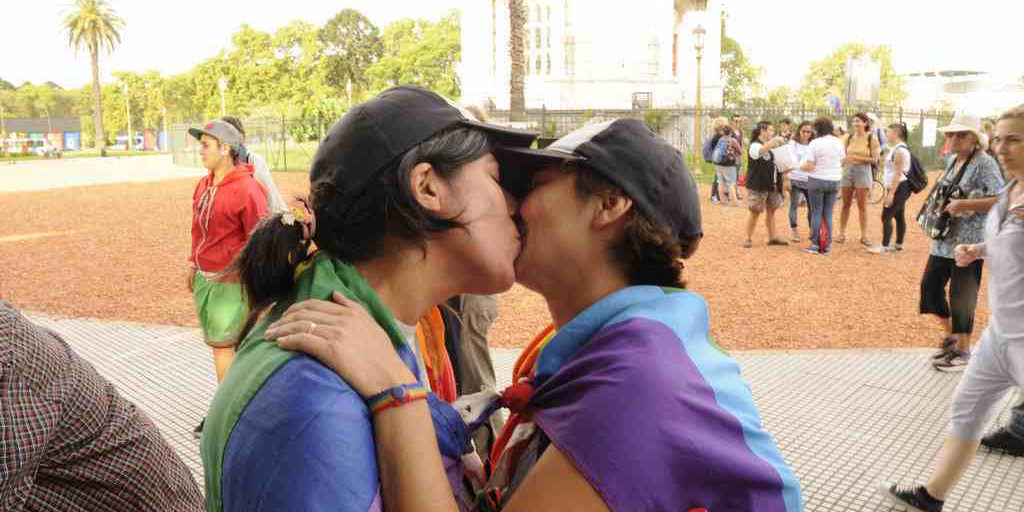
Among some lesbians, the idea of aging in community is circulating. The "lesbian community" is envisioned as a space for coexistence, collective care, and activism. This, in turn, sparks many reflections on the particularities of dissident identities and aging. How does one reach old age when so many basic rights have been violated? Who accompanies us in that stage of life? By Rocío Varela Photos: Ariel Gutraich and Mariana Leder Kremer "Where are we going to live when we're old?" That question comes up again and again in many conversations among lesbians, among friends. The fantasy: to grow old together. The question: how to achieve it. And from this unknown, others arise: how to reconfigure a collective economy of care. Is it possible to think about aging differently? Eugenia Murillo is a lesbian activist and member of the Permanent Lesbian Assembly, and she affirms that this question is always present: “What we’re thinking about now is how to make that idea tangible and real.” For some time now, the idea of creating a “lesbian-themed shelter,” a home where they can live together in community, has been circulating. Eugenia says the name originated as a joke, but that she gradually refined the concept: “We’re not just thinking about a house that addresses the issue of care for people, but also one that has resources and initiatives to keep activism and activism alive at this stage of life,” she explains. The idea aims—though not exclusively—at the continuity of lesbian activism, at continuing to generate spaces for debate and political and cultural exchange.

Culture and care
Although the project is still in its experimental stage, the main pillars are already being defined. Eugenia explains that one of the keys is creating a significant cultural space: “A library where people can share readings, form discussion groups, watch films, and engage in various creative activities that keep the mind constantly active.” Eugenia explains that the project team believes this aspect of life has immense potential that needs to be nurtured.[READ ALSO: When the medical system violates the rights of LGBT people]
Many LGBT people severed ties with their biological families when they came out. That is “the first oppressive entity,” in Eugenia’s words. The intention is that this idea will function like a cell and replicate, so that a different notion of aging in community can be expanded, facilitating activity in that final stage of life.Practical ideas
Regarding funding, those planning the lesbian community have considered—for now—two different approaches. On the one hand, they believe that “perhaps there are older lesbians who own a house with one or two unused rooms that they could open up to use as a home for other older lesbians.” For this to happen, Eugenia says it's first necessary to identify people who want to be part of this project and “see what their needs and expectations are regarding sharing a communal house.” The operation would be communal in terms of the division of tasks within the house, “which is why we need to establish certain rules of coexistence, agreements, and consensus, which are also in the experimental stage and which each house will create according to the needs of its residents,” Eugenia emphasizes. Thus, the key is for the houses to connect through shared experiences and gradually refine the idea.
How sexual dissidence ages
Sebastián Amaro is a sociologist specializing in gerontology, and he believes there are certain differences between the aging of homosexual and heterosexual people. He begins by explaining that all of a person's life experiences influence how they age, and "the way a person lives with a particular gender identity or a non-heteronormative sexual orientation also affects the aging process, because it influences how the psychological aspects are structured: a person's self-esteem, their ability to cope with others, and the fears and anxieties that shape their subjectivity."[READ ALSO: To provide reparations to trans and travesti victims of police violence]
According to Amaro, based on these particular configurations, many older LGBT people act out of fear of discrimination, and that "we must also differentiate the case of older people who are not visible because they grew up in a time in the country where sexual dissidence and non-binary genders were much more persecuted, and where homosexual visibility was much lower." The case of trans people is even more critical because when they reach old age (in cases where they do, because the life expectancy of a trans person is 40 years in Argentina) they face even more disadvantages. “It’s important to keep in mind that the aging process is marked by much greater structural and systematic discrimination and violence,” Amaro explains. She also raises a “double challenge”: including the issues faced by older people on the LGBT agenda and dismantling the heteronormativity that exists in spaces outside the community, such as senior centers and healthcare facilities.
Why community?
The LGBT community is deeply connected to the concept of "community" and chosen family. Through diverse experiences and shared journeys, friendships are forged, taking on a different character and presence. "Today, with the progress made in terms of rights and institutional matters, it's easier for lesbians to start a family, but it wasn't always so, and sometimes they reach an age where they can experience a certain degree of loneliness," reflects Eugenia, adding that "it is precisely in these situations that bonds of support and family can be created through projects like the one we're proposing." Regarding this, Amaro says that from a gerontological perspective, "it's been proven that when a person has support networks and connections, it generates well-being and has an impact on not only physical but also psychological health."Special cases
As Amaro explains, even within the entire dissident community, distinctions must be made based on gender: “Lesbians are affected by the issues that shape women's aging, and statistically, they live longer than men.” Thus, living longer leads to greater frailty, greater disability, and a greater need for care. However, she adds that “lesbians, due to socialization among women, have stronger support networks than men.” This is why the project to create several homes where older lesbians can live arises from the need to “prioritize places where we find the fabric of family,” as Eugenia explains. She emphasizes that in our society, nursing homes and other places where older people go at a certain stage of their lives already exist, and that is why “the core of this project is having shared a life with very similar experiences.”[READ ALSO: March 7: Lesbian Visibility Day Against Violence]
“During our lives as lesbians,” says Eugenia, “we were oppressed or had to fight to find work, and these shared experiences create bonds of support that are intrinsic to lesbians. Heterosexual people have other experiences to share, other specificities.” And she concludes: “Sharing these particularities seems fundamental to me when it comes to generating support and community.”We are present
We are committed to journalism that delves into the territories and conducts thorough investigations, combined with new technologies and narrative formats. We want the protagonists, their stories, and their struggles to be present.
SUPPORT US

FOLLOW US
Related notes

We are present
This and other stories are not usually on the media agenda. Together we can bring them to light.