

They mocked her gender identity on the radio: this is her response
SaSa Testa is 31 years old and a non-binary person: gender fluid. Last week, a radio program picked up on their statements to mock their identity, saying it was an illness or a pose. SaSa denounced them and responds in this opinion piece. “We will not rest in the task that one day, although we may not live to see it, we will stop being 'all' and be 'all'. Long live gender anarchy.”

Share

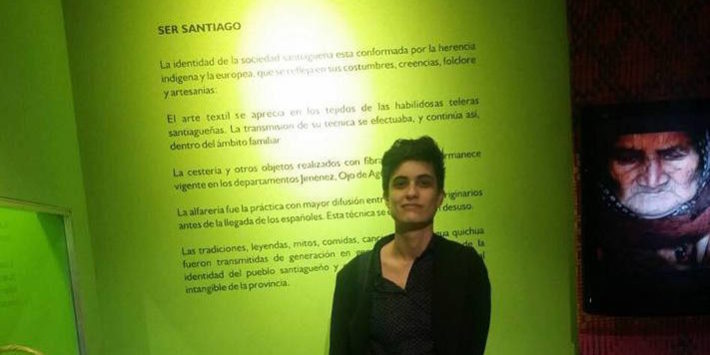
SaSa Testa is 31 years old and a non-binary person: gender fluid. Last week, a radio program picked up on their statements to mock their identity, saying it was an illness or a pose. SaSa denounced them and responds in this opinion piece. “We will not rest in the task of one day, although perhaps we won't live to see it, ceasing to be 'all' and becoming 'all'. Long live gender anarchy.” By SaSa Testa* “Silence is health,” says an old proverb, born and upheld during the dictatorship. That's how we were raised, how we grew up, and how many also died: in silence, believing that they would live better that way. But no. Luckily, some of us gave ourselves the benefit of the doubt and, so, dared to question several things, including the categories associated with names, what biology calls “sex,” and also the categories of gender. And when I speak of doubt, I mean that we grant ourselves this privilege, because it would seem that—in this world—nothing can be doubted. And when doubt arises, one must immediately encounter certainty. Doubt is frightening. Doubt is the margin. Doubt is abject. I was born on November 11, 1985, and the medical establishment determined that my sex was XX, which is why I was named “Sabrina Testa.” However, I never liked the things that “Sabrina” was expected to like. “Sabrina” was not what society and culture wanted her to be. “Sabrina” always lived in ambiguity and, until a few years ago, in silence, because, as I said, silence was healthy. Today things are a little different. They called me Sabrina, yes, but I am also named Santiago Testa, I am 31 years old, and I am a gender-fluid person; That is, someone whose self-perceived identity doesn't fit solely into the female or male universe, but rather encompasses various personal gender experiences. And if I can say this today, and say it to myself, it's because, before, there was an entire collective of political struggle that took action so that we would stop being "todos" (all) and start being "todEs" (all), "todXs" (all), "tod*s" (all).
"I am proud to belong to the LGBTTIQ community"
Recently, A hegemonic media outlet decided to give a voice to some representatives of dissenting groups. And I was invited to participate. I accepted because it seemed very important to me that, in this world where everything remains so divided and split in two, our voices and our existence could reach as many people as possible, to instill in them, at the very least, the same right to question the system that I had to cultivate for myself because I live in a society more inclined towards silence and pretense than diversity. I am proud to belong to the LGBTTIQ community because I am also proud of its history and its tireless political struggle for recognition. In this context, which is so exclusionary, my fight is there, because that fight is also the fight to break down gender hierarchies. And breaking down hierarchies, in any case, always helps us see things presented to us as absolute truths from different perspectives. However, it seems that, in some sectors or for some people who call themselves "social communicators", the breaking down of hierarchies and the visibility of the fractures that every power structure possesses, causes them a certain discomfort that they transform into pathologizing discourses."They treated my self-perceived identity as a syndrome."
On Friday, July 7, 2017, the program “No está todo dicho”, broadcast by The 100 On the radio program (99.9 MHz), hosted by Guido Kaczka and Marcela Tauro, along with two panelists, they discussed the report on non-binary genders in which I participated for broadcast television. There, in addition to treating my self-perceived gender identity (the ability to self-identify thanks to the Gender Identity Law No. 26,743, enacted on May 9, 2012) as a “syndrome,” “a psychological or hormonal issue,” or as “wanting to be different,” even though I don't feel 100% woman or 100% man, they also discussed inclusive language for humorous purposes. This situation clearly not only harms my personal integrity but also throws overboard all the years of political struggle that the group I choose to belong to and of which - as I already expressed - I am proud, has carried out in pursuit of empowerment, visibility and labor inclusion."Long live the anarchy of genders"
For this reason, I filed a complaint with the LGBT Ombudsman, the INADI (National Institute Against Discrimination), and the Ombudsman for the Public. At the Ombudsman's Office, I requested a public apology from these people, not only for me but for the entire LGBT community, which is being pathologized. I also requested my right to reply on air because they used my name and my self-perceived gender identity without authorization. Furthermore, I requested a mandatory gender workshop for Guido Kaczka, the panelists, and the entire production team of "No está todo dicho" (It's Not All Said and Done). Laughing at the use of "todEs" (a gender-inclusive term) is laughing at the Trans Employment Quota Law, laughing at the Gender Identity Law, and ultimately, laughing at the possibility of considering that other ways of being exist and that if we weren't named before, it was because we didn't have a place. Today, that space is being built thanks to the actions of the LGBTTIQ community. And, thankfully, we won't rest until one day, though perhaps we won't live to see it, we stop being "todos" (all of us) and become "todos" (all of us). He who laughs last laughs best. And long live gender anarchy! *Professor of Spanish, Literature, and Latin (JVG), Senior Specialist in the Management of Secondary and Equivalent Educational Institutions (JVG), Senior Specialist in Teacher Tutoring (JVG). Currently pursuing a Master's degree in Gender Studies and Policies (UNTREF). Published works include, among others, the book *The Existence of Mocha Celis or Visibility in Educational Invisibility* (La mariposa y la iguana, 2016). Teaches at the secondary level.]]>We are present
We are committed to journalism that delves into the territories and conducts thorough investigations, combined with new technologies and narrative formats. We want the protagonists, their stories, and their struggles to be present.
SUPPORT US

FOLLOW US
Related notes
We are present
This and other stories are not usually on the media agenda. Together we can bring them to light.
What authority do these people have to give their opinions? Please! And on top of that, they make jokes, idiots. Why do they give these morons a microphone?