

#Pride2017Peru: “Don’t mess with equality”
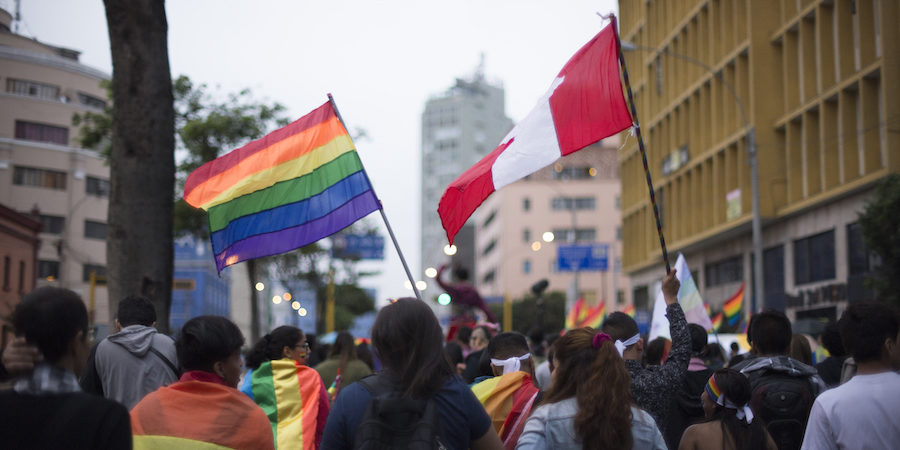
"Don't mess with equality" was the slogan of the 16th Lima Pride March. Hundreds of LGBTQ+ people gathered to demand their rights, display their colors, and march for those who are no longer with us. Three members of Congress were present.

Share

"Don't mess with equality" was the slogan of the 16th Lima Pride March. Hundreds of LGBTQ+ people gathered to demand their rights, display their colors, and march for those who are no longer with us. Three members of Congress were present.
On Saturday, July 1, the Campo de Marte (located in the district of Jesús María) was the center of concentration for the XVI Pride march where gays, lesbians, trans people, bisexuals, families and hetero allies took to the streets to demand rights at a time when the Peruvian Congress is cutting laws and decrees that protected the LGBTI population.

The slogan of the march was "Don't mess with equality," paraphrasing the anti-LGBTI campaign "Don't mess with my children" that has been flooding the streets of Peru for a year.

“These events are useful because public spaces in Lima must be reclaimed,” said activist André Mere to Presentes , who has not stopped taking to the streets since he was kicked out of Lima’s Plaza Mayor on February 14 for participating in a public kiss-in.

The march lasted approximately one hour and ended in the historic Plaza San Martín. Last year, the use of this plaza was denied by the Municipality of Lima.

“What brings me to the march is being part of a history of struggle that continues to this day due to conservative political interests,” says activist Verónica Ferrari.

A police unit of at least 100 officers was on alert at all times.

“Visibility is important because we live in a society that is still under the power of religion. We need to liberate life, liberate spaces. For many, the march is the first place where they can say: I am here, I exist,” singer Merian Presentes

Congress members and allies
For some, the participation of heterosexual allies plays an important role as it unites society through love. “The most important and strategic aspect of this march, I believe, is that it unites everyone who supports rights for all and love. It is a march that humanizes the LGBTQ+ community,” emphasized José Antonio Perez-Wicht.

The main banner was carried by congressmen Carlos Bruce and Alberto de Belaunde, both from the ruling party Peruvians for Change (PPK) and the only two Peruvian parliamentarians who have publicly declared their homosexuality. They were accompanied by congresswoman Indira Huilca of the Broad Front and former Interior Minister Daniel Urresti.
Trans force
Unlike previous years, the prominence of transgender people increased. It wasn't all about gays and lesbians. Many activists commented that they felt more supported in their fight to achieve the much-needed Gender Identity Law.

“It is the first time I felt that the trans chants had such intense force against the homonormative at the Pride March,” highlighted trans activist Santiago Balvín.

While there were no fights or brawls, homophobic slurs could be heard from the cars at times. “These marches can make people uncomfortable, but it’s important that people feel uncomfortable in order to bring about change,” says Silvina Salori.


We are present
We are committed to journalism that delves into the territories and conducts thorough investigations, combined with new technologies and narrative formats. We want the protagonists, their stories, and their struggles to be present.
SUPPORT US

FOLLOW US
Related notes
We are present
This and other stories are not usually on the media agenda. Together we can bring them to light.