

Psychological evaluations of Higui: "They will allow the actions taken by the Justice system to be dismissed"
Eva Higui de Jesús was arrested almost six months ago for defending herself against a sexual assault by a group of men. What are the results of the psychological evaluation she underwent, and why are they crucial to the case? Will they appeal her pretrial detention?

Share

Eva Higui de Jesús was arrested almost six months ago for defending herself against a sexual attack by a group of men. What are the results of the psychological evaluation performed on him and why are they crucial to the case? Will they appeal the preventive detention? By Paula Bistagnino Photos: Presentes archive/Ariel Gutraich Video: Milena Pafundi Analía “Higui” de Jesús has been imprisoned since October 16, 2016, accused of homicide. Her account indicates that it was a case of self-defense, defending herself against an attack by a group of men, but the case is officially classified as simple homicide. Her lawyer, Raquel Hermida Leyenda, told Present The results of the psychological evaluation, a key tool in determining what happened, were crucial. “Her account of the events has all the characteristics consistent with sexual abuse, with all the scars that a gunshot wound to the forehead—sexual abuse—is known to leave on the psyche.” Carolina Abregú, representative of the Gender Advocacy Office of Malvinas Argentinas, the first to lead the demand for Higui's release and to denounce the irregularities in the process, emphasized the positive outcome of the psychological evaluation: “It is important that it is confirmed that she suffers from post-traumatic stress. That would also allow us to dismiss everything the Justice system has done so far, which was to proceed with a case that lacks evidence. Furthermore, it has shortcomings such as incomplete statements and expert analyses, like the one on the clothing, that were not carried out in a timely manner,” said Abregú, a member of the Justice for Higui Working Group, which includes political and social organizations.
How was the expert analysis performed and what is it used for?
Before her arrest, Higui was attacked in the hallway of a house in San Miguel by members of a gang of men who assaulted her for being a lesbian and attempted to rape her. She defended herself with a knife and killed one of her attackers. Since then, she has been held in pretrial detention at the San Martín Police Station. The psychological evaluation concluded last Wednesday and will serve to determine Higui's involvement in the events of which she is accused. "The Raven's Progressive Matrices test [which analyzes a series of figures, sequences, and patterns] showed that she is a woman with intellectual resources and that, if she hasn't been able to pursue further education, it's not due to comprehension problems, but rather to poverty," her lawyer stated. "Secondly, she underwent the Rorschach test, which repeatedly revealed the post-traumatic stress she experienced. This corroborates what she stated during questioning: the sexual assault by her attackers." Higui is psychologically healthy, although those who are in contact with her say that she is in a state of anguish and pain: “First, because of the abuse she suffered, but also because she committed an act she never would have wanted to commit. Until she arrived at the interrogation, she didn't know that her aggressor had died. She believed that she had only hurt him,” says the lawyer.
How the case continues: they will appeal the pretrial detention.
The official results of the psychological evaluation will be released next week, when the court-appointed expert from the San Martín Forensic Advisory Office and Alicia Castro, the expert representing the Red de Contención (Containment Network) – the organization to which Hermida Leyenda belongs – will present their reports to the prosecutor's office handling the case, UFI 25 in Malvinas Argentinas, headed by Germán Muñoz. “It's likely that the court-appointed expert will only focus on whether or not Higui is criminally responsible. Meanwhile, the expert representing the defense will address the concerns we have, which are Higui's current state and the scars she bears that demonstrate the abuse.” In three weeks, a request for a less restrictive form of pretrial detention will be filed. It couldn't be filed earlier because by the time Hermida took over the defense, a little over two months ago, the deadline had already passed. “In addition to the expert testimony, the request will be based on Higui's defenseless state and, fundamentally, on the fact that the events she described in her statement were never investigated. And our Constitution states that everyone is innocent until proven guilty. In this case, none of the events she is accused of were ever proven, because they weren't even investigated.”
These are the irregularities that his defense is denouncing.
Until January, for almost three months, Higui had a public defender whom she never saw, not even on the day of her arrest and interrogation. Her family was also unable to contact the court official, despite numerous attempts. It wasn't until December, after the Malvinas Argentinas Gender Advocacy Office initiated a joint working group with other political and social organizations, that this public defender was replaced.[READ MORE: She was attacked for being a lesbian and is in jail for homicide]
By that time, four months had passed since the arrest, and virtually none of the measures required by the legal process had been taken: Higui received no medical attention, no examinations were performed to determine her physical condition and verify signs of abuse. Her clothing was also not examined, something that could have provided evidence of the abuse. Although this examination is underway at the Scientific Police in San Martín, Hermida Leyenda doesn't believe the results will be very revealing: “I have no guarantees regarding the chain of custody of the clothing, and besides, I don't think it will yield anything interesting because they are protecting institutional violence and a flawed investigation.” All these irregularities have already been documented, along with other arguments such as Higui's lack of legal representation during the first months of her detention. For now, the next step will be to request a modification of her pretrial detention: “We estimate it will take about 60 days. Within that timeframe, we could receive a ruling on this request for Higui's release,” Hermida concludes. She believes that with the progress of the expert analysis, the status of the case, which until now seemed almost closed, could be modified.“Higui follows the details of what we are doing for her”
At the San Martín Detention Center, Higui is only allowed visits from her immediate family and her lawyer. From there, she wrote in January. a letter –published by Presentes last week– “(…) In here they’ve erased even my dreams. The noises of the locks become more unbearable, horrible every day. You sleep locked in a tiny room that barely fits a bed, having to sleep locked up, in here you can’t breathe (…)”, wrote the 42-year-old woman.[READ MORE: Higui is stronger, eager to be released soon ]
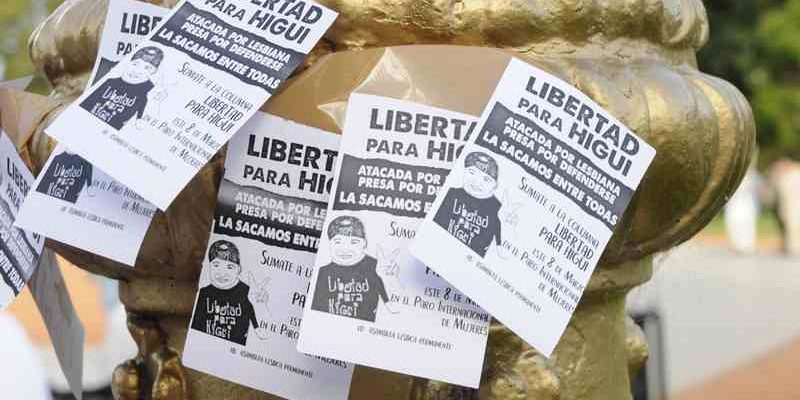
The letter was addressed first and foremost to Carolina Abregú, who has been at the forefront of all efforts to promote Higui's freedom from the very beginning. These efforts have multiplied in the last two months, not only on social media but also through stickers and graffiti in public spaces, and by participating in mass demonstrations under the banner of #FreedomForHigui, such as the Women's Strike on March 8th. “She’s doing well now and is in good spirits, because she’s becoming aware of everything that’s happening outside with her case, of everything we’re doing to secure her freedom: she’s following all the details,” says Abregú, who, from the Gender Advocacy Office as a member of the case’s working group, is continuing with her own strategy: “At the next meeting, we’re going to set a national date to demand Higui’s freedom and acquittal. Based on what the lawyer presents, we’ll work first to achieve her release and then, of course, her acquittal.”
We are present
We are committed to journalism that delves into the territories and conducts thorough investigations, combined with new technologies and narrative formats. We want the protagonists, their stories, and their struggles to be present.
SUPPORT US

FOLLOW US
Related notes

We are present
This and other stories are not usually on the media agenda. Together we can bring them to light.