

The hearing at the IACHR brought to light the violence against intersex people
Surgical interventions, mutilations, pathologization, and medical exhibition are some of the human rights violations suffered by intersex people. The issue was presented and testimonies were given at a hearing of the Inter-American Commission on Human Rights (IACHR).

Share

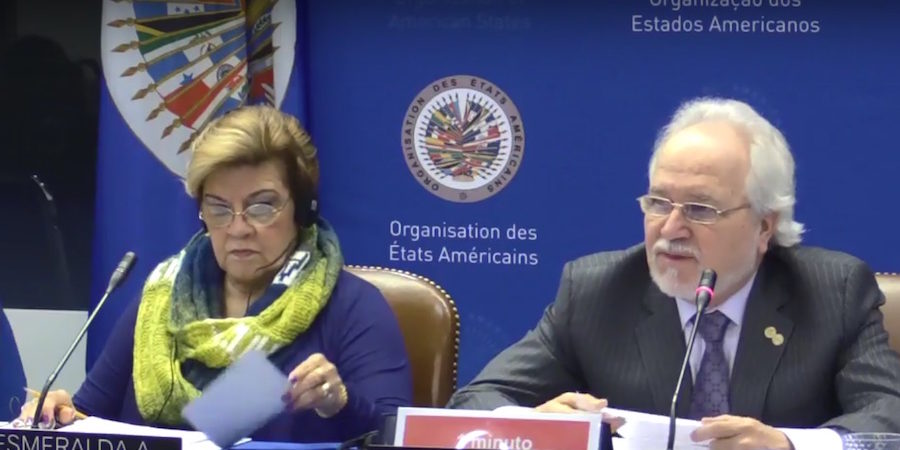
Surgical interventions, mutilations, pathologization, and medical exhibition are some of the human rights violations suffered by intersex people. The issue was addressed and testimonies were presented at a hearing of the Inter-American Commission on Human Rights (IACHR). The IACHR convened the hearing on its own initiative to learn about the situation of intersex people in the Americas. This took place within the framework of the sessions it is currently holding in Guatemala. The President of the IACHR, Francisco Eguiguren, along with two rapporteurs, listened for almost an hour to the reports and recommendations of activists and the testimony of Alejandro, an intersex man from Chile. Representatives from Brújula Intersexual (Mexico); Justicia Intersex (Argentina); MULABI Espacio Latinoamericano de Sexualidades y Derechos (Costa Rica); and InterACT (United States) participated in the hearing. These organizations also prepared reports on their local realities.
[READ ALSO: #Americas: 9 LGBTI people are murdered every week ]
“The IACHR has become fully aware of the situation of intersex people. It is an issue that is made invisible. This situation is somewhat diluted within the LGBTI acronym,” Eguigueren noted when she opened the hearing.The situation in Chile
Costa Rican activist Natasha Jiménez presented a report she co-authored with Chilean Andrés Rivera Duarte. She began by explaining that intersex people have different sexual orientations and identify as men, women, or non-binary. “It is not a trans experience,” she clarified. Jiménez addressed the situation in Chile, where the Ministry of Health issued Circular No. 18 (December 2015), which suspends unnecessary gender-normalizing treatments for intersex children, including irreversible genital surgeries, until they are old enough to make decisions about their own bodies. “Unfortunately, as of the date of this report, we can report that there are no public statistics on the number of intersex births in the country, much less on the treatments they have undergone and their outcomes,” she stated.Surgical mutilations
Jiménez pointed out that there is no public policy or law that mentions intersex people or seeks to protect their rights, fundamentally their bodily identity, autonomy, and informed consent. She maintained that there are even cases in which the parents of newborns are not consulted before undergoing genital surgeries that are “irreversible, mutilating, and in many cases cause sterility in intersex people.” She also noted that most intersex newborns are assigned female, which involves irreversible and invasive surgical treatments and unnecessary medications. Another issue she denounced was the photographic exposure to which intersex people are subjected by doctors, nurses, and students, “which causes serious psychological consequences in their lives, marked by feelings of rape and torture.”[READ ALSO: The intersex girl who lived two years registered as male ]
Reparative measures
Jiménez recommended that legislative protections be established for intersex people, ensuring, through the Ministry of Health, the effective implementation of Circular 18 and Circular No. 7 (of 2016). The latter recommends that Chile halt any unnecessary medical interventions performed without the informed consent of those involved. Jiménez also requested reparations for intersex people who have been victims of non-consensual interventions or interventions performed without genuinely informed consent. At the same time, she called for the approval of the gender identity law to facilitate the process of legal gender change. Finally, she demanded that the World Health Organization (WHO) eliminate any terminology that pathologizes intersex people, and that states respect the right to bodily identity and self-determination of intersex people.“I felt aged, violated, sad, and full of pain.”
Alejandro, 39, introduced himself as a Chilean intersex man. “This is the first time someone from Chile has given their testimony in person,” he stated as he began his 15-minute address. He recounted that he discovered his true identity at age 35. “All my life, I was forced into an identity that wasn't mine. Doctors ordered my mother to hide the truth from me so as not to jeopardize the treatments I was undergoing,” he said. “When I was born, doctors determined that my genitals had to be modified because they didn't fit what medicine considers normal for a man,” he maintained, adding that at two months old, “my penis was removed, which led to a process of forced feminization that can be defined in two words: rape and torture.” At age nine, he underwent a second surgery to “create” a vagina and ensure a passage that could be penetrated. To prevent this passage from closing, dilators were inserted. When he wasn't in the hospital, his mother was in charge of providing that therapy. “I have no words to describe the humiliation I experienced every day. I felt aged, violated, sad, and full of pain,” he said.Children, the first victims
When Alejandro was 11 years old, he underwent his last surgery to reconstruct a urinary tract because doctors wanted to ensure that “the girl they were creating would urinate sitting down,” he stated. “This surgery completely destroyed my life. And the worst part is that none of the previous surgeries were necessary to protect my health. They were merely cosmetic surgeries to make my future behaviors conform to the medical standards that define normality. Numerous efforts to erase all traces of my bodily diversity,” he said. In closing, the Special Rapporteur on the Rights of the Child, Esmeralda Arosemena de Troitiño, stated that “children are the first victims of this reality.” She referenced the International Convention on the Rights of the Child, which stipulates that all institutions must act in the best interests of the child. “This is a form of violence against children; we must say enough is enough to any kind of violence, and this one is particularly cruel,” she noted.Follow Presentes:
Twitter
@PresentesTLGBI Instagram:
PresentesLTGBI Facebook:
https://www.facebook.com/presentesLGBTI/
]]>
We are present
We are committed to journalism that delves into the territories and conducts thorough investigations, combined with new technologies and narrative formats. We want the protagonists, their stories, and their struggles to be present.
SUPPORT US

FOLLOW US
Related notes

We are present
This and other stories are not usually on the media agenda. Together we can bring them to light.