

Police repression on #8M: it was ruled that there was lesbophobia
This was determined by the Office of the Prosecutor for Institutional Violence (Procuvin) in a report following testimony from victims. The report denouncing institutional violence was presented as part of the investigation led by prosecutor Laura Belloqui.

Share

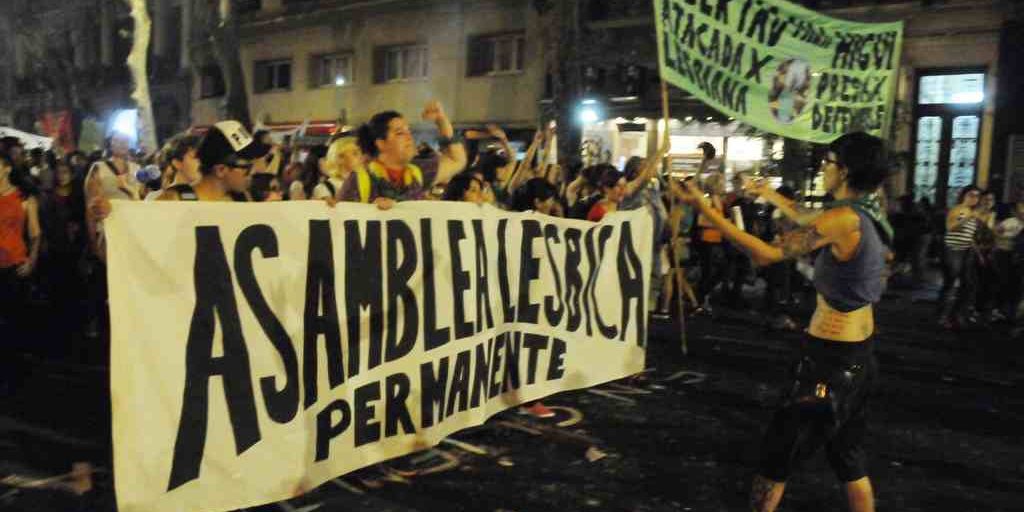
The Office of the Prosecutor for Institutional Violence (Procuvin) determined this in a report following the testimonies of the victims. The ruling denouncing institutional violence was presented as part of the investigation being conducted by prosecutor Laura Belloqui. Photos: Ariel Gutraich . The Office of the Prosecutor for Institutional Violence (Procuvin) ruled that the events that occurred after the march to Plaza de Mayo for International Women's Day are "acts of institutional violence that must be investigated in order to determine the responsibilities of the security forces involved." On Wednesday, March 8, as the march was dispersing, the police began to repress some women, mostly lesbians, who were in the areas surrounding Plaza de Mayo, beating and groping them.
[READ ALSO: #8M Lesbians were repressed and arrested: “it was a police hunt” ]
They were taken into custody at the 1st and 30th police stations, and later some were transferred to the 4th Precinct police station, located at Zabaleta and Chutro. There were 15 female and 4 male detainees.Gender-based reasons and hate
The victims also reported that all those detained at the 30th Police Station were lesbian women with "dark complexions," so the Procuvin concluded that "the investigation must be carried out taking into account the particularity of the case, since beyond the fact that the events may be subsumed in the criminal types linked to institutional violence, it must be added that, said violence was motivated by reasons of gender and hatred towards the sexual orientation of the victims."[READ ALSO: #8M “We came: lesbians, bisexuals, trans people and gay feminist men” ]
According to the website ProsecutorsThe document was presented as part of the case being handled by Laura Belloqui, head of Criminal and Correctional Prosecutor's Office No. 59. It contains statements from victims and witnesses. Furthermore, it outlines the preliminary conclusions of the Procuvin (Office of the Prosecutor for Institutional Violence) regarding the criminal nature of the police action.
Tear gas
The report divides the events to be investigated into three main areas: first, what occurred in the vicinity of the Metropolitan Cathedral, when officers of the City Police deployed tear gas, pepper spray, and riot control projectiles—at close range—injuring several people. Furthermore, arbitrary, violent, and irregular arrests took place. In this regard, the report notes that the officers involved failed to identify themselves and arrested, among others, people who were not connected to the initial fire that had started at the Cathedral's entrance.[READ ALSO: #8M “We were at the Cathedral and nothing that happened was by chance” ]
The text argues that "the elements incorporated so far allowed us to infer the absence of special precautions on the part of those officials in charge of planning and coordinating the police operation, in order to safeguard the physical integrity and guarantee the exercise of the right of assembly by those people who were demonstrating peacefully."The repression in the vicinity of Plaza de Mayo
Secondly, it requests an investigation into the events that occurred in the vicinity of Bolívar and Diagonal Sur streets., where a water cannon dispersed the remaining people. There, in addition, there were also “violent and illegal arrests, and some of the victims were pepper-sprayed or dragged away by several police officers.”Upon leaving the pizzeria
The third point, the report from the specialized prosecutor's office headed by prosecutor Félix Crous, focuses on what happened around 10:00 p.m., when a group of women having dinner at a pizzeria on Perú Street were confronted by the police and told to leave. When they asked why, many of the women were assaulted by the officers, arrested, and put into a transport van.Illegal coercion and degrading searches
According to the victims' testimonies, after their arrests they were initially taken to Police Station No. 1. They were then taken, one by one, to a separate room where female police officers made them undress and, in some cases, groped them. Later, they were transferred to Police Station No. 4, where they were searched again, despite being told they had already been searched at Police Station No. 1. According to the report, the searches were conducted by unidentified police officers, who forced them to undress, and in some instances, the doors were open, violating their privacy.Follow Presentes:
Twitter
@PresentesTLGBI Instagram:
PresentesLTGBI Facebook:
https://www.facebook.com/presentesLGBTI/
]]>
We are present
We are committed to journalism that delves into the territories and conducts thorough investigations, combined with new technologies and narrative formats. We want the protagonists, their stories, and their struggles to be present.
SUPPORT US

FOLLOW US
Related notes

We are present
This and other stories are not usually on the media agenda. Together we can bring them to light.