

Yren Rotela, the spokesperson for trans people who is calling for #8M
In Paraguay, Yren Rotela became the spokesperson for the trans community to call for the International Women's Strike on March 8th. Who is this activist who challenged the UN's report on women, took her case to the Inter-American Court of Human Rights, and is running for Congress in 2018?

Share

In Paraguay, Yren Rotela has become the spokesperson for the trans community to call for the International Women's Strike on March 8th. Who is this activist who challenged the UN's report on violence against women, took her case to the Inter-American Court of Human Rights, and is running for Congress in 2018? By María Domínguez, from Asunción.
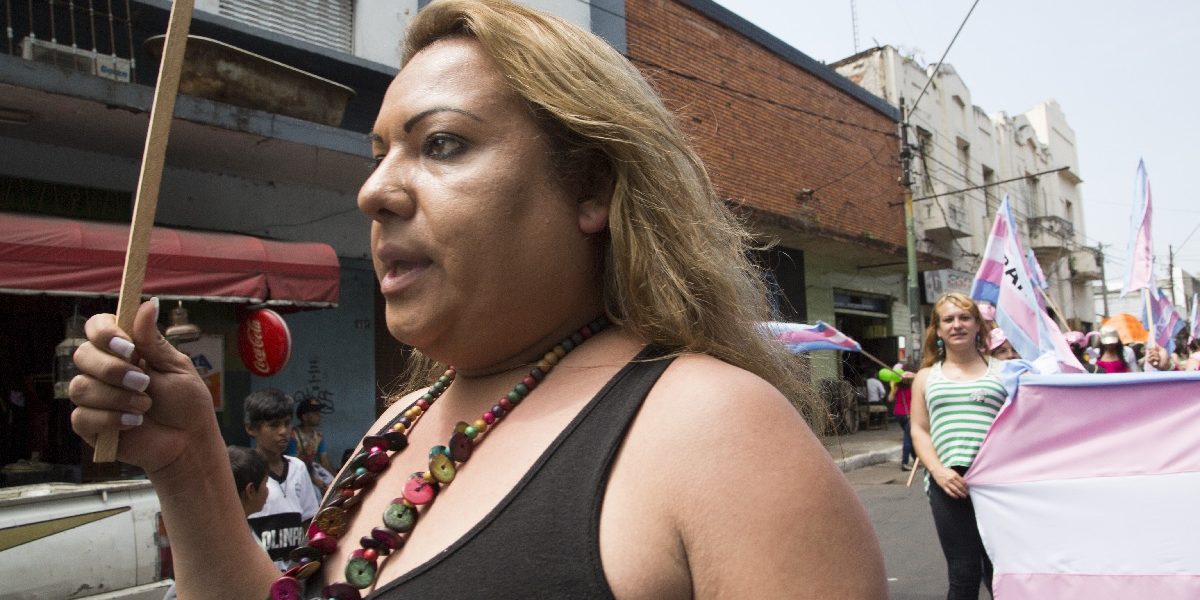
Photos: Mariluz Martín. Yren Rotela is 36 years old and has been an activist for trans rights for 17 years. Until a month ago, she presided over the Panambí association, which represents transgender, transsexual, and transvestite people in the country. These days, Yren is calling for participation in #8M: the international women's strike planned for March 8th. Her voice is being amplified through the media, along with those of students, journalists, researchers, and representatives of peasant movements. So far, she is the only trans woman in Paraguay who has taken on the role of spokesperson for this protest. Winner of the 2015 Peter Benenson Award (given by Amnesty International for human rights advocacy), Yren has taken her case to the Inter-American Court of Human Rights. There, she reported on the more than 50 unsolved murders of transgender people in Paraguay since the fall of the dictatorship in 1989. Politics is her next battleground. This year, Yren announced her intention to run for Congress in the 2018 general elections. She will seek to ensure that education, employment, healthcare, and justice are no longer off-limits to transgender people, an invisible and discriminated-against population, from the streets to Parliament.
“Why don’t you offer me another job instead of Red Zone?”
In 1998, she was a sex worker under the Calle Última viaduct, the area that separates Asunción from the neighboring town of Fernando de la Mora, where Greater Asunción begins. There she waited for her clients. There she suffered police violence. “At first, the sole purpose of my activism was to prevent police abuse. I began to strongly advocate in the area where I worked. The mayor at the time, Martín Burt (of the Liberal Party), wanted to implement a “red-light district” for sex work. I told him, “Why are you proposing a zone? Why don’t you offer me another job?” Back then, I didn’t know we could have access to other rights,” she recounts. In Paraguay, sex work employs approximately 98% of transgender people, according to data from Panambí. Many of them were unable to finish their studies, Yren explains, because upon assuming their gender identity, they faced discrimination and had to drop out. She left school in the San Pablo neighborhood of Asunción while still a teenager.
“We assume an identity that cannot be hidden”
“When I was little, my teacher said that homosexuality was something ugly, that God would punish that person. If you grow up like that, who's going to dare to speak out? We embrace an identity that is undeniable, it can't be hidden,” she says. As a child, Yren dreamed of taking her First Communion. She couldn't. “They wouldn't let me go in my little dress, with my flower crown. I never understood that could be because of my identity. But that was my first breaking point.” Yren dropped out of school, broke with her family. She had embraced her identity. The only job she could find then was as a domestic worker, in conditions bordering on slavery. “In domestic service, I was paid a miserable sum or exploited; I suffered a lot of violence. Later, I learned about sex work. I was 15 years old. I never knew where the State, the programs, or the Secretariat for Children and Adolescents were at that time,” she says. Yren began working on the streets in the years following the end of the dictatorship. In the early 1990s, there was a heavy police and military presence in public spaces. Many of these authorities also solicited her services, even though she was a minor. “I want trans people to have a wide range of opportunities, and for them to choose the option they want. I'm not clinging to being limited to just a few jobs again: hairdressing, sewing, manicures… If it's something I like, I'll do it, but it shouldn't be the only option. I have the right to choose whatever I want, simply because I'm a person.” The struggle to access diverse job options has several fronts. First, the educational arena. “The education system isn't prepared to address the needs of trans people. We don't want privileges or a new curriculum. We don't need a fancy chair. We just need teachers to have the tools to work with diverse individuals. If we have their respect, we'll learn the rest,” says Yren, who is finishing high school and wants to study law. She proposes creating a quota system, similar to those already in place in countries like Uruguay, where the Montevideo municipality opens certain positions exclusively for transgender people. With these opportunities, transgender people will be able to leave the space where they are confined when they decide to embrace their identity: the night. “There’s already progress: you see some trans women during the day. Before, transgender life was only at night. If you went to Mercado 4 (Asunción’s largest municipal market) during the day, they would throw eggs, tomatoes, cassava… anything to keep you from going. I would wake up in the afternoon and get ready to go out to work. And I got tired of it, because that’s no life for anyone. But it’s still hard for me to go to a park. I can’t feel safe: they see me as a sex object, they think I’m doing sex work, and they assault me,” she acknowledges.
Hate speech from politics
Advancing the recognition of transgender rights in Paraguay is no easy task. The Paraguayan political landscape is rife with legislators and spokespeople who engage in strong hate speech against transgender people, and it is common for them to go unpunished. In May 2014, Senator Carlos Núñez, of the ruling Colorado Party, took the floor during a parliamentary session on a bill to protect the family. “When I see a man dressed as a woman on the street, I stick my head out the car window and yell ‘scourge of society’ at him,” he said. In November 2014, a law against all forms of discrimination—which every country in the region has except Paraguay—was rejected by Congress, due to fears that it would enable the recognition of LGBT rights. In 2016, legislators removed the word “gender” from the text of the comprehensive law on protection against violence against women. They did not want this law to be applicable to transgender people.“The conservatives can never forget me”
Yren is ready to fight. From Panambí, she has participated in various regional meetings on LGBTI rights. She has also met with ministers, prosecutors, and legislators in Paraguay. “I have an effect on conservatives: they can never forget me,” she wrote a few weeks ago on her Facebook page. In 2015, during a Fourth of July event to which she was invited by the U.S. Embassy in Paraguay, Yren broke protocol and confronted the President of Paraguay, Horacio Cartes. She demanded answers about the lack of investigation into the 54 murders of transgender people. “I didn’t ask him for a favor, I asked him for urgent guarantees of our rights,” she told the media at the time. Shortly afterward, Yren met with the then Minister of the Interior, Francisco de Vargas, and with the Public Prosecutor's Office's human rights prosecutor, Santiago González Bibolini.
Today, the number of murders of transgender people stands at 57. Yren made sure to remind everyone of this in mid-January at the United Nations headquarters in Paraguay, during the presentation of a report on violence against women in the country. Once the question period began, Yren asked to speak. “I am here as a representative of transvestites, transgender people, and transsexuals,” she said to an audience packed with feminists and representatives of NGOs and institutions—most of them cisgender women. “I am glad that you have included the murders of transgender people in the report. But there are 57 murders, not 36 as it says here,” she pointed out. In the 119-page document, prepared by UN Women, violence against transgender people occupies only two paragraphs.
Listening to Yren were Paraguay's Minister of Women, Ana María Baiardi, and the President of the Supreme Court of Justice, Alicia Pucheta. Yren continued speaking. She criticized them, pointing out that the law against femicide does not protect trans women, and asked when they would address the specific demands of LGBTI people who are victims of violence. A few days later, on January 31, the Ministry of Women posted a photo on its Facebook page of the minister talking with Yren in an office. Yren wrote that there had been "openness" on the part of the Ministry.
The progress of Yren and her classmates
Through countless meetings in offices and demonstrations in the streets, Yren and her comrades from Panambí are making progress. Since October 2016, Ministerial Resolution 695 has allowed trans people to use their chosen name in medical consultations. This is no small victory, considering that in Paraguay, care for trans people in hospitals and health centers is critical. “Here, people are given hormones without any medical supervision; there are no endocrinologists specializing in trans people in Paraguay. People with industrial silicone implants can experience side effects, and the doctor isn't prepared,” says Yren. The use of chosen names is also another achievement. Although Paraguayan law allows for name changes for adults, this option doesn't exist for trans people. “They don't want to give us any rights. It's a lie that the State is absent. The State has always been present to deny us rights. We are the ones who have to engage in politics and empower our comrades from there,” says Yren.[READ MORE: Paraguay: They entered the Judiciary to defend their trans colleagues]
Political objectives of the trans candidate
“I’m interested in politics so I can challenge the status quo. Perhaps the path forward is to form an LGBT political movement and build a candidacy for office. I’m considering running for Congress in the Central Department (where Asunción is located).” She wants Paraguay to have not only a law that punishes discrimination, but also legislation on gender identity that recognizes the right, explicitly stated in the Paraguayan Constitution, to identity and free expression of personality. She wants the authorities to recognize that the murders of trans people are hate crimes, and that they be investigated and solved. And she wants these objectives to be on the agenda of political candidates. She wants to be a political candidate herself. To get involved where decisions are made. To demonstrate that trans people are capable, but also to ensure they are recognized as active members of society. Step by step, Yren pushes forward. She never tires of saying: “Let’s go for more.”Follow Presentes:
Twitter
@PresentesTLGBI Instagram:
PresentesTLGBI Facebook:
https://web.facebook.com/presentesTLGBI/
]]>
We are present
We are committed to journalism that delves into the territories and conducts thorough investigations, combined with new technologies and narrative formats. We want the protagonists, their stories, and their struggles to be present.
SUPPORT US

FOLLOW US
Related notes

We are present
This and other stories are not usually on the media agenda. Together we can bring them to light.