

"Transphobia is not a phobia, it is not an illness."
Violeta Alegre, a trans researcher and artist, questions the use of the term "phobia" when talking about hatred against subjects and identities.


Share

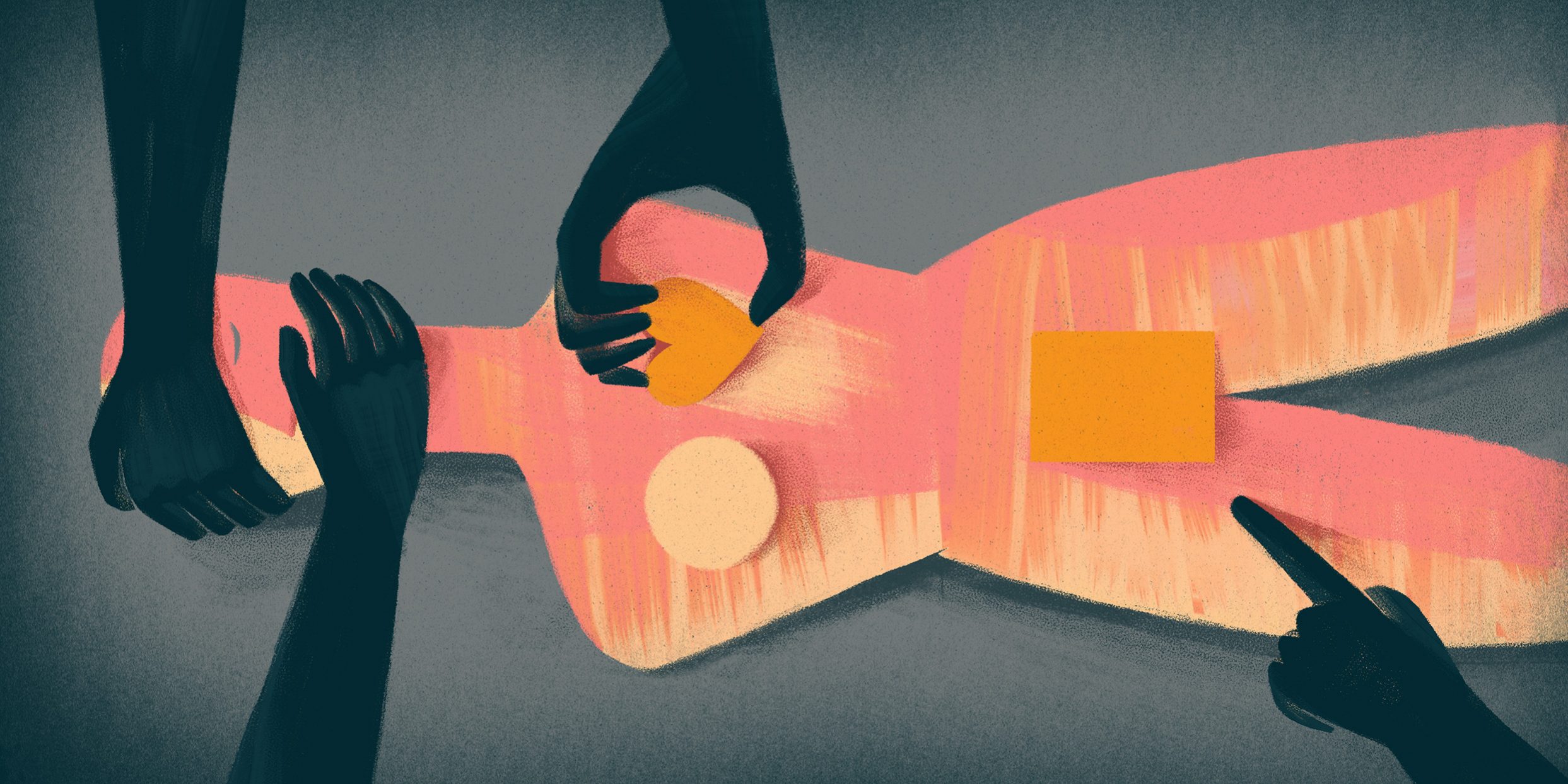
Phobias seem to lack accountability. When we talk about phobias, we're mainly talking about the lack of rational control over an individual's subjective tolerance. Faced with this lack of tolerance, the person acts. How do they act? By screaming, fleeing, hating, crushing, killing. The word "phobia"—which refers to emotional or psychological health—is characterized by intense and disproportionate fear of specific objects or situations. I believe in the need to politicize the word "phobia," since it only refers to a diagnosis proposed by medical science , rendering invisible the violence of a system that operates to create this type of hatred. A social and cultural hatred of which patriarchy is a construct, perpetrator, and perpetuator. When we talk about phobias, we turn the perpetrator into the victim.
Phobia and castration
Lacan emphasizes the difference between phobia and anxiety: “Anxiety appears initially, whereas phobia is a defensive formation that transmutes anxiety into fear of one or more specific objects.” He adds that phobia is not limited to representing a single unconsciously feared person, but rather several different people successively. The phobic object arises from anxiety, but what it carries with it is fear, and in a certain way, fear concerns something articulateable: it is more reassuring than anxiety. From then on, the world appears marked by a whole series of dangerous points, of alarms. The mechanism of phobia culminates in the fact that the subject can protect themselves through attempts to flee from an external danger. This external danger turns out to be castration.
Castration, in its most concrete sense, refers to the practice of mutilation or removal of the genitals. At a symbolic level, it has many meanings, such as cutting, destroying, separating, or losing "something" that belonged to the subject in reality or in fantasy: could this be power (the phallus)?
The concept of object is very broad in psychoanalysis, but one of its definitions, according to Lacan, maintains that “the phobic object comes to fulfill its function against the backdrop of anxiety, and this anxiety in question is ultimately—as we know from Freud—castration anxiety.” Hence, we can establish a direct relationship between the concept of “phobia” and phallocentrism, one of the least discussed oppressive systems.
Phallus is power
Phallus means penis, male genitalia, derived from phallos , meaning "that which swells." The term refers to the fact that the penis has always been considered a symbol of domination and power, and that the male body, and society, is controlled by the penis. Phallocentrism focuses on the idea that masculinity is the central axis and source of power and authority. It can refer to the erect penis or to an object in the shape of a penis or phallus.
Casilda Rodrigáñez Bustos, a Spanish writer and founder of the Antipatriarchal Association, explains that "phallocentrism" is when the phallus is the center of sexuality, when all sexuality is oriented toward and revolves around it. The phallus is the object of all drives, of all desire, capable of attracting and absorbing all of a woman's erotic energy. We internalize this message from birth, from the moment, as Lea Melandri says, that our mother is not there as a woman with her body as a woman in extrauterine gestation, but as a woman belonging to man for man. By denying us her body, she denies the entire flow of erotic energy and all of woman's non-phallocentric sexuality. And we learn to perceive ourselves through the male gaze, and to devalue our own bodies.
Although related in many ways, phallocentrism is not the same as sexism. Sexism is a stance towards life that can be personal and private (no less political for that), while phallocentrism is a social stance that permeates the environment and seeks to extend into everyone's lives.
We can understand phallocentrism as a symbolic order that centers the sexual difference between men and women on the phallus. Women are often seen as objects incapable of doing the same things as men.
The transvestite body challenges: it breaks with binary thinking
When we talk about “transphobia ”—using terminology from the medical sciences— isn't this just another attempt by science to domesticate violence through language? If it's a pathology, it's not the fault of the “sick” person, and it turns the perpetrator into a victim.
Based on the theoretical exploration of the concepts of object, subject, and phallocentrism , these questions arise: What happens to a feminized body that challenges masculinity in the space between desire and the phallus? Could it be that a man's desire for a transvestite body then triggers a need to eliminate it?
We know that the transvestite body challenges us because it breaks with the binary system so deeply ingrained in our subjectivities, and it automatically leads us to re-examine our own identity.
Could it be that the term “phobia” dilutes issues so that—in this case, by combining it with the prefix “trans”—it loses its sense of collective, political, and social representation?
Heteronormativity and science
A feminized body, socialized “phallically” through genital reductionism, could place masculinity under terrible strain. The dark side of heteronormativity engages in friendly dialogue with science, always focusing on the (pathological) victimization of individuals .
To what extent is the transvestite body detached from the idea of object-phallocentrism-power in the construction of masculinities under a patriarchal system? Is this why we experience anxiety/“phobia”/excessive fear of losing that power?
This feminized body, the construct of man becoming woman, often includes—with the endorsement of medical science—genital reassignment. This becoming- woman , for us trans women, could be part of the fear of not being ourselves, of not fitting into that binary system, that construct of woman (which women don't always question). Trans women, to be accepted, often need to fit into that category.
Killing a trans person isn't phobia; that word falls short. It has no political content . If anything, we should politicize the term in order to understand and modify the serious consequences of oppressive systems, which often go hand in hand with science.
We are present
We are committed to journalism that delves into the territories and conducts thorough investigations, combined with new technologies and narrative formats. We want the protagonists, their stories, and their struggles to be present.
SUPPORT US

FOLLOW US
Related notes


We are present
This and other stories are not usually on the media agenda. Together we can bring them to light.