

The Argentine comic that pays tribute to the victims of Orlando
Luciano Vecchio imagined how Wonder Woman could have saved the Orlando massacre and drew it. Now his comic, featuring an LGBTQ+ Justice League, is making the rounds worldwide. We talked to him about the importance of queer and anti-patriarchal language in comics and about his heroic activism.

Share

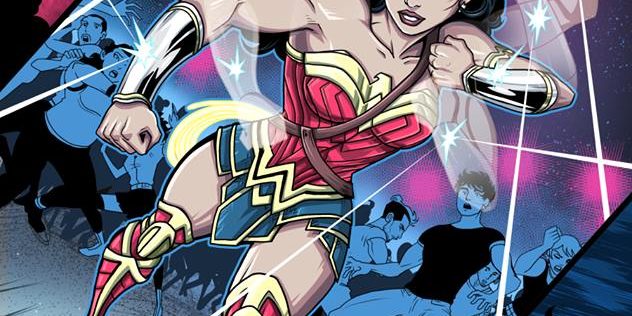
Luciano Vecchio imagined how Wonder Woman could have prevented the Orlando massacre and drew it. Now his comic, "The Origin of Love," featuring an LGBTQ+ Justice League, is making the rounds worldwide. We talked to him about the importance of queer and anti-patriarchal language in comics and about his heroic activism. By Lucas Gutiérrez. Puto, sudaca, apprentice feminist, apostate, and more, Luciano Vecchio is an Argentinian comic book artist who collaborates with DC Comics and Marvel, among others. He recently allowed himself to imagine the intervention of our heroes and heroines in the face of an event like the massacre of June 12, 2016, in the American city of Orlando. But not only that, he also envisioned wonderful actions by fantasy characters that could have repercussions in our daily lives. Following the Orlando massacre, where 49 people were killed by a lone gunman in a gay nightclub, IDW and DC Comics decided to release a commemorative issue. With several contributions, they published "Love is Love" in December, an anthology celebrating diversity, with proceeds going to the victims and their families. Vecchio didn't initially submit a piece, but after reading the magazine, he felt he could contribute. "The Origin of Love," his first fan fiction, is accompanied by a thought-provoking statement: "I think mainstream comics still need higher-profile queer superheroes, tied to their most visible franchises, who are super queer activists alongside characters who do contribute to minority representation but sometimes just 'happen to be queer.' Of course, as a Wonder Woman fan, I think one connected to the Wonder Woman franchise would be perfect." The final piece of the three-page fan fiction features a band of queer superheroes.
Q: When the call for submissions for 'Love is Love' opened, you decided not to participate. Why? LV: At the time, I felt I wouldn't know what to say that would add anything. Besides, I was overwhelmed by the news of the shooting, which was just another terrible piece of news in a year of terrible news for the LGBTQ+ community and in general, both internationally and in our country. After reading the submission, I was surprised that the DC characters were included. I don't know why I wasn't expecting it, and I couldn't help but imagine what I could have said through them, what I needed to say that hadn't been said. Q: Why did you choose to be in the Wonder Woman universe? LV: For several reasons. I think a queer super-activist would benefit from being connected to the most visible franchises. While, for example, we have Batwoman, who is a lesbian in the Batman family, it's something that goes unnoticed by the general public who don't read comics and confuse her with Batgirl. And just as there are Supergirl and Batwoman, there isn't a character in the Wonder Woman franchise who transcends the male gender, and she's a point of identification, a role model, and an aspirational figure that many readers would love. Wonder Woman partly represents queerness, but above all, since her creation, anti-patriarchy. And that's why the LGBT community finds in her a symbol of empowerment. This year, the 75th anniversary of her creation, her bisexuality or pansexuality was canonically established. She was named an honorary UN ambassador and then revoked . She's about to headline the first superhero film with a female protagonist in a long time. As a concept, she's at a peak of focus and relevance that could be capitalized on for the LGBT struggle through comics.
The final piece of the three-page fan fiction features a band of queer superheroes.
Q: When the call for submissions for 'Love is Love' opened, you decided not to participate. Why? LV: At the time, I felt I wouldn't know what to say that would add anything. Besides, I was overwhelmed by the news of the shooting, which was just another terrible piece of news in a year of terrible news for the LGBTQ+ community and in general, both internationally and in our country. After reading the submission, I was surprised that the DC characters were included. I don't know why I wasn't expecting it, and I couldn't help but imagine what I could have said through them, what I needed to say that hadn't been said. Q: Why did you choose to be in the Wonder Woman universe? LV: For several reasons. I think a queer super-activist would benefit from being connected to the most visible franchises. While, for example, we have Batwoman, who is a lesbian in the Batman family, it's something that goes unnoticed by the general public who don't read comics and confuse her with Batgirl. And just as there are Supergirl and Batwoman, there isn't a character in the Wonder Woman franchise who transcends the male gender, and she's a point of identification, a role model, and an aspirational figure that many readers would love. Wonder Woman partly represents queerness, but above all, since her creation, anti-patriarchy. And that's why the LGBT community finds in her a symbol of empowerment. This year, the 75th anniversary of her creation, her bisexuality or pansexuality was canonically established. She was named an honorary UN ambassador and then revoked . She's about to headline the first superhero film with a female protagonist in a long time. As a concept, she's at a peak of focus and relevance that could be capitalized on for the LGBT struggle through comics.
 Luciano Vecchio by Gianluca Macri Rey
Q: How did the idea of placing a fantasy character in a real-life situation come about? Did you ever think it could be misunderstood? LV: While I had fantasized about and drawn a "Wonder Boy" some time ago (and a quick Google search revealed I wasn't the only one), this occasion seemed significant enough to connect it to a character origin. Many superheroes find their fictional origins in tragedy and in response to it. I initially imagined him as a survivor of the (Orlando) shooting, but when I started the story, I felt that—at least in our imagination—the tragedy could have been avoided; that's what superheroes do, after all. When I finished, I hesitated, wondering if it was disrespectful to the real victims, but I think it's understood as an expression of longing for what didn't happen and what we wish it had. Besides, witnessing empowerment in the face of violence and injustice can be just as, if not more, inspiring. Q: How much queer representation is there in mainstream comics today? And anti-patriarchal representation? LV: There's more and more. When I drew the last page with all the DC LGBT characters together, it was powerful to see how many there are. Separated, they become almost invisible to us, but there are actually many, and I was pleasantly surprised to see that about half were added in the last decade. I'm sure that image will soon be outdated. Marvel is also doing a great job representing minorities through its most visible icons. And at the same time, it's expanding and showcasing the work of female authors and other LGBT and ethnic minorities. It's an upward trend, and I imagine there will be more and more.
Luciano Vecchio by Gianluca Macri Rey
Q: How did the idea of placing a fantasy character in a real-life situation come about? Did you ever think it could be misunderstood? LV: While I had fantasized about and drawn a "Wonder Boy" some time ago (and a quick Google search revealed I wasn't the only one), this occasion seemed significant enough to connect it to a character origin. Many superheroes find their fictional origins in tragedy and in response to it. I initially imagined him as a survivor of the (Orlando) shooting, but when I started the story, I felt that—at least in our imagination—the tragedy could have been avoided; that's what superheroes do, after all. When I finished, I hesitated, wondering if it was disrespectful to the real victims, but I think it's understood as an expression of longing for what didn't happen and what we wish it had. Besides, witnessing empowerment in the face of violence and injustice can be just as, if not more, inspiring. Q: How much queer representation is there in mainstream comics today? And anti-patriarchal representation? LV: There's more and more. When I drew the last page with all the DC LGBT characters together, it was powerful to see how many there are. Separated, they become almost invisible to us, but there are actually many, and I was pleasantly surprised to see that about half were added in the last decade. I'm sure that image will soon be outdated. Marvel is also doing a great job representing minorities through its most visible icons. And at the same time, it's expanding and showcasing the work of female authors and other LGBT and ethnic minorities. It's an upward trend, and I imagine there will be more and more.
A romantic and anti-patriarchal hero
Vecchio also has his own creations. One of the most recent is 'Sereno', a superhero who just finished his first season and had his own exhibition of works at the Casa Brandon art gallery. Q: What is Sereno?
Sereno, the series I write and draw for the web Totem Comics and which was compiled into a book by Gutter GlitterUnder the premise of "author's superheroes", it tells the adventures of the guardian of New Teia, a technomistic city of utopian days and terrible nights, where monsters come out of their hiding places and the collective psycho-emotional field is at stake.
Q: Do you consider it a queer product? Why?
LV: Besides having a gay protagonist and his romantic interest, I see him as an anti-patriarchal hero through his actions, his approach to situations, and his conflict resolution. He's a sensitive man, and a magician before he's a warrior. I also feel it's somewhat queer as a work within the superhero genre. It takes the characteristic elements of this genre and combines them with poetry, aestheticism, and other influences that make it a somewhat trans-genre (literary) work.
Q: What is Sereno?
Sereno, the series I write and draw for the web Totem Comics and which was compiled into a book by Gutter GlitterUnder the premise of "author's superheroes", it tells the adventures of the guardian of New Teia, a technomistic city of utopian days and terrible nights, where monsters come out of their hiding places and the collective psycho-emotional field is at stake.
Q: Do you consider it a queer product? Why?
LV: Besides having a gay protagonist and his romantic interest, I see him as an anti-patriarchal hero through his actions, his approach to situations, and his conflict resolution. He's a sensitive man, and a magician before he's a warrior. I also feel it's somewhat queer as a work within the superhero genre. It takes the characteristic elements of this genre and combines them with poetry, aestheticism, and other influences that make it a somewhat trans-genre (literary) work.
READ ALSO: Buenos Aires taken over by the disobedient queer comic
Q: Every Friday, a Totem author presents a story in a single comic book cover. Yours feature powerful femininities; tell us about that. LV: As an author and aspiring feminist, I know that the presence and representation of women in fiction is a field that needs to be reclaimed and healed. At the same time, Sereno fell short in terms of female presence due to its intimate tone and interactions only with villains, and since the protagonist is gay, I didn't want to cast women as villains and add a false interpretation. At Tótem, we do Pin-ups of the Week, stories or ideas told in a single image, and I took the opportunity to channel many female and trans heroines and smuggle queer and feminist ideas into the superhero genre. Q: Why do you consider it necessary to propose queer and anti-patriarchal dialogues in comics? LV: Because they're still missing, and we need them. For the strange species that comic book readers are, and especially superhero readers, the characters are alive, they accompany us throughout our lives, they inspire us, and we find in them roles to aspire to, identification, and empowerment. Fiction in general feeds our imagination, and in imagining ourselves, we create, deconstruct, and rebuild. As fiction writers, we have the opportunity to generate and share tools of imagination, and there will always be a reader for whom a narrative detail can make a difference in their life and their relationship with the world. Queer people, in particular, do intense work from a young age, challenging the patriarchal context that limits and attacks us, and we need these tools of imagination to respond and empower ourselves.Who's who in "The Origin of Love"
 ]]>
]]>
We are present
We are committed to journalism that delves into the territories and conducts thorough investigations, combined with new technologies and narrative formats. We want the protagonists, their stories, and their struggles to be present.
SUPPORT US

FOLLOW US
Related notes

We are present
This and other stories are not usually on the media agenda. Together we can bring them to light.