

Buenos Aires: LGBTI activists protested for human rights
The march, organized in Plaza de Mayo by human rights organizations, denounced, among other urgent issues, the increase in institutional violence against working-class communities, young people, and migrants. Trans and travesti people added their urgent demands: a trans job quota, the right to work, to health, and to education. On International Human Rights Day…

Share

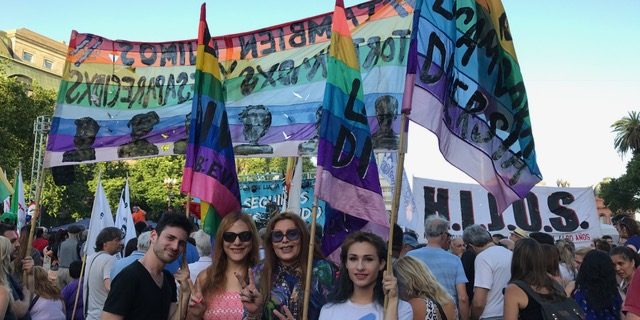
The march, organized in Plaza de Mayo by human rights organizations, denounced, among other urgent issues, the increase in institutional violence against working-class communities, youth, and migrants. Trans and travesti people added their urgent demands: a trans employment quota, the right to work, health, and education. On International Human Rights Day, fourteen organizations called for a national day of struggle and resistance, centered in Plaza de Mayo. Members of LGBTQ+ collectives participated in the gathering, on a date laden with meaning for human rights activists in Argentina: yesterday marked 33 years since the return of democracy and the first year of Mauricio Macri's government. Stella De Vita was among the first to arrive at Plaza de Mayo. She carried a sign with urgent demands, written on both sides of the paper. It demanded: "Respect and rights for sex workers," "a law for historical reparations," "stop the murders of trans people." She expressed her support for a trans employment quota. And she clarified, "Sex is a human right." Victoria Rivadaneira came from Villa Fiorito. "I came to defend rights. We want dignified work," she demanded. "I'm here to defend the trans job quota," Paula Arraigada, a member of the Frente Florida, a cross-party group, told Presentes. "Rights belong to everyone, and they must be enforced. We have the right to health, work, and education. But our community hasn't even had access to employment, for example. There's no public policy that incorporates trans and travesti people into the labor market. We're here to support human rights and to demand those that aren't being respected," she said.
 Institutional violence: an urgent issue for democracy. From the stage, the convening organizations—including Grandmothers of Plaza de Mayo, the Center for Legal and Social Studies, Mothers of Plaza de Mayo Founding Line, HIJOS Capital, and the Permanent Assembly for Human Rights—read excerpts from the document agreed upon by all, something that hadn't happened for many years. The main demands regarding human rights were for the dismantling of public memory policies, the safe return of Julio López, the restitution of the identities of the missing grandchildren, the release of Milagro Sala and other political prisoners, and the rejection of the criminalization of violence, layoffs, and austerity measures. For several months, the trans and travesti movement has been denouncing the escalation of institutional violence in 2016 to various bodies. In November, their complaint reached the UN. Yesterday, state violence featured prominently in the document read by representatives of the organizing groups.
 They demanded that those convicted of crimes against humanity serve their full prison sentences in regular jails, stating: “While we demand that no genocidal perpetrator walk the streets, we also witness the increase in institutional violence: excessive and unjustified use of firearms; raids; repression of social and labor protests; brutal incursions into neighborhoods; and unjustified document checks.” Unwarranted personal searches in public; abusive, hostile treatment and threats (…) These repressive policies are validated by those in power and by the media that yesterday stigmatized the 30,000 disappeared and their comrades, and that today justify violence and persecution against working-class communities, especially young people and migrants.” The organizations called, among other things, for an end to repressive practices. They pointed to “the operation of prisons and police stations as places where poverty is criminalized and torture is carried out.” And they considered it “one of the most urgent needs of democracy.” Under a rainbow flag, members of La Cámpora Diversia—the sexual diversity sector of the organization—listened to a topic that was very familiar to them. There was Marcela Tobaldi, one of the many victims of police violence within the trans and travesti community. “We are here because institutional violence is on the rise.” But also because the Argentine struggle for rights is unique in the world, it belongs to everyone, and here we are together, defending what has cost us so much."
We are present
We are committed to journalism that delves into the territories and conducts thorough investigations, combined with new technologies and narrative formats. We want the protagonists, their stories, and their struggles to be present.
SUPPORT US

FOLLOW US
Related notes



We are present
This and other stories are not usually on the media agenda. Together we can bring them to light.