

Trans women, migrants, and hairdressers: they opened Las Charapas to escape prostitution
They were working as prostitutes and decided to organize themselves into a cooperative. The Las Charapas hair salon opened its doors in La Plata after three years of training and work for ten trans women. The ribbon, stretched across the entrance, was rainbow-colored, matching the lettering of…

Share

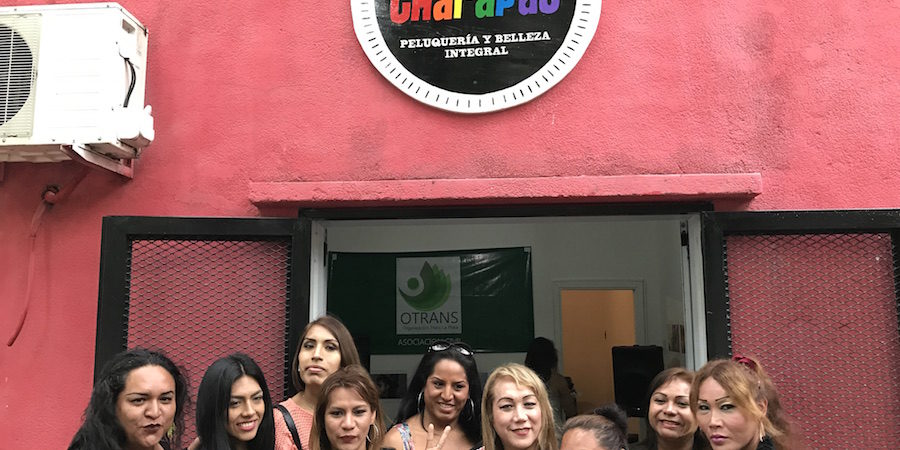
They were working as prostitutes and decided to organize themselves into a cooperative. The Las Charapas hair salon opened its doors in La Plata after three years of training and work by ten trans women. The ribbon, stretched across the entrance, was rainbow-colored, matching the lettering on the sign: "Las Charapas, hair salon and comprehensive beauty services." The ten trans and travesti women who launched this self-managed cooperative in December 2016 arranged the brushes and dryers and checked the mirrors one last time (hung up just days before, amid tears of emotion), with the emphasis and nervousness that comes with doing something for the first time. For three years, they poured their dreams and hopes into the salon they inaugurated yesterday in La Plata. "For us, this is a historic moment. We always knew, and still know, that we have the ability and the desire to do dignified work, just like anyone else." “Given the absence of a present state, incapable of creating public policies, we did this and paid for it with work on the streets,” said Celeste Shunia, 29, president of the cooperative. Thus began the brief ceremony that inaugurated the shop where ten people formerly in prostitution have become hairdressers and manicurists. It’s called Las Charapas and is located on 18th Street, between 39th and 40th. Celeste tells Presentes that they are still finalizing the list of services, and promises “affordable prices on haircuts for men, women, girls, and boys; blowouts , styling, color, and manicures.” It is open Monday through Saturday, from 10 a.m. to 8 p.m. This venture joins other cooperatives designed to create jobs for transgender and transvestite people. This is how the pioneering Nadia Echazú textile workshop was born in Avellaneda (Buenos Aires Province), opened in 2008 by Lohana Berkins through the Association for the Struggle for Transvestite and Transsexual Identity (ALITT). Also, in the La Boca neighborhood, La Paquito , which has been operating for four years, specializes in printing t-shirts, mugs, and souvenirs. "Charapas are aquatic turtles, typical of the Peruvian jungle, where we all come from. And it's also a way of referring to the indigenous people, the people from the native communities who live there," explained Koral Flores (30), born in Iquitos. Few charapas remain in the Amazon because their meat is highly prized, and they are endangered. The ten women who yesterday wore strict black uniforms - pants and shirts or t-shirts - and arranged on a table the platters with finger sandwiches, matchsticks, cookies, and bottles of orange juice, are also, in some way, survivors of adversity.
“I no longer feel alone”
“I’m a trans migrant from Tarapoto, in northeastern Peru. I left home at 17 because of my parents’ rejection. And that’s when I started working as a prostitute. I come from a very patriarchal country, and I arrived in Argentina in 2012 because a friend invited me to visit. She told me life was more liberated, and it was,” Celeste explains. Gilda’s “Corazón Valiente” plays in the background. Celeste recalls that as soon as she arrived, she decided to settle in La Plata and work on the streets. A month later, she was invited to a meeting: “That’s where I met Claudia, who told me about the Otrans project. Since joining, I no longer feel alone.” Claudia Vásquez Haro—president of Otrans Argentina, also a migrant and Peruvian—is a crucial part of the project, like a coach on a soccer team. She is also the person chosen by the organizations to take one of the most urgent demands of the trans and travesti community to the United Nations in November: police violence and the lack of public policies for access to decent work. Yesterday, Claudia thanked "the comrades who accompanied us through these complex processes," "with a State that looks the other way." And she remembered those who have become historical figures: "The cooperative is an example that it can be done, of the love and fury of trans people that Diana (Sacayán) and Lohana (Berkins) taught us. In this scenario of heavy-handed policies that generate unemployment, jobs are created here thanks to organization. And it nourishes our souls to continue fighting," Claudia said. Claudia was the first trans migrant to receive her national identity document (DNI) after the Gender Identity Law was passed. She graduated from the Faculty of Journalism and Communication at the National University of La Plata, a pioneer in recognizing students' self-perceived gender on official documents. With the support of the faculty and in the wake of the Gender Identity Law's passage in 2012, Claudia and a group of transvestite, transsexual, and transgender people founded Otrans, a space for organizing and reflecting on sexual diversity. It was there that the idea for this hair salon emerged, seeking to reclaim the values of cooperativism and operating from a social economy perspective. They didn't have it easy getting the project off the ground. According to them, renting a space was very difficult due to landlords' prejudices, who kept raising the price. That's why they ended up setting up the cooperative in the Vásquez Haro neighborhood. Las Charapas has a godmother, chosen by the workers: Florencia Saintout, the dean of the Faculty of Journalism, who also participated in yesterday's inauguration. "We live in a society that tells us 'we have to save ourselves.' But we have learned that the possibility of saving ourselves is collective," said the dean. "This cooperative is a project that unsettles and challenges us, because it tells us that we can all transform the world. And it is emblematic in La Plata, a city that is sometimes so hypocritical. I think that sooner or later, we have to learn a lot from this organization, from those who fight despite adverse times," she expressed. "This is trans fury, because fury, among other things, is love, it is being alive, it is going out to fight for what's right, it is work and dignity."
"We paid for our studies, nobody gave us anything for free."
Also present were friends and family, students and teachers from the Faculty of Journalism and Communication, and activists like Ariel Borgna, from the Front of TLGBI organizations of La Plata, Berisso and Ensenada. “It’s a great achievement. They’ve been organizing for a long time and have finally managed to access dignified work.” Lourdes Rivadeneira, from the Migrant and Refugee Network in Argentina, congratulated them: “We know what this means; the entire migrant community is with you.” Inside the salon, everything was ready to welcome clients: new chairs, hair dryers, freshly painted white walls, and air conditioning. “It moves me to think that we bought all this with our own work. We trained in hairdressing and manicuring, and we paid for our studies to be here; nobody gave us anything,” said 24-year-old Ariana Linares. Ariana arrived in Argentina in 2012, when her mother worked as a domestic worker in a house in Tigre. Her mother returned to Peru, but Ariana’s plans remain in Argentina: “This has been like a springboard; my next step is to study business administration at university. Now I can finally say that I have a job, and it’s something I’m not ashamed of.” “Prostitution is not a job for us,” Celeste, the president of the cooperative, declared at the ceremony. “That’s why the ten of us who make up the cooperative are determined to get our fellow women out of this situation, a product of our sexist and heteropatriarchal society. We are harassed and mistreated in the streets, and we don’t know when our last day will be. We don’t want any more police violence, nor do we want to be dead. We want to be alive, with work, education, and healthcare, and above all, with dignity. Trans and travesti fury, now and forever!” she rallied. On behalf of her fellow women, she also called for the implementation of the Diana Sacayán quota law. And everyone present chanted the names of Diana and Lohana. Standing at the entrance to the hall, the ten workers, the technical director, and the godmother gathered and symbolically brought their hands together to cut the ribbon. And when the scissors tore through the colorful fabric and the entrance to the hair salon was cleared for the first visitors, what opened up in that planned, decisive gesture was much more than a place to refresh and style hair.We are present
We are committed to journalism that delves into the territories and conducts thorough investigations, combined with new technologies and narrative formats. We want the protagonists, their stories, and their struggles to be present.
SUPPORT US

FOLLOW US
Related notes


We are present
This and other stories are not usually on the media agenda. Together we can bring them to light.
Simply beautiful! An example of struggle and perseverance. This news made me happy; it's comforting to read something that represents such a big step forward in our society, amidst so much regression. Bravo to them!!!
Simply beautiful! An example of struggle and perseverance. This news made me happy; it's comforting to read something that represents such a big step forward in our society, amidst so much regression. Bravo to them!!!